

You know what you mean.
You can feel the thought sitting there, perfectly understandable inside your own head. But when somebody asks what you think—or how you feel—the words suddenly seem much harder to find.
Perhaps you start explaining and lose your train of thought. Maybe you choose words that don’t quite capture what you meant. Or you say very little, only to think of exactly what you wanted to say once the conversation is over.
If that experience is familiar, these books for people who struggle to express themselves approach the problem from several useful directions.
Some focus on finding language for what you’re feeling. Others help with speaking clearly, navigating conversations or communicating when the subject matters to you.
Because expressing yourself well isn’t simply about having a bigger vocabulary.
It’s about turning what is happening inside into something another person can understand.
1. Say What You Mean — Oren Jay Sofer
There’s a big difference between speaking and actually saying what you mean.
Oren Jay Sofer’s Say What You Mean explores communication through mindfulness, Nonviolent Communication and somatic awareness. Its focus includes speaking clearly and kindly, staying focused on what matters in an interaction and listening more deeply to other people.
That makes it particularly relevant when your difficulty isn’t a lack of thoughts, but getting those thoughts across without becoming defensive, withdrawing or losing sight of what you were trying to communicate.
One of the useful ideas behind this kind of approach is that communication starts before the words arrive.
What are you actually trying to express?
What matters here?
What do you want the other person to understand?
Those questions can be more valuable than searching for the perfect sentence.
Best for: readers who want to express themselves more thoughtfully while also becoming better listeners.
2. Atlas of the Heart — Brené Brown
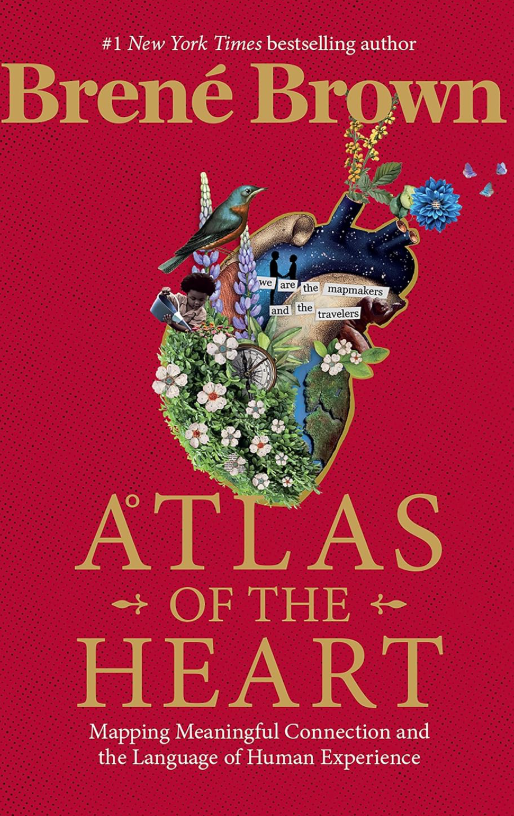
Sometimes you struggle to explain what you’re feeling because you don’t yet have language precise enough to describe it.
Atlas of the Heart approaches that problem from an emotional direction.
Brené Brown explores 87 emotions and experiences, with the broader aim of helping people develop the language needed to understand themselves and connect meaningfully with others.
That’s important because vague feelings can produce vague communication.
“I’m upset” might be accurate.
But are you disappointed? Embarrassed? Frustrated? Lonely? Overwhelmed?
Those aren’t interchangeable experiences.
The better you become at recognising what is actually happening inside you, the easier it can become to explain it to someone else.
This doesn’t mean every conversation needs an elaborate emotional vocabulary. Often, greater precision simply helps you move beyond “I don’t know how to explain it.”
Best for: readers who particularly struggle to put emotions and internal experiences into words.
3. The Next Conversation — Jefferson Fisher
Sometimes you know what you want to say, but the conversation itself gets in the way.
You become nervous.
The other person reacts unexpectedly.
You feel pressure to respond immediately.
Or a conversation that seemed simple suddenly becomes tense.
Jefferson Fisher’s The Next Conversation takes a practical approach to everyday communication, offering strategies and phrases aimed at helping people become more direct, confident and productive communicators at home, at work and in relationships.
That’s a useful perspective because expressing yourself isn’t something that happens in isolation.
There’s usually another person involved.
They interrupt. They misunderstand. They disagree. They ask questions you weren’t expecting.
Learning to express yourself therefore also means learning how to remain connected to what you wanted to say while a real conversation unfolds around you.
Best for: readers who know what they want to say but find conversations themselves difficult to navigate.
4. Permission to Feel — Marc Brackett
Before you can communicate an emotion clearly, you often need to recognise and understand it yourself.
That’s where Permission to Feel by Marc Brackett fits into this list.
Brackett, founding director of the Yale Center for Emotional Intelligence, focuses on understanding emotions and developing emotional intelligence. His work encourages greater awareness of what we’re feeling and how those emotions influence our lives and relationships.
For somebody who regularly responds to “What’s wrong?” with “I don’t know,” that process can matter.
You may genuinely not know—not yet.
Taking time to identify what you’re experiencing gives you something more concrete to communicate.
Instead of trying to manufacture the right words while somebody waits for an answer, you become better at noticing and naming what’s happening before you attempt to explain it.
Best for: readers who find it difficult to identify what they’re feeling, not just describe it.
5. Articulate — Julian Merren
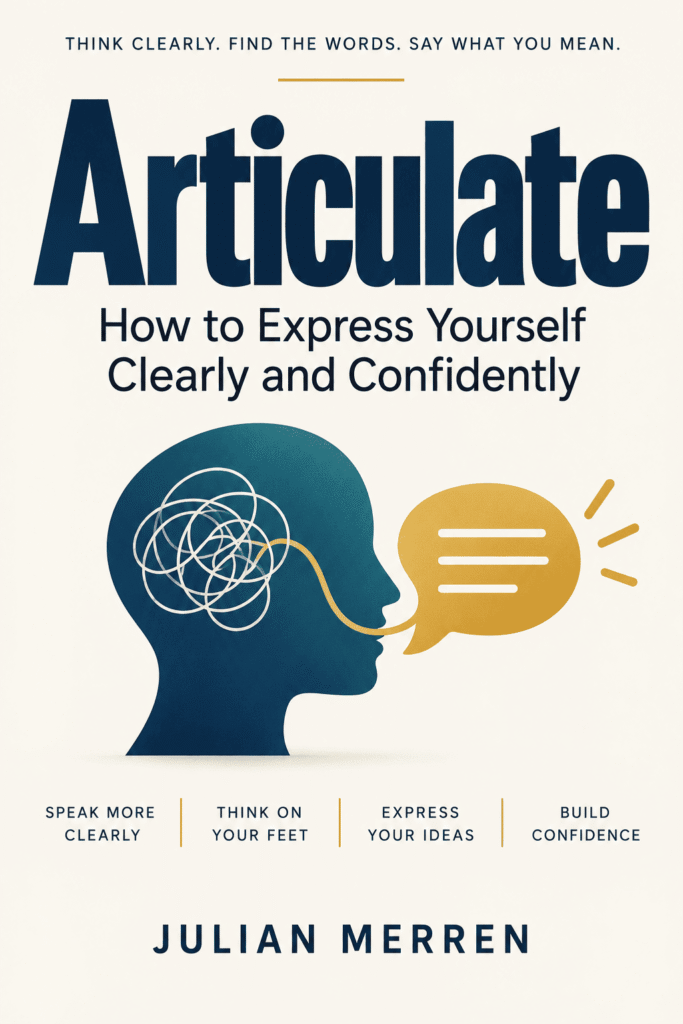
Not every struggle with self-expression is primarily emotional.
Sometimes the thought itself is clear.
The difficulty is getting it out.
You may lose the thread halfway through an explanation, struggle to find the right word, ramble around your point or freeze when somebody asks for your opinion unexpectedly.
That’s the territory explored in Articulate: How to Express Yourself Clearly and Confidently by Julian Merren.
The book takes a practical look at everyday communication: organising your thoughts before you speak, getting to the point, finding the right words, explaining ideas more clearly, thinking on your feet and becoming more comfortable expressing what you mean.
The goal isn’t to teach you to sound clever or polished.
It’s to make the gap between knowing what you mean and being able to say it a little smaller.
If that’s the part of communication you most want to work on, you can discover Articulate here.
What the Best Books for People Who Struggle to Express Themselves Can Teach You
These books approach self-expression differently because there isn’t just one reason people find it difficult.
You might need to become better at:
- identifying what you’re actually thinking or feeling
- separating the main point from everything surrounding it
- finding more precise language
- pausing rather than speaking before you’re ready
- staying calm enough to remember what you wanted to say
- listening to the other person without losing your own point
- accepting that you don’t need the perfect words to communicate honestly
The important thing is recognising where the difficulty occurs.
If you understand yourself but can’t organise the words, that’s one problem.
If you can’t identify what you’re feeling in the first place, that’s another.
And if you communicate perfectly well until pressure enters the conversation, that’s something different again.
Try Writing the Sentence Before Saying It
One simple exercise can help you discover where you’re getting stuck.
Think of something you’ve recently struggled to explain.
Now write:
“What I’m really trying to say is…”
Then finish the sentence.
Don’t make it impressive.
Don’t worry about whether it’s beautifully phrased.
Just make it true.
Perhaps you write:
What I’m really trying to say is that I felt left out.
Or:
What I’m really trying to say is that I disagree with the plan, but I didn’t want to create an argument.
Or simply:
What I’m really trying to say is that I need more time.
Once you’ve found that sentence, imagine beginning the conversation there.
You can add context afterwards.
But you’ve already identified the message.
You Don’t Need Perfect Words
One of the traps of struggling to express yourself is believing that somewhere there is a perfect sentence that will make another person understand you completely.
Usually there isn’t.
Communication is rarely that tidy.
You say something.
The other person responds.
You clarify.
They ask a question.
You try again.
That’s not failed communication.
That’s conversation.
Becoming better at expressing yourself doesn’t mean always finding exactly the right words on your first attempt. It means becoming more capable of recognising what matters and communicating enough of it for another person to meet you there.
Start With the Part You Find Hardest
The five books here don’t offer identical solutions—and that’s precisely why they work well together as a reading list.
Say What You Mean explores more mindful, compassionate communication. Atlas of the Heart expands the language available for understanding emotional experience. The Next Conversation focuses on handling real conversations more effectively, while Permission to Feel digs further into understanding emotions themselves. Their respective authors and publishers describe those aims in similar terms.
And Articulate brings the focus back to the everyday mechanics of turning thoughts into clear spoken communication.
If you’ve been looking for books for people who struggle to express themselves, don’t worry about finding the single book that solves everything.
Choose the one that most closely resembles your difficulty.
Then practise one idea from it.
Because finding your voice isn’t necessarily about changing who you are.
Sometimes it’s simply learning how to make what’s already inside you easier to hear.