
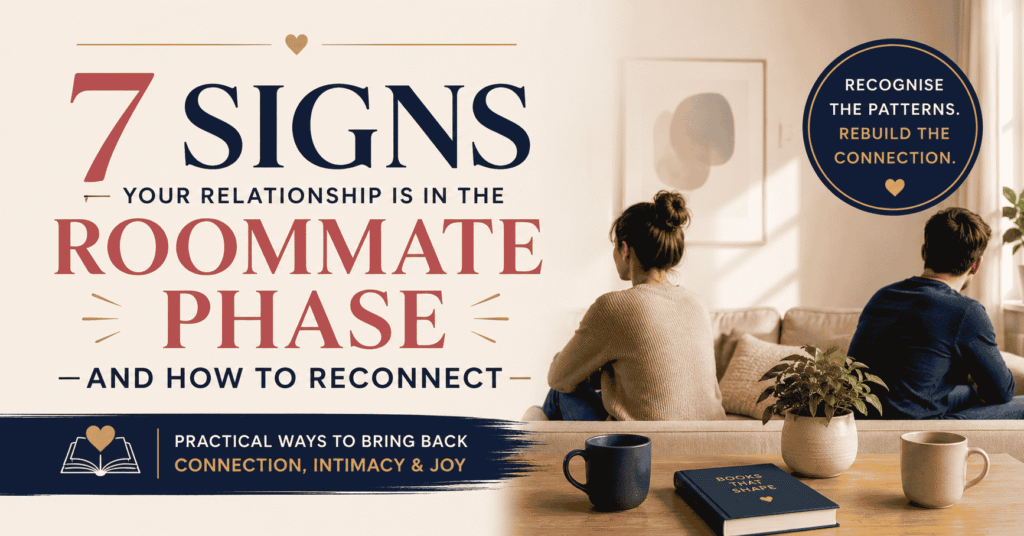
You still share a home. You manage the bills, organise meals, discuss what’s happening tomorrow and perhaps raise children together. From the outside, your relationship may look perfectly fine.
But something feels different.
You’re functioning brilliantly as a team, yet you can’t remember the last time you really talked. Evenings are spent beside each other rather than with each other. Conversations revolve around responsibilities instead of hopes, feelings or anything that makes you feel genuinely close.
You may even have caught yourself thinking:
Are we partners anymore, or have we become roommates?
Recognising the signs your relationship is in the roommate phase doesn’t automatically mean your relationship is failing. Relationship counsellors describe the term as a period when life administration begins taking up more space than emotional and physical connection, particularly during demanding seasons involving children, work, caregiving or other pressures.
The encouraging part is that disconnection can be noticed—and noticing it gives you somewhere to begin.

What Is the Roommate Phase in a Relationship?
The “roommate phase”, sometimes called roommate syndrome, isn’t a formal diagnosis. It’s a useful way of describing a relationship that has gradually become dominated by routine and logistics.
You still operate together.
But you aren’t connecting in quite the same way.
Recent relationship guidance from the Gottman Institute describes how careers, children’s schedules, household responsibilities, financial pressure and other stresses can gradually crowd out emotional intimacy. ABC Australia similarly describes the roommate phase as a period where couples can feel as though they’re co-existing while life admin replaces connection, fun and spontaneity.
So what might that look like in everyday life?
7 Signs Your Relationship Is in the Roommate Phase
1. Most of Your Conversations Are About Logistics
Think about your last few conversations.
Were they something like:
“Who’s getting the groceries?”
“Did you pay that bill?”
“What time will you be home?”
“Can you pick that up tomorrow?”
There’s nothing wrong with these conversations. Every shared life requires organisation.
The problem comes when practical conversations become almost the only conversations you have.
You stop asking what your partner is thinking about, worrying about, dreaming about or looking forward to.
You know their schedule.
But you gradually stop knowing their inner world.
Try this: Ask one question tonight that has absolutely nothing to do with running the household.
2. You’re Together, but Rarely Give Each Other Your Full Attention
You sit on the same sofa.
One person watches television while the other scrolls through their phone.
You eat dinner together but barely speak.
You’re physically close, yet your attention is somewhere else.
This is one of the strange things about relationship disconnection: proximity can create the illusion of togetherness.
Being in the same room isn’t necessarily the same as connecting.
Try creating ten or fifteen minutes where neither of you is watching, scrolling, cleaning or organising anything.
Just talk.
3. Affection Has Become an Afterthought
Affection doesn’t have to mean grand romance.
It’s often much smaller.
A kiss goodbye.
A hug in the kitchen.
Holding hands.
Sitting close together.
Touching your partner’s shoulder as you walk past.
When those small gestures gradually disappear, a relationship can begin feeling more functional than affectionate.
Healthdirect Australia notes that healthy relationships benefit from support, affection, appreciation and deliberately making time for each other—even when routine has taken over.
Try this: Reintroduce one small, natural gesture of affection rather than waiting for a romantic occasion.
4. Fun Has Quietly Disappeared
When was the last time you did something together simply because it was enjoyable?
Not because the children wanted to.
Not because something needed buying.
Not because you had an obligation.
Just because the two of you wanted to.
The roommate phase often removes spontaneity first.
You become excellent at getting through life but forget to enjoy it together.
You don’t need an expensive weekend away to change that.
Go somewhere new for coffee.
Cook something you’ve never tried.
Play a game.
Take a walk somewhere different.
Watch the ridiculous film you both secretly enjoy.
Research and relationship practitioners quoted by ABC suggest that novelty, play and shared activities can help couples create opportunities for renewed connection.
5. You Stop Being Curious About Each Other
One of the clearest signs your relationship is in the roommate phase can be the assumption that there’s nothing left to discover.
After years together, it’s tempting to think:
“I already know everything about them.”
But people change.
The person sitting beside you isn’t exactly the same person you met years ago.
Neither are you.
Ask:
What’s something you’d love to do this year?
What’s been on your mind lately?
Is there anything you wish we did more often?
What would make life feel more enjoyable right now?
Curiosity tells another person:
I’m still interested in you.
And sometimes that’s exactly what has been missing.
6. Appreciation Has Been Replaced by Expectation
Your partner takes care of something and you barely notice because that’s what they always do.
You organise something and they barely notice for exactly the same reason.
Gradually, effort becomes expectation.
That’s dangerous because one or both people can begin feeling invisible.
Try noticing the things that have become ordinary.
“Thanks for making dinner.”
“I appreciate you sorting that out.”
“Thanks for asking how my day went.”
The words are simple.
But the underlying message is powerful:
I noticed you.
7. You Miss the Relationship You Used to Have
Perhaps this is the biggest sign.
You find yourself thinking about how you used to be.
The long conversations.
The laughter.
The excitement of seeing each other.
The things you did together.
And you wonder where those people went.
But be careful with nostalgia.
The goal isn’t necessarily to recreate the relationship you had ten years ago.
You’re different people now.
A better question might be:
What kind of relationship do we want to create from here?
That shifts the focus from mourning the past towards building something meaningful in the present.
How to Move Out of the Roommate Phase
If you’ve recognised yourselves in several of these signs, resist the temptation to fix everything at once.
Start small.
Healthdirect’s current relationship guidance emphasises open communication, listening carefully, making time for one another, showing affection and appreciation, and facing pressures as a team.
That might translate into:
- 15 minutes without phones each evening
- one walk together each week
- asking one meaningful question over dinner
- planning something enjoyable each month
- thanking each other more often
- talking about something other than responsibilities
- revisiting something you once loved doing together
The aim isn’t to manufacture romance.
It’s to create opportunities for attention.
Don’t Forget to Reconnect With Yourself Too
There’s another side to this conversation that often gets overlooked.
When a relationship becomes dominated by responsibilities, sometimes you haven’t only lost connection with your partner.
You’ve lost some connection with yourself.
Perhaps hobbies disappeared.
Friendships became less frequent.
Everything became about work, family, home and keeping things running.
Reconnecting with your relationship doesn’t require abandoning your individuality.
Healthdirect includes having the freedom to pursue hobbies and activities among the characteristics of healthy relationships.
Make room for something that belongs to you too.
A stronger you and a stronger us don’t have to compete.
A Practical Guide to Finding Your Way Back
This balance between rediscovering yourself and reconnecting with your partner is at the heart of Invisible No More: Rediscover Yourself and Find Your Way Back to Each Other by Julian Merren.
The guide was created for women who feel they’ve gradually become lost beneath responsibilities while their relationship has shifted from connection towards routine.
Rather than blaming either partner or promising an overnight transformation, Invisible No More focuses on small, meaningful changes: rebuilding confidence, communicating without blame, rekindling friendship and appreciation, and creating daily habits that help both people feel seen and valued.
Each chapter also includes practical Bring It to Life reflections, conversation starters and activities that can be used individually or together.
If you’ve recognised your own relationship in this article and want a practical guide to taking the next steps:
Discover Invisible No More on Payhip
The Roommate Phase Doesn’t Have to Be the Final Phase
Recognising the signs your relationship is in the roommate phase isn’t about attaching a frightening label to your relationship.
It’s about noticing.
Some seasons of life genuinely make connection harder. Work becomes demanding. Children need you. Family responsibilities increase. Energy disappears.
But relationships also need attention.
You don’t necessarily need to overhaul your life.
Start with tonight.
Put the phones away for ten minutes.
Ask something you haven’t asked lately.
Say thank you for something you’ve stopped noticing.
Plan something enjoyable.
Sit a little closer.
The journey from roommates back towards partners may not begin with a grand romantic gesture.
It may begin with something much simpler:
looking up from everyday life and noticing each other again.