
Someone asks you a straightforward question.
You begin answering it.
Then you add some background because it seems important. That reminds you of something else the listener probably needs to know. You clarify the clarification, circle back to something you said earlier and eventually realise you’ve been talking for two minutes without actually answering the question.
Sound familiar?
Rambling doesn’t necessarily mean you have nothing worthwhile to say. Sometimes the opposite is true. You have so many thoughts competing for attention that you’re trying to communicate all of them at once.
That’s where the right books to help you stop rambling can be useful. They can teach you to identify your point, organise your thoughts and recognise that clearer communication often comes from saying less, not more.
Here are five books that approach that challenge from slightly different directions.
1. Brief: Make a Bigger Impact by Saying Less — Joseph McCormack
The title tells you exactly what this book is about.
Joseph McCormack’s Brief focuses on clear, concise communication in a world where people are already dealing with more information than they can comfortably absorb.
Its central challenge is one many ramblers will recognise: you know your subject, you have plenty of information, and you want to make sure the other person understands everything.
The trouble is that everything isn’t usually necessary.
McCormack’s B.R.I.E.F. approach is designed to help people organise and simplify what they want to communicate, particularly in professional situations. His framework covers Background, Relevance, Information, Ending and Follow-up.
That makes Brief particularly relevant if you tend to give people too much context before reaching your point.
The lesson isn’t simply talk less. It’s to decide what the listener actually needs and communicate that information with greater discipline.
If your explanations regularly become longer than you intended, this is a sensible place to begin.
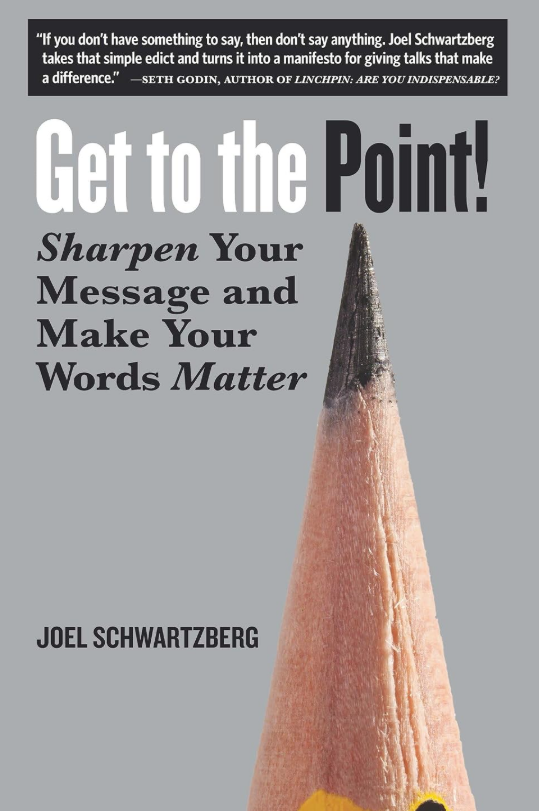
2. Get to the Point! — Joel Schwartzberg
Sometimes rambling starts before you’ve said a single word.
The problem is that you haven’t decided what your point actually is.
You know the subject.
You know what happened.
You have opinions about it.
But if someone asked you to summarise the one thing you’re trying to communicate, the answer isn’t immediately obvious.
That’s the territory Joel Schwartzberg explores in Get to the Point!
Rather than treating a topic and a point as the same thing, Schwartzberg concentrates on identifying the message you genuinely want another person to understand. The updated edition applies that thinking across speeches, presentations, emails, meetings and everyday workplace communication.
This distinction is surprisingly useful.
Imagine somebody asks:
“How did the meeting go?”
Without a clear point, you might begin replaying the meeting chronologically.
Who attended. What happened first. What somebody said. Why that mattered. What happened next.
But perhaps the point is simply:
“It went well. They’ve approved the proposal, but they want one change before we proceed.”
Now the listener knows what matters.
The rest can follow if they want it.
3. Smart Brevity — Jim VandeHei, Mike Allen and Roy Schwartz
Smart Brevity comes from the creators of Axios and is built around a simple communication challenge: how do you make important information easier for busy people to absorb?
The method encourages communicators to put the most important information first, explain why it matters and remove material that doesn’t earn its place. The authors apply the approach across different forms of communication rather than limiting it to one particular setting.
Although much of its focus is written and workplace communication, there’s an obvious lesson for speaking as well.
Rambling often happens because we communicate in the order we thought about something rather than the order another person needs to hear it.
Those are not always the same thing.
You may have needed ten different thoughts to reach your conclusion.
The listener probably doesn’t need to accompany you through all ten.
Start with what matters.
Then explain.
It’s a small change in sequence that can make communication considerably easier to follow.
4. Simply Said — Jay Sullivan
Being concise doesn’t mean becoming abrupt.
That’s an important distinction.
Some people worry that if they stop explaining every detail, they’ll sound cold, dismissive or uninterested. So they compensate by adding more and more words.
Simply Said: Communicating Better at Work and Beyond takes a broader view of communication. Jay Sullivan’s approach emphasises focusing less on yourself and more on the person you’re communicating with, covering clearer messages alongside presentations, difficult conversations and listening.
That’s particularly useful because good communication isn’t a competition to see who can produce the shortest sentence.
The real question is:
What does this person need from me right now?
Sometimes they’ll need a detailed explanation.
Sometimes they’ll need three sentences.
Sometimes they’ll simply need yes or no.
Learning to recognise the difference can help you become more concise without losing warmth or connection.
5. Articulate — Julian Merren
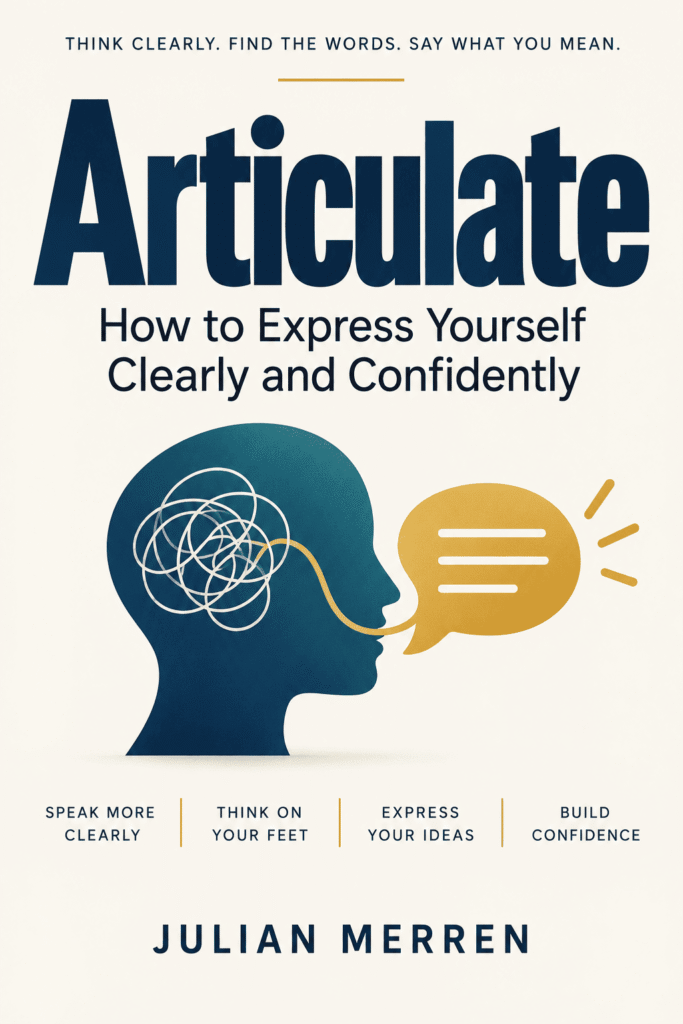
Articulate: How to Express Yourself Clearly and Confidently approaches rambling as part of a wider communication problem.
You might ramble because you haven’t organised your thoughts.
You might begin talking before you’ve worked out your point.
You might be nervous and fill every silence.
Or you may keep explaining because you’re worried the other person hasn’t understood you.
Articulate focuses on practical ways to deal with these everyday situations. It explores organising your thoughts before speaking, getting to the point, finding the right words, explaining ideas clearly and thinking on your feet when you don’t have time to prepare.
The aim isn’t to turn you into an unnaturally brief speaker.
It’s to help you recognise what you’re trying to say and communicate it without burying the idea underneath unnecessary words.
If you regularly find yourself thinking I could have said that much more simply, you can learn more about Articulate by Julian Merren.
What the Best Books to Help You Stop Rambling Have in Common
These books use different methods, but several principles keep appearing.
Know your point before you start. If you don’t know where you’re going, it’s easy for your listener to get lost with you.
Put important information earlier. Don’t make someone listen to two minutes of background before discovering why you’re talking to them.
Give people the information they need. Knowing a lot about a subject doesn’t mean you have to say all of it.
Allow yourself to pause. Silence can feel uncomfortable, but a two-second pause is often better than twenty seconds of unnecessary words.
Stop when the point has landed. You don’t always need another example, another explanation or another way of saying the same thing.
That final one can be particularly difficult.
When you care about being understood, your instinct may be to keep talking until you’re absolutely certain.
But sometimes clarity means trusting the sentence you’ve already said.
A Simple Way to Practise Getting to the Point
You don’t have to wait until you’ve finished one of these books to start practising.
Try the one-sentence-first exercise.
Before answering a question, silently ask yourself:
If I could say only one sentence, what would it be?
Say that sentence first.
Then add whatever supporting information is genuinely necessary.
Someone asks how a project is progressing?
Instead of beginning with everything that has happened since Monday:
“We’re on schedule, but we need the final figures by Thursday.”
Then explain if necessary.
Someone asks what you thought of a book?
Instead of retelling half the book:
“I liked the ideas, but I thought it was more repetitive than it needed to be.”
Again, expand if the person is interested.
This isn’t about reducing every conversation to sound bites.
It’s about learning to separate your point from all the information surrounding it.
Clear Communication Isn’t About Saying as Little as Possible
There’s a danger in taking concision too far.
Some ideas genuinely need explanation.
A difficult conversation deserves more care than a routine update. A complicated subject may require examples. Someone learning something new may need context that an expert doesn’t.
The goal isn’t to become the person who responds to everything with five words.
It’s to become more deliberate.
Ask yourself:
What am I trying to communicate?
What does this person need to understand it?
Have I already made the point?
Those three questions can prevent a surprising amount of unnecessary talking.
Say What Matters — Then Give It Room to Land
Rambling is a habit, which means it can also be changed through practice.
You can learn to pause before speaking.
You can put the conclusion before the backstory.
You can notice when you’ve begun repeating yourself.
And you can become comfortable ending a sentence without immediately adding another one.
The best books to help you stop rambling won’t teach you to suppress your personality or become unnaturally terse. They’ll help you give your ideas enough structure that other people don’t have to search for the point.
Start with whichever book most closely matches your problem.
If you struggle with brevity, consider Brief or Smart Brevity. If identifying your actual message is the difficulty, Get to the Point! is particularly relevant. If you want a broader communication approach, look at Simply Said.
And if rambling is one part of a wider desire to organise your thoughts, find the words and express yourself more clearly, Articulate by Julian Merren was created around exactly those everyday communication challenges.
You don’t need to have less to say.
You just need to make the important part easier to hear.