
Have you ever walked away from a conversation wishing you’d explained yourself better?
Perhaps you had a good idea during a meeting but couldn’t find the right words. Maybe you were telling a story and lost your train of thought halfway through. Or perhaps you knew exactly what you wanted to say, only to find yourself rambling when it was your turn to speak.
It’s frustrating, especially when your thoughts seem perfectly clear inside your head.
But speaking clearly isn’t simply about having a good vocabulary or sounding intelligent. It involves organising your thoughts, choosing the right words, understanding your audience and knowing when to stop talking.
And confidence doesn’t necessarily mean being the loudest person in the room.
Sometimes the most confident speaker is the person who pauses, thinks carefully and communicates one useful idea without unnecessary explanation.
If you’re looking for books to speak clearly and confidently, the following five recommendations explore different aspects of effective communication.
Whether you want to contribute more comfortably in meetings, become a better conversationalist or simply express yourself without overthinking every sentence, these books offer practical ideas worth exploring.

1. Think Faster, Talk Smarter — Matt Abrahams
Best for: Speaking clearly when you’re put on the spot.
Some conversations give us plenty of time to prepare.
Others don’t.
Your manager asks for your opinion during a meeting. Somebody unexpectedly asks you to explain an idea. Or you’re invited to contribute to a discussion you weren’t expecting.
Suddenly, your mind goes blank.
Think Faster, Talk Smarter by Matt Abrahams explores how to communicate more effectively in spontaneous situations.
Rather than expecting people to produce flawless answers instantly, the book offers approaches to managing speaking anxiety, structuring responses and communicating when preparation time is limited.
One particularly useful lesson is that you don’t need to say everything that comes into your head.
You need to identify what’s most relevant.
Try this: Give your answer a simple structure
Imagine somebody asks what you thought of a recent presentation.
Instead of beginning with a long explanation, try:
“I thought it was useful, particularly the section on customer feedback. It gave us a clearer picture of what needs improving.”
You’ve expressed an opinion and explained why.
That’s often enough to begin a productive discussion.
You can always add more detail if somebody asks.
Why read it? If you struggle to think on your feet or feel uncomfortable answering unexpected questions, this book offers a practical starting point.
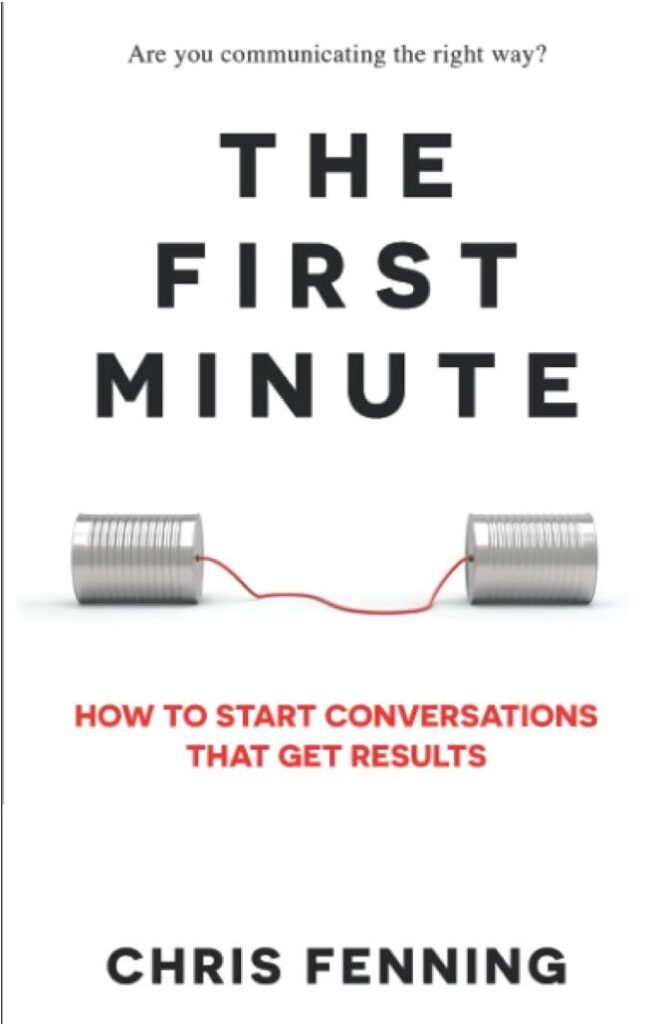
2. The First Minute — Chris Fenning
Best for: Getting to the point without unnecessary rambling.
Have you ever listened to somebody explain an idea and wondered when they were going to reach the point?
We’ve all encountered conversations where the main message gets buried beneath too much background information.
And occasionally, we’re the person doing the explaining.
The First Minute by Chris Fenning focuses on communicating clearly and concisely, particularly in professional settings.
It encourages readers to establish the purpose of a message and make it easier for others to understand what matters.
This is especially valuable when you’re explaining a problem, making a request or providing an update.
Try this: Start with the reason you’re speaking
Imagine you need to tell a colleague that a project is running behind schedule.
You could begin by explaining everything that’s happened over the past two weeks.
Or you could say:
“We’re running two days behind schedule because we’re waiting for the final figures. I’d like to discuss how we can recover that time.”
The second approach immediately identifies the problem and the purpose of the conversation.
Your colleague knows what you’re discussing and why it matters.
The supporting details can follow.
Why read it? If people sometimes ask you to get to the point, or you find yourself overexplaining simple ideas, this book is particularly relevant.
3. How to Speak, How to Listen — Mortimer J. Adler
Best for: Becoming a more thoughtful and effective communicator.
Speaking clearly isn’t only about the words you choose.
It’s also about understanding the person you’re speaking to.
A message that makes perfect sense to you may be confusing to somebody who doesn’t share your knowledge, experience or assumptions.
How to Speak, How to Listen by Mortimer J. Adler explores communication as a process involving both expressing ideas and understanding others.
It examines the importance of thoughtful speaking and attentive listening.
That’s a useful reminder because conversations aren’t simply opportunities to deliver information.
They’re exchanges.
Try this: Check whether your message is being understood
Imagine you’re explaining a complicated process to somebody who’s unfamiliar with it.
Rather than delivering several minutes of information without stopping, pause after your main point.
You could ask:
“Does that make sense so far, or would it help if I gave you an example?”
This gives the other person an opportunity to ask questions before becoming overwhelmed.
It also helps you recognise whether your explanation needs adjusting.
Being clear isn’t always about speaking less.
Sometimes it’s about explaining something differently.
Why read it? If you want to improve both sides of communication — expressing yourself and understanding others — this book offers a broader perspective.
4. The Quick and Easy Way to Effective Speaking — Dale Carnegie
Best for: Building confidence when speaking in front of others.
For some people, finding the right words isn’t the biggest challenge.
It’s having the confidence to say them.
You might have a useful idea during a meeting but remain silent because you’re worried about being judged.
Perhaps you become nervous when introducing yourself to a group.
Or you avoid speaking opportunities because you don’t feel naturally confident.
The Quick and Easy Way to Effective Speaking by Dale Carnegie focuses on developing confidence and becoming more comfortable communicating with an audience.
The book emphasises preparation, practice and learning through experience.
An important lesson is that confidence can develop through repeated action.
You don’t necessarily need to feel completely ready before you begin.
Try this: Practise speaking in smaller situations
If contributing during meetings makes you nervous, don’t begin by expecting yourself to deliver a lengthy presentation.
Start with something manageable.
Ask one question.
Offer one suggestion.
Or prepare a brief update you can share when the opportunity arises.
The aim is to become more comfortable expressing yourself through regular practice.
Over time, those smaller experiences can help make larger speaking situations feel more familiar.
Why read it? If nervousness prevents you from sharing ideas or speaking up when it matters, Carnegie’s book offers encouragement and practical guidance.
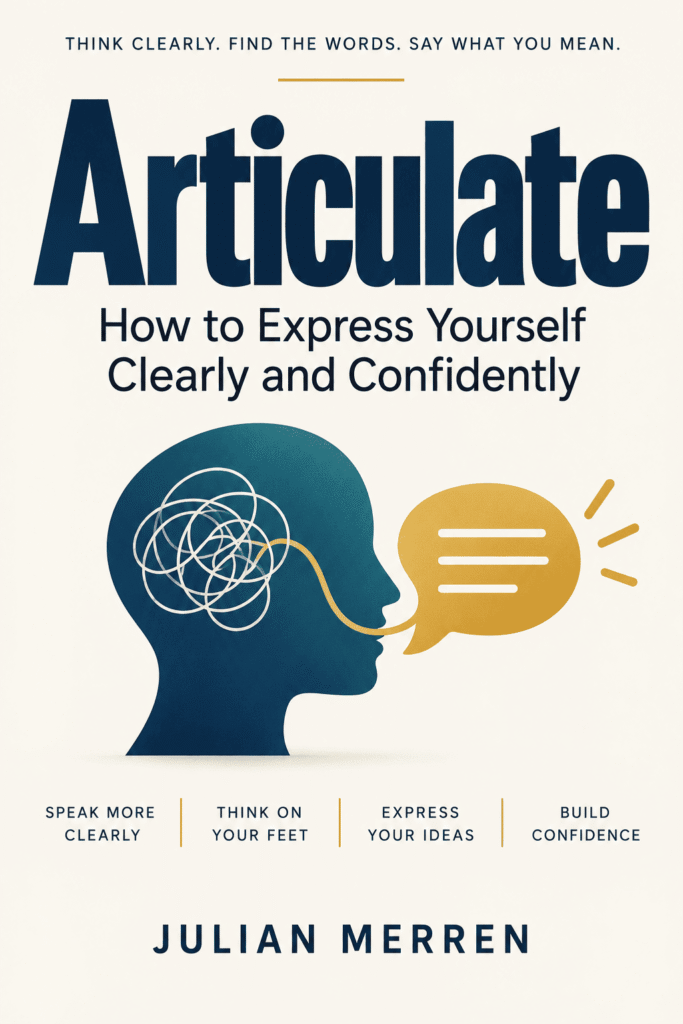
5. Articulate — Julian Merren
Best for: Organising your thoughts and expressing yourself clearly in everyday situations.
Sometimes you know your subject.
You understand what you want to communicate.
And you have something genuinely worthwhile to say.
But when the moment arrives, the words don’t come out as clearly as you’d hoped.
You start explaining, lose your direction and add unnecessary details.
Or you become so concerned about sounding confident that you struggle to communicate naturally.
Articulate: How to Express Yourself Clearly and Confidently by Julian Merren addresses these everyday communication challenges.
The book explores practical ways to organise your thoughts, find the right words, reduce unnecessary rambling and communicate with greater clarity.
Rather than treating articulation as a talent that some people naturally possess, it focuses on skills that can be developed through practice.
One useful approach is:
Pause. Point. Explain.
Try this: Say the main thing first
Imagine somebody asks why you disagree with a proposed change at work.
Instead of immediately explaining every concern, pause briefly and identify your main point.
You might say:
“My main concern is that the change could increase the workload without improving the results.”
Then explain your reasoning.
This gives your listener a clear starting point.
It also helps you stay focused rather than trying to communicate several different ideas at once.
The same principle can help during everyday conversations, interviews, presentations and difficult discussions.
You don’t need complicated language to sound articulate.
You need a clear message and a sensible way to communicate it.
Why read it? If you often think, “I know what I mean, but I can’t seem to explain it,” Articulate is designed to help you work on that exact challenge.
You can discover Articulate by Julian Merren here.
What These Books to Speak Clearly and Confidently Have in Common
Although these five books approach communication from different angles, they share several useful principles.
First, effective communication begins with clear thinking.
When you understand the point you’re trying to make, it’s easier to choose the words that support it.
Second, speaking confidently doesn’t require perfection.
You can pause, correct yourself, ask a question or take a moment to organise your thoughts.
Those things don’t automatically make you a poor communicator.
Third, good communication considers the listener.
An explanation isn’t particularly useful if the other person can’t understand it.
And finally, communication improves through practice.
Reading provides ideas and techniques, but applying them during real conversations is where those lessons become meaningful.
Five Small Habits That Can Improve the Way You Speak
You don’t need to overhaul your personality to become a clearer communicator.
Start with a few manageable habits.
- Pause before answering. Give yourself a moment to identify what matters.
- Lead with your main point. Help the listener understand where your explanation is going.
- Use familiar language. Choose words that communicate your meaning rather than trying to sound impressive.
- Pay attention to the listener. Notice when an example or clarification might help.
- Practise one skill at a time. Focus on improving a particular habit rather than trying to change everything at once.
You might spend one week practising shorter explanations.
The next week, focus on asking better questions.
Then work on speaking up during conversations where you’d normally remain quiet.
Small improvements can build on one another.
Final Thoughts: Clear Communication Is a Skill Worth Developing
Being able to express yourself clearly can make a difference in many areas of life.
It can help you contribute ideas at work, explain your feelings in relationships, participate in meaningful conversations and speak up when something matters.
But you don’t need to become a polished public speaker to benefit.
Sometimes the goal is simply to finish a conversation knowing you’ve said what you genuinely meant.
The best books to speak clearly and confidently offer different ways to develop that ability.
Choose the book that addresses your biggest challenge, whether that’s nervousness, rambling, listening or finding the right words.
And remember that you don’t have to change the way you speak overnight.
Start with one idea.
Practise it.
Then build from there.
If you’d like a practical guide to organising your thoughts and expressing yourself more clearly, explore Articulate by Julian Merren.
Think clearly. Find the words. Say what you mean.