

How to Manage Money When You’re Broke — Free PDF Guide
You check your bank balance, mentally subtract the bills still coming, and realise there’s almost nothing left.
Payday might be another week away. The groceries are running low, the electricity bill is due, and something unexpected has just appeared that you hadn’t planned for.
You know you should be managing your money better. You’ve probably heard the usual advice about budgeting, saving and cutting unnecessary spending.
But what happens when there isn’t much money to manage in the first place?
That’s the part many financial guides overlook.
Learning how to manage money when you’re broke isn’t about finding the perfect budgeting app or suddenly becoming brilliant with numbers. It’s about understanding what’s happening, protecting the essentials and making the money you have work as effectively as possible.
You don’t need to solve your entire financial situation this week.
You need a manageable starting point.
In this guide, we’ll explore seven practical steps for dealing with money when things are tight, along with a free PDF ebook to help you begin getting your finances back on track.
Why Budgeting Feels Different When You’re Broke
Most budgeting advice begins with a straightforward suggestion: spend less than you earn.
In principle, that makes sense.
But when your income barely covers rent, groceries, transport and essential bills, there may be very little spending left to reduce.
Perhaps your hours at work have been cut. Maybe your housing costs have increased, a relationship has ended, or unexpected expenses have wiped out the small amount you had saved.
Sometimes poor financial decisions contribute to money problems. Other times, the problem is simply that essential living costs have grown faster than your income.
And sometimes it’s a combination of both.
Whatever the circumstances, the first objective should be to understand your position without becoming overwhelmed by it.
When money is extremely tight, a useful budget doesn’t start with ambitious savings targets.
It starts with answering three questions.
How much money do I actually have available?
What must be paid before my next payday?
And where can I make a realistic adjustment?
Those answers provide something more useful than vague financial anxiety: a picture of what needs attention.

1. Find Out Exactly Where You Stand
When money becomes stressful, avoiding your bank account can feel easier than looking at it.
You might stop opening bills, delay checking balances or try to remember upcoming payments without writing them down.
Unfortunately, uncertainty often makes financial pressure harder to manage.
Start by gathering the basic information.
Check the money currently available across your accounts. Write down when your next income payment is expected and approximately how much you’ll receive.
Then list the bills and essential expenses due before that date.
You don’t need an elaborate spreadsheet.
A notebook or simple document will do.
Imagine you have $320 available and won’t be paid for another ten days.
You know you need $120 for groceries, $60 for transport and $90 for an essential bill.
That leaves $50 before accounting for anything else.
It’s not a comfortable position, but at least you can now see the actual problem.
You can identify whether another payment is coming, whether an expense can be adjusted or whether you need to contact a provider before a bill becomes overdue.
Clarity doesn’t create money.
But it makes the decisions in front of you easier to understand.
2. Protect Your Essential Expenses First
When you’re struggling financially, not every expense has the same urgency.
Some payments protect your immediate wellbeing and ability to keep earning.
Others may be important but have more flexibility around when they’re paid.
A practical starting point is to identify your most essential needs: housing, basic food, necessary medication, utilities and transport required for work or important appointments.
The exact order will depend on your circumstances and the consequences of missing a payment.
For example, keeping your car running may be essential if you cannot get to work without it. In another household, public transport may be a more affordable option.
The aim is to protect the things that keep everyday life functioning.
If you cannot cover all your bills, don’t simply pay whichever company contacts you most frequently.
Consider what happens if each payment is delayed and seek help where the consequences are serious.
For Australian readers, the government’s Moneysmart website provides guidance on deciding which debts and bills need attention first.
When money is limited, prioritising essentials is more useful than trying to make every expense appear equally important.
3. Create a Budget for Your Next Payday, Not Your Ideal Future
A common budgeting mistake is creating a plan for the financial situation you wish you had.
You imagine saving hundreds of dollars each month, paying off all your debt and leaving plenty of money for unexpected expenses.
Then reality arrives.
Your income hasn’t changed, the same bills still exist, and the budget becomes impossible to follow.
Instead, begin with the next pay cycle.
Work out how much money you expect to receive and what needs to be covered before the following payment.
Separate your spending into essential commitments, necessary everyday expenses and items that can wait.
Be realistic.
If groceries usually cost $140 per week, allocating $50 simply because it makes the numbers look better won’t solve the underlying problem.
Likewise, don’t assume every expense can be eliminated through determination.
Your budget needs to reflect what life actually costs.
If the numbers show that your essential expenses exceed your income, recognise that the problem may require more than spending adjustments.
You might need to explore income support, additional earnings, hardship arrangements or professional assistance.
A budget should reveal the problem, not disguise it.
4. Look for Small Changes That Actually Make a Difference
When money is tight, people are often told to stop buying coffee, cancel entertainment and avoid anything unnecessary.
Sometimes those changes help.
But if you’ve already reduced your spending considerably, hearing another suggestion to cut back can feel frustrating.
Instead of searching endlessly for tiny savings, examine your regular expenses for changes that might genuinely matter.
Perhaps you’re paying for a service you rarely use.
Maybe an insurance renewal has increased, or your phone plan includes features you don’t need.
You might discover that changing how you shop for groceries reduces waste without forcing you to buy less food.
The important thing is to compare the benefit with the effort required.
Saving $3 occasionally is useful, but finding a sustainable $25 reduction in a recurring expense may have a greater impact over time.
Consider reviewing one category at a time rather than attempting to overhaul everything in a single afternoon.
And remember that some apparent savings aren’t actually helpful.
Skipping essential healthcare, cancelling necessary insurance without understanding the risks or relying on expensive short-term credit can create larger problems later.
The objective is to spend more deliberately, not simply spend as little as possible.

5. Deal With Bills Before They Become Bigger Problems
One of the most uncomfortable parts of financial difficulty is knowing that a bill is coming and not having enough money to pay it.
You might hope something changes before the due date.
Perhaps you’ll earn a little extra, another payment will arrive or you’ll somehow find the money.
Sometimes that happens.
But waiting without a plan can reduce your options.
If you know you’re going to struggle with a payment, contact the provider as early as you reasonably can.
Explain the situation clearly and ask what assistance is available.
Depending on the provider and your circumstances, options may include extra time, an affordable payment arrangement or financial hardship assistance.
You don’t need to promise an amount you cannot realistically pay.
Before agreeing to anything, consider whether the arrangement leaves enough money for essential living costs.
If a proposed payment plan is unaffordable, say so and ask about alternatives.
The conversation might feel uncomfortable, but avoiding it rarely makes the bill easier to manage.
For Australian readers, Moneysmart explains financial hardship arrangements and the assistance that may be available through lenders and service providers.
If you’re overwhelmed by several debts or facing serious consequences from missed payments, free financial counselling may be a more useful first step than negotiating everything alone.
6. Start Building a Small Financial Buffer When You Can
An emergency fund can seem like an impossible goal when you’re struggling to cover everyday expenses.
Advice about saving several months of living costs may be useful in the long term, but it doesn’t necessarily help someone who has only a few dollars left before payday.
Start with a smaller objective when your essential needs are covered.
Perhaps your first goal is to keep $20 aside rather than spending every available dollar.
Later, you might aim for $50 or $100.
The amount will depend on your income and circumstances.
Some weeks you may not be able to save anything, and that’s not a reason to abandon the idea.
The purpose of a small financial buffer is to create a little flexibility when something unexpected happens.
A small reserve might help cover an additional transport expense, replace an essential household item or reduce the need to borrow for a minor emergency.
However, don’t prioritise saving at the expense of food, housing or urgent essential bills.
And don’t automatically build savings while allowing high-cost debts to become more serious without understanding the consequences.
The order of priorities matters.
A financial buffer is something to build when circumstances allow, not another expectation that makes difficult weeks feel worse.
7. Look Beyond Spending Cuts When the Numbers Don’t Work
Sometimes the most important financial realisation is that you cannot solve the problem by budgeting alone.
If your income is consistently lower than your essential expenses, even a carefully managed budget will leave a shortfall.
That doesn’t mean budgeting is pointless.
It means the budget has revealed a problem that requires a different response.
Depending on your circumstances, possibilities might include checking your eligibility for government assistance, reviewing employment opportunities, asking about additional work hours or seeking support with housing and essential bills.
You might also need help reviewing debts or negotiating payment arrangements.
Be cautious about solutions that promise quick money with little effort.
High-cost borrowing and schemes requiring upfront payments can make an already difficult financial position worse.
And if you’re considering taking on additional work, weigh the potential earnings against transport expenses, childcare costs, time and wellbeing.
The goal is to improve your position sustainably.
Sometimes that involves reducing spending.
Sometimes it involves increasing income.
And sometimes it involves accessing assistance you didn’t realise was available.
The important thing is recognising which problem you’re actually trying to solve.
A Simple 15-Minute Money Reset
If you’re feeling overwhelmed, try this short exercise.
Take a piece of paper and divide it into three sections.
Money available: Write down what you have now and what you expect to receive before your next payday.
Money required: List essential expenses and payments that need attention during that period.
One next action: Identify the most useful thing you can do today.
Perhaps you need to contact your electricity provider, review an upcoming payment or prepare a realistic grocery plan.
Don’t attempt to fix everything at once.
Choose one action that reduces uncertainty or improves your immediate situation.
The following day, choose another.
This exercise won’t eliminate a shortage of money, but it can help turn an overwhelming situation into a series of practical decisions.
Free PDF Guide: Behind With Money? Start Here.
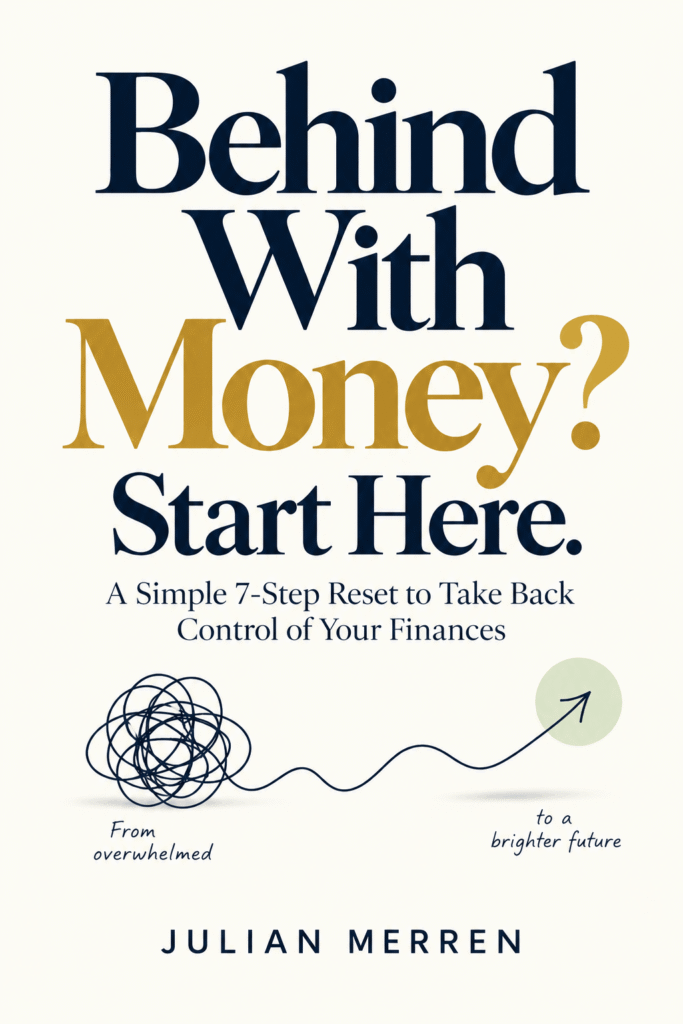
If you’ve been searching for a free PDF guide on how to manage money when you’re broke, Books That Shape has a practical resource designed for people who feel financially behind and aren’t sure where to begin.
Behind With Money? Start Here. is a free 45-page ebook offering a simple seven-step financial reset.
It helps readers begin understanding where their money is going, recognise what needs attention and take manageable steps towards greater control.
The guide is particularly relevant if you’ve been avoiding your finances, feel overwhelmed by everyday money decisions or want a clearer starting point without unrealistic promises about getting rich.
You don’t need to have your financial life organised before reading it.
The purpose is to help you begin organising it.
Get Behind With Money? Start Here. — Free PDF Ebook
The guide is available through the Books That Shape Free Library, alongside other free personal-growth ebooks covering confidence, relationships, habits and communication.
Register once and confirm your email address to access the collection of downloadable PDF guides.
When You Need More Than a Budget
If you’re struggling to afford food, housing, essential medication or important bills, don’t rely on budgeting tips alone.
Practical support may be available through community organisations, government services and financial counsellors.
In Australia, the National Debt Helpline provides free, confidential and independent financial counselling on 1800 007 007. Its website also offers information about managing debts, bills and financial hardship.
Readers outside Australia should seek equivalent free, accredited financial counselling or hardship support services in their own country.
A personal-finance ebook can help you understand money habits and organise your next steps, but it cannot replace professional support when the situation is urgent or complex.
You Can Start From Where You Are
Learning how to manage money when you’re broke isn’t about pretending that every financial problem can be solved by making better choices.
Sometimes the numbers are genuinely difficult.
Income may be limited. Essential expenses may be high. And unexpected events can disrupt even a carefully managed plan.
What matters is finding the next useful step.
Understand what’s coming in and going out. Protect your essential needs. Speak to providers when payments become difficult. Look for realistic improvements and accept appropriate help when you need it.
You don’t have to transform your finances overnight.
You simply need to begin replacing uncertainty with information and worry with manageable action.
A clearer financial future can start with understanding the money you have today.