
Financial mistakes have an irritating habit of surviving long after the money itself has gone.
Perhaps you spent more than you should have in your younger years. Maybe you avoided investing because it seemed complicated, carried debt for too long, cashed out an investment at the wrong moment, or simply woke up one day and realised you hadn’t prepared for the future as well as you’d hoped.
The numbers matter, of course. But often it’s the regret that causes the most trouble.
You keep replaying what you should have done.
That’s why some of the best books about financial mistakes aren’t simply books about budgeting, saving or investing. They’re books that help you understand why we make imperfect decisions with money — and, more importantly, what we can do next.
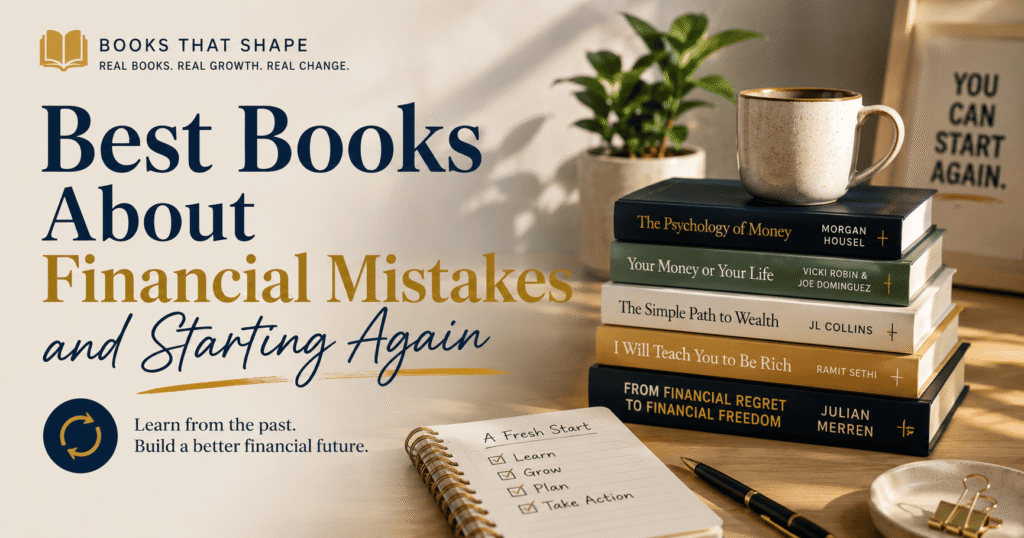
If you’re tired of looking backwards, these five books offer very different ways to begin moving forward.
1. The Psychology of Money — Morgan Housel
Few books have done more to change the conversation around money than The Psychology of Money.
Rather than presenting financial success as a complicated mathematical exercise, Morgan Housel explores something far more human: behaviour.
Why do intelligent people make terrible financial decisions?
Why do some people with modest incomes accumulate wealth while others earning considerably more continually struggle?
And why can knowing what we should do with money be so different from actually doing it?
Housel uses short stories and observations to explore ideas such as risk, greed, patience, compounding, luck and the strange ways our personal experiences shape our financial decisions.
Why read it after making financial mistakes?
Because it can help you stop viewing every poor decision as evidence that you’re simply “bad with money”.
Our financial behaviour doesn’t develop in a vacuum. It is influenced by our upbringing, experiences, fears, expectations and the financial world we’ve personally lived through.
Understanding that doesn’t remove responsibility for past decisions. It simply makes those decisions easier to examine without turning them into a judgement about who you are.
Best for: Readers who want to understand why they behave the way they do around money.
2. Your Money or Your Life — Vicki Robin and Joe Dominguez
Financial regret isn’t always about losing money.
Sometimes it’s about realising how much of your life you’ve exchanged for things that ultimately didn’t matter very much.
Your Money or Your Life encourages readers to think about the relationship between money, time and personal values.
Rather than seeing money purely as something to accumulate, the book asks you to consider what you’re actually trying to accomplish with it.
That distinction can be particularly useful when starting again financially.
If you’ve spent years chasing a lifestyle, buying things you no longer value or simply allowing money to disappear without much thought, starting again doesn’t necessarily mean becoming obsessed with every dollar.
It can mean becoming more deliberate about what your money is for.
Why it belongs among the best books about financial mistakes
It helps broaden the definition of a financial mistake.
Perhaps the mistake wasn’t simply spending too much.
Perhaps it was spending on things that weren’t especially important to you while neglecting the things that were.
That’s a very different problem — and recognising it can change the decisions you make next.
Best for: Readers who want their financial decisions to better reflect the life they actually want.
3. The Simple Path to Wealth — JL Collins
Once you’ve accepted that the past cannot be changed, another question quickly appears:
What should I do now?
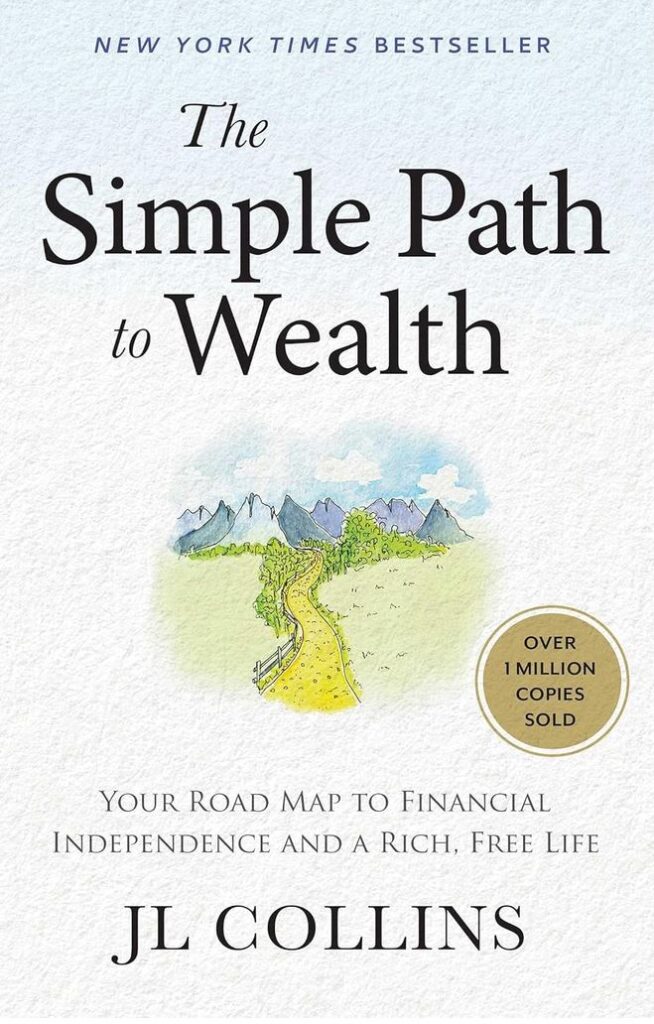
This is where The Simple Path to Wealth earns its place on the list.
JL Collins is known for explaining wealth building in straightforward language and arguing that successful investing does not need to become an endlessly complicated project.
That simplicity can be particularly valuable for someone who feels they’ve already lost time.
When people believe they’re financially behind, there can be a temptation to compensate by doing more: finding the perfect investment, chasing higher returns or attempting to make up years of lost progress quickly.
A simpler approach can provide a useful counterweight.
Why read it when you’re starting again?
Because starting again is much easier when the path ahead doesn’t contain fifty different decisions.
Collins’ broader message around simplicity, consistency and long-term investing can help readers move away from the idea that recovering from financial mistakes requires some spectacular financial manoeuvre.
Sometimes progress begins with doing a few sensible things repeatedly.
Best for: Readers who want a straightforward introduction to long-term wealth building.
4. I Will Teach You to Be Rich — Ramit Sethi
The title may sound bold, but Ramit Sethi’s approach to personal finance is considerably more practical than the name might suggest.
I Will Teach You to Be Rich focuses on creating systems around spending, saving, banking and investing rather than relying on constant willpower.
This makes it particularly relevant if your past financial mistakes weren’t caused by one enormous decision but by hundreds of small ones.
Subscriptions you forgot about.
Saving whatever happened to be left at the end of the month.
Putting off investing.
Ignoring accounts because dealing with them felt like work.
None of these decisions feels catastrophic individually. Over many years, however, they can have a substantial effect.
The useful lesson: make good decisions easier
One of the biggest advantages of financial systems is that they reduce the number of decisions you need to make.
Instead of asking yourself every month whether you’ll save, you create a system that makes saving part of your normal financial routine.
That can be an important shift when starting again.
You don’t need to become a completely different person overnight. You can gradually build an environment in which better financial behaviour becomes easier.
Best for: Readers who need practical systems rather than more financial motivation.
5. From Financial Regret to Financial Freedom — Julian Merren
There is a particular kind of financial worry that appears when regret becomes tangled with time.
You don’t simply think:
I’ve made mistakes.
You think:
I’ve made mistakes — and now I’m running out of time to fix them.
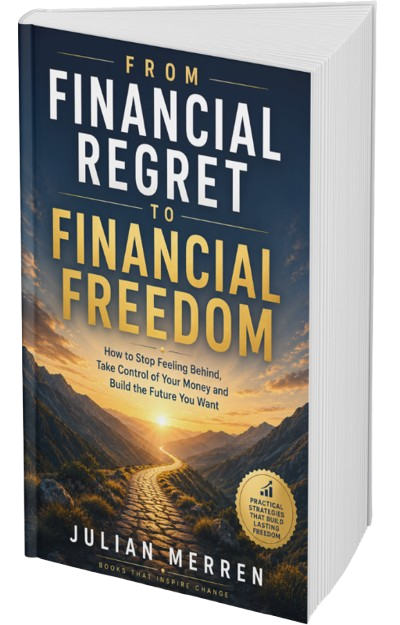
That is the territory explored in From Financial Regret to Financial Freedom by Julian Merren.
The book is written for readers who feel financially behind and want to stop allowing past money decisions to dominate the future.
Rather than promising a shortcut or spectacular financial transformation, it focuses on rebuilding from where you are now: understanding your position, creating financial stability, dealing with debt, beginning or strengthening wealth building and developing a clearer idea of what financial freedom actually means to you.
Why this book is different
Many personal-finance books begin with money.
This one begins with regret.
That’s important because knowing another budgeting technique isn’t necessarily helpful if you’re still mentally comparing today’s finances with the life you believe you should have created ten or twenty years ago.
The goal is not to pretend those lost opportunities never existed.
If debt is one of the mistakes you’re trying to recover from, the Australian Government’s Moneysmart resource on getting debt under control also provides practical steps for understanding what you owe and where to seek help.
It’s to prevent them from claiming the years that remain.
Best for: Readers who feel they’ve started late, made mistakes or lost valuable financial time.
You can learn more about From Financial Regret to Financial Freedom by Julian Merren on the Books That Shape book page.
What the Best Books About Financial Mistakes Have in Common
These books approach money from different directions, but there is an encouraging idea running through all of them:
A financial mistake does not have to become a permanent financial identity.
You may have made poor decisions.
You may also have made perfectly understandable decisions with the knowledge, circumstances and priorities you had at the time.
Either way, the useful question eventually changes from:
“Why didn’t I do better?”
to:
“What can I do better from here?”
Good financial books can help with that transition.
They can help you:
- understand the behaviour behind past decisions;
- reconsider what money actually means to you;
- simplify the process of building wealth;
- create systems that make better choices easier; and
- replace vague financial regret with a clearer direction.
Books cannot make your decisions for you, and general financial information isn’t a substitute for personal advice tailored to your circumstances. But they can give you new frameworks for thinking about the decisions you make next.
Starting Again Doesn’t Mean Starting From Zero
There is another reason financial regret can be misleading.
Starting again at 40, 50 or 60 is not the same as starting from nothing.
You bring decades of experience with you.
You probably understand your own habits better than you did twenty years ago. You may know which purchases mattered and which didn’t. You know what financial stress feels like. You may also have a much clearer understanding of what you want the next stage of life to look like.
Those lessons have value.
The challenge is using them rather than simply regretting how you acquired them.
Which Book Should You Read First?
That depends on what’s troubling you most.
If you’re trying to understand your behaviour around money, begin with The Psychology of Money.
If you’re questioning what money and financial freedom actually mean to you, try Your Money or Your Life.
If investing and wealth building feel unnecessarily complicated, The Simple Path to Wealth may be a useful starting point.
If you know what you should be doing but struggle to turn good intentions into routines, consider I Will Teach You to Be Rich.
And if your biggest obstacle is the feeling that you’ve left things too late, From Financial Regret to Financial Freedom was written specifically around that problem.
Final Thoughts
The best books about financial mistakes don’t ask you to pretend the past didn’t happen.
They help you learn from it.
There is a considerable difference between those two things.
Regret keeps asking what might have happened if you’d made different choices. Progress asks what could happen if you begin making different choices now.
You cannot go back and invest your first pay cheque.
You cannot undo an expensive purchase or recover every opportunity you missed.
But your financial story is still being written.
And sometimes starting the next chapter begins with understanding the last one a little better.
If feeling behind financially is the part you find hardest to move beyond, explore From Financial Regret to Financial Freedom by Julian Merren for a practical and encouraging approach to moving from regret towards greater financial control.