

There is a difficult stage of career dissatisfaction that comes before making a change.
You know you don’t want to keep doing what you’re doing.
But you have absolutely no idea what you want instead.
If you’ve found yourself typing “hate my job don’t know what else to do” into Google, you probably aren’t looking for someone to tell you to simply quit. If it were that easy, you wouldn’t be searching for answers in the first place.
There may be a mortgage to pay. A family relying on your income. Years of experience tied to your current industry. Perhaps the job is reasonably well paid, which somehow makes leaving even harder.
And then there is the biggest problem of all:
What would you actually do instead?
Before making a dramatic decision, it can help to understand why your current work feels so wrong — and what a better working life might realistically look like.
These five books approach that problem from different directions.
1. Designing Your New Work Life — Bill Burnett and Dave Evans
When you hate your job, quitting can begin to feel like the only meaningful action available.
Designing Your New Work Life challenges that assumption.
Bill Burnett and Dave Evans apply design thinking to working life, encouraging readers to examine and experiment with their situation rather than assuming they already know the solution. The authors explore ways of redesigning your current job as well as navigating towards something new when a bigger change really is necessary. PenguinRandomhouse.com
That’s an important distinction.
Perhaps your career isn’t actually the problem.
Maybe it’s your manager. Your workload. The culture. The commute. The hours. The lack of autonomy. Or perhaps you’ve simply been doing the same thing for so long that the work no longer challenges you.
Changing careers won’t automatically fix every one of those problems.
Understanding what you actually hate gives you a much better chance of changing the right thing.
Best for: Someone who wants out but hasn’t yet worked out whether they need a different job, employer or career.

2. Working Identity — Herminia Ibarra
One reason leaving a long-term career can feel so difficult is that you’re not simply leaving a job.
You’re potentially leaving part of your identity.
If you’ve spent fifteen years saying, “I’m an accountant,” “I’m a teacher,” “I’m an engineer,” or “I work in IT,” it can be surprisingly difficult to imagine what comes after that sentence.
Working Identity by Herminia Ibarra is particularly useful for people caught in that uncomfortable middle ground.
Ibarra’s approach challenges the idea that you must first figure out exactly what you want and only then take action. Instead, career reinvention can develop through experimentation — trying new professional activities, meeting different people and learning from those experiences. Herminia Ibarra
That takes some pressure off.
You don’t need to discover your perfect second career this weekend.
You can start gathering evidence.
Talk to someone doing work that interests you. Try a project. Explore another industry. Learn something new. Notice what energises you and what only sounded appealing from a distance.
Sometimes clarity comes after movement begins.
Best for: Someone who knows what they don’t want but cannot yet picture themselves doing anything else.
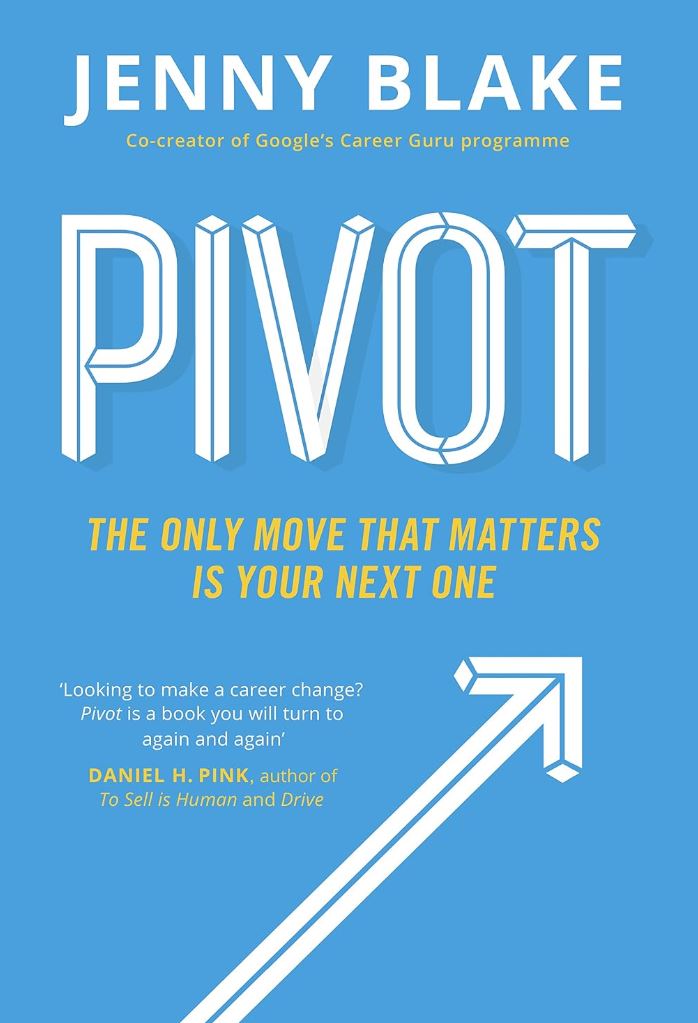
3. Pivot — Jenny Blake
Perhaps you know you want to leave, but another thought keeps stopping you:
“I’ve spent too long building this career to throw it all away.”
Pivot offers a useful answer.
Jenny Blake’s approach focuses on building your next move from the strengths, interests and experience you already possess. Her Pivot Method includes identifying what is already working, exploring opportunities, running small experiments and then taking considered risks towards a new direction. Jenny Blake
That matters because changing direction doesn’t automatically mean starting from zero.
Think about what your current career has taught you beyond the technical parts of your job.
Perhaps you’ve learnt to:
- manage people;
- solve difficult problems;
- organise complex projects;
- communicate under pressure;
- negotiate;
- train others;
- work with customers;
- make decisions with incomplete information.
Those abilities can travel.
Your job title might stay behind.
Your experience doesn’t have to.
Best for: Someone afraid that leaving their current career means wasting everything they’ve built.
4. The Squiggly Career — Helen Tupper and Sarah Ellis
Sometimes feeling trapped comes from an outdated picture of what a career is supposed to look like.
Choose something.
Become good at it.
Get promoted.
Keep climbing.
Eventually retire.
The Squiggly Career offers a different model. Helen Tupper and Sarah Ellis describe modern careers as increasingly fluid, with people moving between roles, industries, locations and even careers rather than simply travelling upwards on one ladder. Squiggly Careers
That opens up possibilities.
A sideways move doesn’t have to mean failure.
A job with less status but greater flexibility may be an improvement.
Changing industries without changing your core skill set may be enough.
Even stepping away from management and returning to work you actually enjoy doing can be progress.
You don’t necessarily need a more impressive career.
You may simply need one that fits you better.
Best for: Someone who feels trapped because every alternative looks like a backwards step.
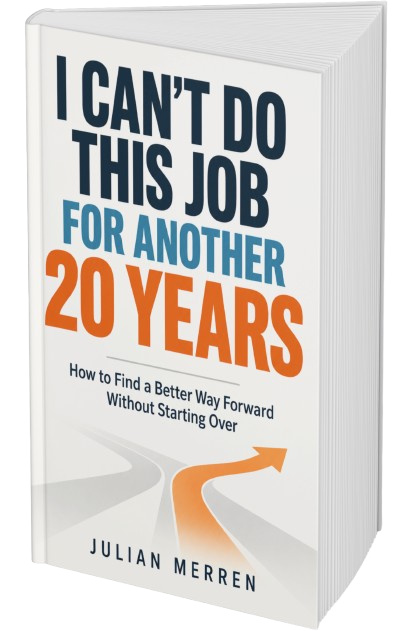
5. I Can’t Do This Job for Another 20 Years — Julian Merren
Sometimes the most honest starting point isn’t:
“What is my dream career?”
It’s:
“I just can’t keep doing this.”
I Can’t Do This Job for Another 20 Years: How to Find a Better Way Forward Without Starting Over by Julian Merren was written for that exact stage.
Rather than assuming you need to resign or completely reinvent yourself, the book begins by helping you identify what you’re actually trying to change.
Is it the work?
The role?
The employer?
The industry?
The lifestyle surrounding the job?
Or have your priorities simply changed since you first chose this career?
That’s particularly important when hate my job don’t know what else to do feels like the only way you can describe where you are.
You don’t need to pretend that money doesn’t matter. You don’t need to ignore family responsibilities. And you certainly don’t need to throw away years of experience simply because your current working life no longer fits.
The aim is to understand the problem first — and then make the smallest change capable of solving it.
Best for: Someone who knows something has to change but doesn’t yet know how much.
Explore I Can’t Do This Job for Another 20 Years
When “Hate My Job Don’t Know What Else to Do” Is Where You Are
Here’s something worth remembering:
You don’t have to know what you want next before you begin exploring.
Those are two different stages.
Instead of demanding an answer from yourself, start collecting information.
Look at jobs outside your usual field and notice which ones catch your attention. Talk to people whose work seems interesting. Write down which parts of your current job you would happily never do again — but also which parts you wouldn’t mind taking with you.
Pay attention to the difference between:
“I don’t want to work here anymore.”
and:
“I don’t want to do this kind of work anymore.”
That distinction can save you from making a much bigger change than you actually need.
Don’t Quit Just to Escape
When work has become miserable, almost any alternative can look appealing.
That’s exactly when it’s worth slowing the decision down.
Leaving may ultimately be the right move. But wherever possible, try to make the decision based on what you’re moving towards, not only what you’re desperate to escape.
You don’t need a five-year plan.
You need enough information to identify your next sensible move.
That might be applying for another role.
Talking to your employer.
Moving industries.
Retraining.
Testing a side project.
Or simply spending the next few months investigating possibilities while keeping your income intact.
Small steps aren’t a lack of courage.
Sometimes they’re how you make a big change responsibly.
You Don’t Need the Whole Answer Yet
Hating your job and not knowing what else to do can make you feel unusually trapped.
But uncertainty isn’t the same as having no options.
You may simply not have discovered them yet.
The five books above approach that uncertainty differently. Designing Your New Work Life helps you question whether quitting is the only solution. Working Identity encourages experimentation. Pivot helps you build from what you already have. The Squiggly Career challenges the idea that careers must follow one straight path.
And I Can’t Do This Job for Another 20 Years helps you step back and decide what actually needs to change before deciding how to change it.
You don’t need to solve the rest of your working life today.
Start by understanding why this one no longer works.
Then make the next move.
Not the forever move.