
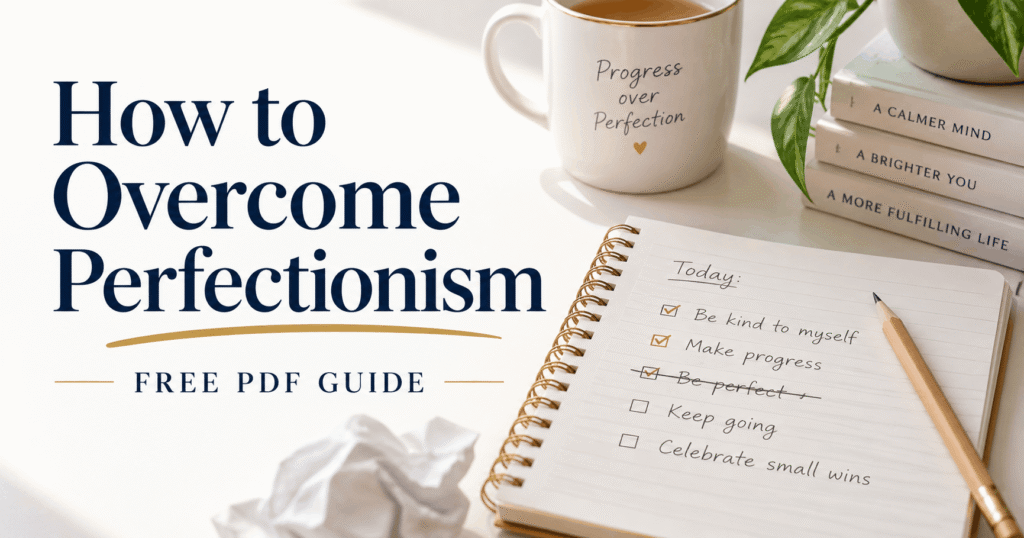
You sit down to start something important. Perhaps it’s a work project, a personal goal, or even a simple task you’ve been putting off for days.
You know what needs to be done. You have the time, the ability, and every intention of doing it well.
But something stops you.
You want to get it exactly right. You worry about making mistakes, wonder whether you’re good enough, and keep imagining how things could go wrong.
So you hesitate. You prepare a little more. You change your plans. Or perhaps you finally finish the task, only to spend the next hour noticing everything you could have done better.
That’s the frustrating side of perfectionism. What looks like high standards on the outside can feel like constant pressure on the inside.
If you’re wondering how to overcome perfectionism, the answer isn’t to stop caring about quality or lower every standard you have. It’s to develop a healthier relationship with expectations, mistakes, and progress.
In this article, we’ll explore seven practical ways to loosen perfectionism’s grip, along with a free PDF guide you can use to continue working on these habits.
When High Standards Become a Problem
There’s nothing wrong with wanting to do something well.
High standards can encourage you to learn new skills, take pride in your work, and make thoughtful decisions. They’re often responsible for achievements you genuinely value.
Perfectionism becomes a problem when doing something well no longer feels sufficient.
You might complete a project successfully but focus entirely on one minor mistake. You might avoid trying something new because you can’t guarantee you’ll be good at it. Or you might spend hours improving something that was already perfectly acceptable.
The difference is often found in what drives your behaviour.
Healthy ambition encourages you to improve because improvement matters to you.
Unhelpful perfectionism pushes you to improve because anything less than perfect feels unacceptable.
Over time, that pressure can affect your confidence, productivity, and willingness to take opportunities.
Recognising the difference is an important first step.
1. Recognise the Impossible Standards You’re Setting
Perfectionism often operates so quietly that you don’t realise how demanding your expectations have become.
You might tell yourself that you should never make mistakes at work, always know what to say, keep everyone happy, or complete every task to an exceptional standard.
Individually, these expectations may sound reasonable.
Together, they create a life where you’re constantly falling short.
Start paying attention to situations where you feel unusually pressured.
Perhaps you’re rewriting a simple email for the fifth time. Maybe you’re reluctant to invite friends over because your home isn’t spotless. Or perhaps you refuse to begin exercising because you can’t commit to an ideal routine.
Ask yourself a straightforward question:
Would I expect this same standard from someone I care about?
If a friend made a small mistake, would you consider them incompetent? If a colleague completed a good project with a few imperfections, would you dismiss everything they’d achieved?
Probably not.
Yet perfectionism can convince you that different rules should apply to yourself.
Try identifying one expectation that feels unnecessarily demanding. Then replace it with a standard that’s challenging but achievable.
You’re not abandoning excellence. You’re making room for reality.

2. Learn to Separate Your Worth From Your Performance
One of perfectionism’s most exhausting habits is turning ordinary outcomes into judgments about who you are.
A disappointing presentation becomes proof that you’re terrible at speaking.
An unfinished task becomes evidence that you lack discipline.
A mistake becomes something you replay long after everyone else has moved on.
But your performance in one situation isn’t a complete measure of your ability, character, or value.
Imagine learning to play a musical instrument.
You wouldn’t expect to perform beautifully after your first few lessons. You’d expect mistakes, awkward moments, and gradual improvement.
Yet many people approach other parts of their lives as though they should already be experts.
The next time something doesn’t go according to plan, try describing what happened without attaching a personal judgment.
Instead of saying, “I’m useless at this,” you might say, “That approach didn’t work as well as I’d hoped.”
The second statement leaves room to learn.
The first simply makes you feel worse.
The distinction may seem small, but practising it helps separate a temporary result from your overall sense of self-worth.
3. Stop Waiting Until You Feel Completely Ready
Perfectionism has a clever way of disguising itself as preparation.
You tell yourself that you’ll apply for the job once you’ve improved your skills. You’ll start writing when you’ve developed a better idea. You’ll launch the project when you’ve researched every possibility.
Preparation is useful, of course.
But at some point, preparing can become a way of avoiding the uncertainty of actually beginning.
The problem is that complete readiness rarely arrives.
There’s almost always another book to read, another skill to develop, or another detail to improve.
Try replacing the question, “Am I completely ready?” with something more practical:
“Am I ready enough to take the next reasonable step?”
Perhaps you’re not ready to deliver a polished presentation, but you can write the opening.
Maybe you’re not prepared to launch an entire business, but you can speak to one potential customer.
You don’t need to know how every stage will unfold before beginning the first one.
Confidence often develops through experience, not endless preparation.
4. Give Yourself Permission to Produce a First Draft
Think about how much easier certain tasks would become if your first attempt didn’t have to be impressive.
You could write without constantly editing yourself.
You could brainstorm ideas without immediately judging them.
You could experiment with something unfamiliar without worrying about looking inexperienced.
This is the value of separating creation from improvement.
When you’re starting a task, concentrate on producing something you can work with.
If you’re writing, get the main ideas onto the page.
If you’re organising something, create a basic structure.
If you’re learning a skill, practise the fundamentals without expecting professional results.
You can improve the outcome later.
For example, imagine you’re preparing an important email. Instead of spending twenty minutes trying to write the perfect opening sentence, write a straightforward first version.
Then review it once for clarity, accuracy, and tone.
In many everyday situations, that’s enough.
The aim isn’t to accept careless work. It’s to stop demanding a polished result before you’ve allowed yourself to create anything at all.
5. Decide What “Good Enough” Looks Like Before You Begin
Perfectionism becomes especially difficult when there’s no clear finishing point.
You keep checking, adjusting, reviewing, and improving because you haven’t decided when the task will be complete.
Even after doing a good job, you wonder whether another hour might make it better.
One useful strategy is to establish a reasonable standard before starting.
Imagine you’re creating a short report for work.
You might decide that a successful report needs accurate information, a clear explanation, and a final review for obvious errors.
Once those conditions are met, the report is finished.
It doesn’t need to be the best report anyone has ever written.
This approach works particularly well for everyday tasks where the effort required to achieve perfection is far greater than the actual benefit.
Of course, different situations require different standards.
A safety-critical decision deserves considerably more checking than choosing the wording of a casual message.
The skill is learning where additional effort genuinely matters and where it simply feeds your fear of getting something wrong.
6. Practise Making Small, Harmless Imperfections
If you’ve spent years trying to avoid mistakes, the idea of deliberately allowing an imperfection might feel uncomfortable.
That’s understandable.
But you can begin with situations where the consequences are minimal.
Perhaps you send a friendly message without rewriting it several times. Maybe you leave a minor household task until tomorrow instead of insisting everything must be finished tonight.
Or you try a new hobby knowing you’ll probably be terrible at it initially.
Pay attention to what happens.
You may notice an urge to correct the situation, explain yourself, or seek reassurance.
Rather than immediately acting on that discomfort, give yourself a little space to experience it.
You might discover that the outcome is much less serious than you imagined.
This doesn’t mean deliberately making important mistakes or neglecting responsibilities.
It means learning that ordinary imperfections don’t always require immediate correction.
If an exercise causes significant distress, choose something gentler or seek guidance from a qualified professional.
The aim is to build flexibility, not create another challenge you feel obliged to perform perfectly.
7. Measure Progress by What You Do, Not Just How Well You Do It
Perfectionism tends to keep moving the finish line.
You complete a difficult project, but instead of acknowledging your effort, you immediately notice what could have been better.
You achieve a goal, then raise your expectations before you’ve allowed yourself to appreciate it.
Eventually, even meaningful progress can feel disappointing.
Try measuring your efforts differently.
At the end of the day, ask yourself what you actually moved forward.
Did you begin something you’d been avoiding? Did you finish an important task without excessive checking? Did you try something unfamiliar despite feeling uncertain?
Those actions matter.
Consider someone who wants to become more confident speaking in meetings.
A perfectionist might judge success by whether they spoke flawlessly, sounded intelligent, and received positive reactions from everyone.
A healthier measure might be whether they contributed one useful idea.
That goal encourages participation rather than avoidance.
Over time, repeated participation provides opportunities to improve.
You don’t need to feel completely confident before acting. Sometimes, acting while feeling uncertain is the progress worth recognising.
A Simple Exercise to Start Letting Go of Perfectionism
Before moving on, think of one ordinary situation where your expectations regularly make life harder.
It might be answering emails, completing household tasks, making decisions, or working towards a personal goal.
Take a few minutes to answer three questions.
What am I demanding of myself?
Be specific. Perhaps you’re expecting to complete every task without mistakes or produce excellent work every single time.
What would a reasonable standard look like instead?
Choose something that still respects the importance of the task but allows room for ordinary human limitations.
What is one action I can take this week?
It might be finishing a task after one careful review, beginning a project before you feel fully prepared, or allowing yourself to learn something without expecting immediate success.
Keep the action small.
You’re not trying to eliminate perfectionism in one afternoon.
You’re beginning to practise a different response whenever those familiar expectations appear.
Free PDF Guide: The Perfectionism Trap
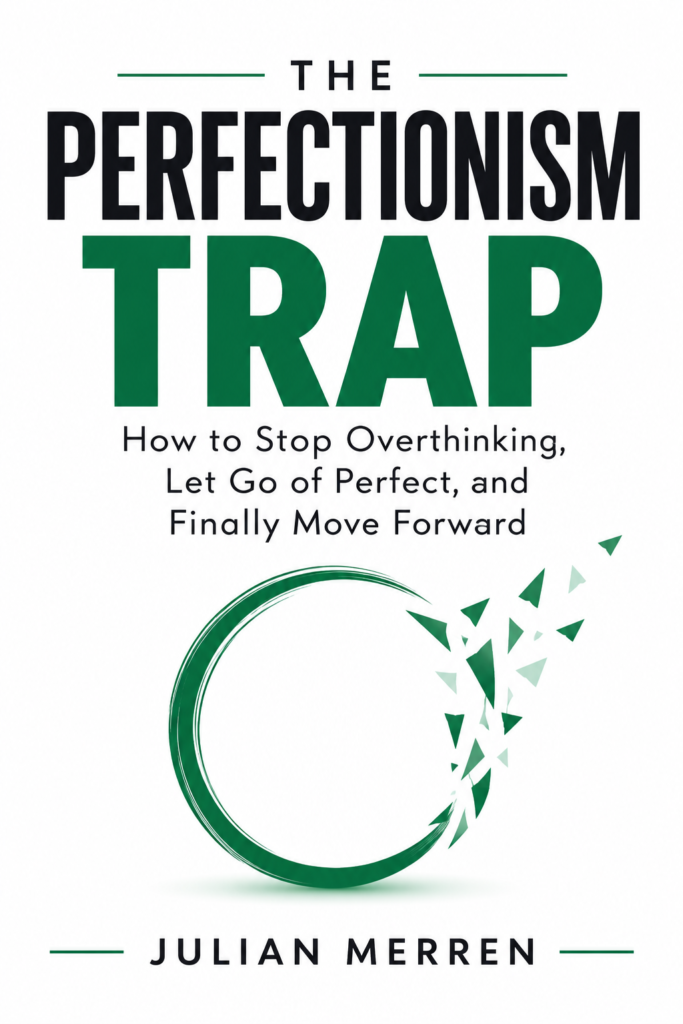
If you’re looking for a free PDF guide on how to overcome perfectionism, there’s a practical resource waiting for you in the Books That Shape Free Library.
The Perfectionism Trap: Breaking Free from Perfectionism, by Julian Merren, is a free 46-page ebook created for readers who are tired of impossible standards, constant overthinking, and feeling that nothing they do is ever quite good enough.
The guide explores practical ways to recognise perfectionistic patterns, challenge harsh self-criticism, and start moving forward without needing everything to be perfect.
It also includes a simple seven-day action plan to help you begin putting the ideas into practice.
Rather than asking you to give up your ambitions, the book encourages a more balanced approach to personal growth—one where mistakes are part of learning and progress matters more than flawless performance.
Get The Perfectionism Trap — Free PDF Ebook
You’ll find the guide in the Books That Shape Free Library alongside other free ebooks covering confidence, habits, relationships, money, and personal development.
Register once and confirm your email address to access the collection. There’s no need to register separately for each book.
When Perfectionism Becomes More Than a Habit
For some people, perfectionism is an occasional frustration. For others, it can become a persistent source of anxiety, avoidance, or emotional distress.
If your standards are regularly affecting your relationships, work, wellbeing, or ability to function, professional support may be helpful.
Approaches such as cognitive behavioural therapy can help people examine rigid beliefs, unhelpful thinking patterns, and behaviours that maintain perfectionism.
A self-help book can offer useful ideas and a starting point for reflection, but it isn’t a replacement for individual mental-health care when that is needed.
You Don’t Have to Be Perfect to Make Progress
Learning how to overcome perfectionism doesn’t mean accepting poor standards or giving up on becoming better at what you do.
It means recognising that effort, learning, and improvement don’t require constant self-criticism.
You can care deeply about your work without checking it endlessly. You can pursue ambitious goals without expecting every step to go smoothly. And you can make mistakes without allowing them to define you.
Perhaps the most useful change is learning to finish something, acknowledge the effort you’ve made, and move forward.
Not because the result was perfect.
But because it was good enough to matter.
And sometimes, that’s exactly what progress looks like.