

There is a particular kind of loneliness that can be difficult to explain.
You can share a home with someone.
Share meals, bills, responsibilities and years of memories.
You may still love each other.
And yet, somewhere among all the routines of everyday life, you can begin to wonder:
When did I stop feeling like me?
Perhaps you’re needed constantly but rarely noticed.
Perhaps conversations revolve around what needs doing rather than how you’re actually feeling.
Or perhaps you’ve become so accustomed to putting everybody else first that you’re no longer entirely sure what you would choose for yourself.
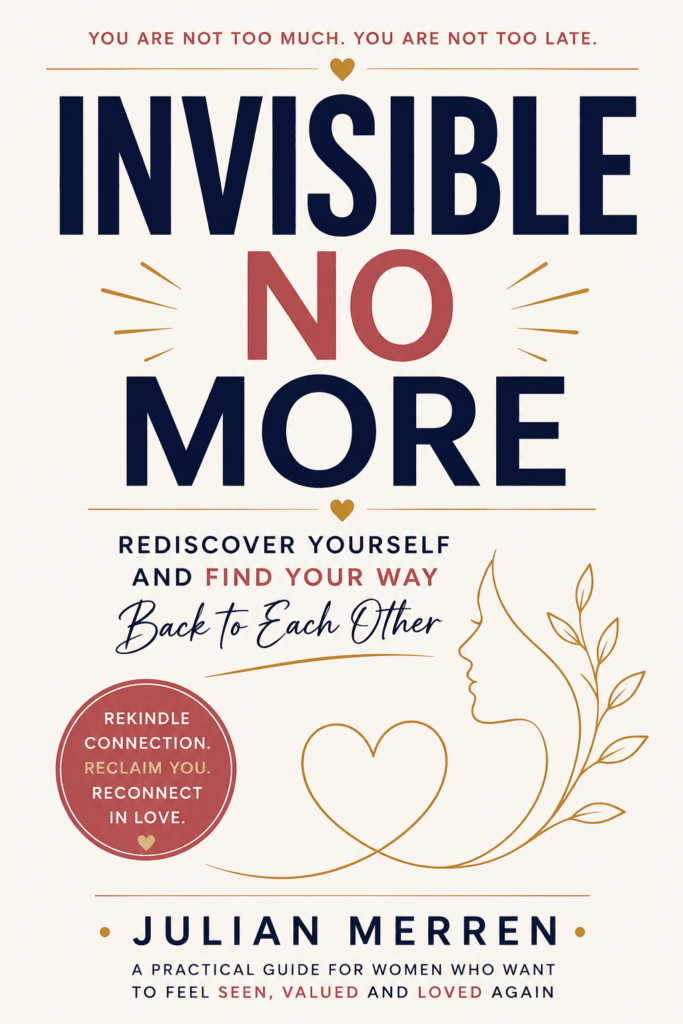
Invisible No More: Rediscover Yourself and Find Your Way Back to Each Other by Julian Merren is a book for women who feel unseen within a long-term relationship and want to understand what has happened to their sense of self — without automatically assuming the relationship itself has to end.
It begins from a compassionate premise.
Before trying to find your way back to each other, sometimes you need to find your way back to yourself.
What Does It Mean to Feel Invisible in a Relationship?
Feeling invisible isn’t necessarily the same as being unloved.
That’s partly what makes the experience so confusing.
Your partner may care about you.
You may have built a good life together.
There may be no dramatic crisis that explains why something doesn’t feel right.
Instead, the change can happen gradually.
You become the person who remembers appointments.
The one who keeps things running.
The parent.
The organiser.
The dependable one.
The person everyone turns to.
Those roles can be meaningful. But they can also become so dominant that the woman underneath them receives less and less attention — sometimes from her partner, and sometimes from herself.
Eventually, you may realise that you can answer almost any question about what your family needs while struggling with a much simpler one:
What do I need?
Invisible No More Is Not About Blaming Your Partner
One thing that distinguishes the book’s approach is that feeling unseen isn’t automatically presented as evidence that your partner is a bad person.
Relationships can drift.
Life becomes busy.
Children require attention.
Work becomes demanding.
Habits settle in.
Two people who once talked for hours can gradually find themselves discussing little more than groceries, schedules and whose turn it is to do something.
The emotional connection hasn’t necessarily disappeared.
But it may no longer receive much attention.
That distinction matters because blame often closes conversations rather than opening them.
Instead of beginning with:
You don’t care about me anymore.
A more useful question may sometimes be:
How did we get here, and what do I actually miss?
A Book for Women Who Feel Unseen — But Also Want to Understand Why
The title Invisible No More points towards being seen by your partner again, but there is another layer to it.
You have to begin seeing yourself too.
That means looking beyond the roles you’ve accumulated and becoming curious about the person underneath them.
What interests have quietly disappeared?
When do you feel most like yourself?
What have you stopped doing because there never seems to be enough time?
Which opinions do you keep to yourself because disagreement feels easier to avoid?
What do you want more of in your life?
What do you want less of?
These aren’t selfish questions.
They’re questions about identity.
And answering them doesn’t mean abandoning the people you love.
It means recognising that you belong in your own life as well.
Rediscovering Yourself Doesn’t Mean Starting Over
Personal growth is sometimes presented as a dramatic reinvention.
Quit everything.
Start again.
Become somebody new.
But rediscovering yourself can be much quieter.
It might mean returning to something you once enjoyed.
Speaking more openly about what you need.
Spending time with people who bring out parts of you that have been neglected.
Setting a boundary where you previously remained silent.
Doing something simply because you enjoy it.
Or noticing that you’ve become so efficient at caring for everybody else that you’ve stopped extending the same consideration to yourself.
Small changes can matter because they begin answering an important question:
Who am I when I’m not simply responding to what everybody else needs from me?
Feeling Seen Often Begins With Being Heard
There is also a relationship component.
You cannot expect another person to understand everything happening inside you without communication.
But communication becomes difficult when frustration has been building quietly for years.
Instead of explaining what you need, it can come out as criticism.
Instead of saying:
I miss spending time with you.
You say:
You never make time for me.
Instead of:
I’d like you to ask me how I’m doing sometimes.
It becomes:
You don’t even notice me anymore.
The feeling underneath both statements may be completely understandable.
But the way it’s expressed can affect what happens next.
One useful starting point is becoming more specific.
Rather than saying, I want to feel loved, ask yourself what feeling loved actually looks like to you now.
Is it:
- being listened to without interruption?
- physical affection?
- appreciation?
- spending uninterrupted time together?
- being asked about your day?
- feeling desired?
- sharing laughter again?
- having your opinions taken seriously?
- feeling like partners rather than household managers?
The clearer you become about what is missing, the easier it becomes to talk about it.
The Small Moments of Connection Matter
Relationship researcher John Gottman’s work offers a useful complement to this idea.
The Gottman Institute describes small attempts to gain a partner’s attention, affection or support as “bids” for connection. Responding positively — what Gottman calls “turning toward” — is associated with building trust and emotional connection.
These moments can be remarkably ordinary.
Look at this.
How was your day?
A touch on the shoulder.
A joke.
A sigh that quietly invites someone to ask what’s wrong.
An observation made while you’re sitting together.
They don’t look like major relationship events.
But perhaps that’s the point.
Connection isn’t only created during romantic weekends and serious conversations.
Much of it happens in the tiny exchanges of ordinary life.
And when you’ve begun feeling invisible, those moments of genuine attention can carry enormous meaning.
Who Is Invisible No More For?
This book for women who feel unseen may be particularly relevant if you recognise thoughts such as:
- I love my family, but I’ve lost touch with myself.
- We’re good at running our life but not very good at being a couple anymore.
- I don’t want to leave — I want things to feel different.
- I miss feeling noticed and appreciated.
- I’ve spent so long putting everyone else first that I don’t know what I want anymore.
- I want to speak up without turning everything into an argument.
- I want to feel like a woman and a partner again, not just the person who keeps everything going.
The book explores rediscovering identity alongside rebuilding connection, with themes including confidence, boundaries, communication, friendship, appreciation and small everyday habits.
It isn’t about pretending every relationship can or should be repaired.
Nor is finding yourself dependent on somebody else changing first.
The focus is on understanding where you are, reconnecting with your own voice and considering what healthier connection could look like from there.
Being Unseen Is Different From Being Unsafe
There is an important distinction worth making.
Ordinary relationship drift, poor communication and feeling taken for granted are not the same as controlling or abusive behaviour.
If a partner is frightening, threatening, humiliating, deliberately isolating or controlling you, that requires a different kind of support. Emotional abuse can include non-physical behaviours intended to control, isolate or frighten someone.
A relationship book should never be used to explain away behaviour that makes you unsafe.
Professional or specialist support may be the more appropriate next step in those circumstances.
You Don’t Have to Disappear to Stay Connected
Perhaps the most important idea behind Invisible No More is contained within its subtitle:
Rediscover Yourself and Find Your Way Back to Each Other.
The order matters.
Because rebuilding a relationship shouldn’t require becoming smaller.
You shouldn’t need fewer opinions.
Fewer interests.
Fewer needs.
Less of a voice.
Finding your way back can instead mean bringing more of yourself into the relationship — while becoming curious about the person your partner has become too.
Maybe you don’t need to recreate who you were ten years ago.
Maybe the opportunity is to discover who you both are now.
Is Invisible No More Worth Exploring?
If you’ve been searching for a book for women who feel unseen, the first question isn’t whether a book can fix your relationship.
No book can promise that.
A better question is whether it can help you put language around something you’ve been struggling to understand.
Why do I feel invisible?
What have I lost touch with?
What do I need now?
What would feeling connected look like?
And what part of this can I begin changing myself?
Sometimes recognising the right questions is the beginning of moving forward.
If those questions sound familiar, you can discover Invisible No More by Julian Merren and decide whether it feels like the right next read for you.
You don’t necessarily need to become someone new.
Perhaps you simply need to start making room for the person who’s been there all along.