

The house is quiet. The day is finally over. You climb into bed hoping for some much-needed rest — and suddenly your brain decides it is the perfect time to think about everything.
An awkward conversation from three days ago. Tomorrow’s responsibilities. Something you forgot to do. A decision you still haven’t made.
When your mind refuses to slow down, reaching for a book can provide a gentler transition between the activity of the day and the stillness of bedtime.
The best books for calming your mind before bed aren’t necessarily books that promise to make you fall asleep. Instead, they can help you understand your thoughts, loosen your grip on worry, become more comfortable with uncertainty or simply direct your attention somewhere quieter.
Here are seven books worth keeping beside your bed.

Why reading can be a useful part of winding down
Reading creates something many of us are missing at the end of the day: a transition.
We can easily go from answering emails, watching television or scrolling through our phones straight into bed and then wonder why our minds haven’t received the message that the day is over.
A quiet reading ritual changes the pace.
The Sleep Foundation notes that reading can form part of a regular bedtime routine and may help take attention away from stressful circumstances. It also offers an alternative to spending those final minutes of the evening looking at a screen.
The important thing is not to turn reading into another sleep rule.
You don’t need to finish a chapter. You don’t need to read for precisely 30 minutes. And you certainly don’t need to start worrying that you haven’t read enough to fall asleep.
Think of it instead as permission to step away from the day.
The Best Books for Calming Your Mind Before Bed
1. The Sleep Book — Guy Meadows
If you’ve ever become anxious about the fact that you aren’t asleep yet, The Sleep Book is an especially relevant place to begin.
Guy Meadows takes an acceptance-based approach to sleep difficulties. Rather than treating sleep as something that must be forced or controlled, the book explores changing the way we respond to wakefulness, uncomfortable thoughts and the frustration surrounding sleep.
That distinction matters.
Trying desperately to make yourself sleep can turn bedtime into a performance. Reading about a different way of relating to sleeplessness may help remove some of that struggle.
Best for: Readers who find themselves worrying about sleep itself.
2. Don’t Believe Everything You Think — Joseph Nguyen
Nighttime thoughts can feel extraordinarily convincing.
During the day there are conversations, work, errands and distractions competing for your attention. At night, those distractions disappear — leaving your thoughts with a much bigger stage.
Don’t Believe Everything You Think explores the distinction between having a thought and becoming caught up in it.
That’s a useful idea to take into the evening.
You don’t necessarily need to answer every question your mind produces. You don’t need to finish every imaginary conversation. And a thought appearing in your mind doesn’t automatically make it something requiring action tonight.
Best for: Overthinkers who become absorbed in their own thoughts.

3. The Happiness Trap — Russ Harris
Russ Harris introduces readers to principles from Acceptance and Commitment Therapy (ACT), including ways of responding differently to difficult thoughts and feelings.
One particularly useful theme is psychological flexibility: rather than spending all our energy trying to eliminate uncomfortable internal experiences, we can learn to make room for them while directing attention towards what matters.
For the nighttime overthinker, that can be refreshing.
The objective doesn’t have to be achieving a perfectly empty mind before sleep. Thoughts can exist without becoming tonight’s project.
Best for: Readers who struggle with trying to control or suppress unwanted thoughts.
4. The Worry Trick — David A. Carbonell
Worry often disguises itself as preparation.
Your mind tells you that if you think about tomorrow for another twenty minutes, perhaps you’ll finally solve everything and be able to relax.
Usually another question simply appears.
David A. Carbonell’s The Worry Trick examines the patterns that can keep worry going and why our attempts to fight anxious thoughts can sometimes make them more persistent.
It’s particularly relevant for people whose bedtime thinking consists of endless what if? scenarios.
Best for: Readers who repeatedly anticipate what might go wrong.
5. Quiet Nights — Julian Merren
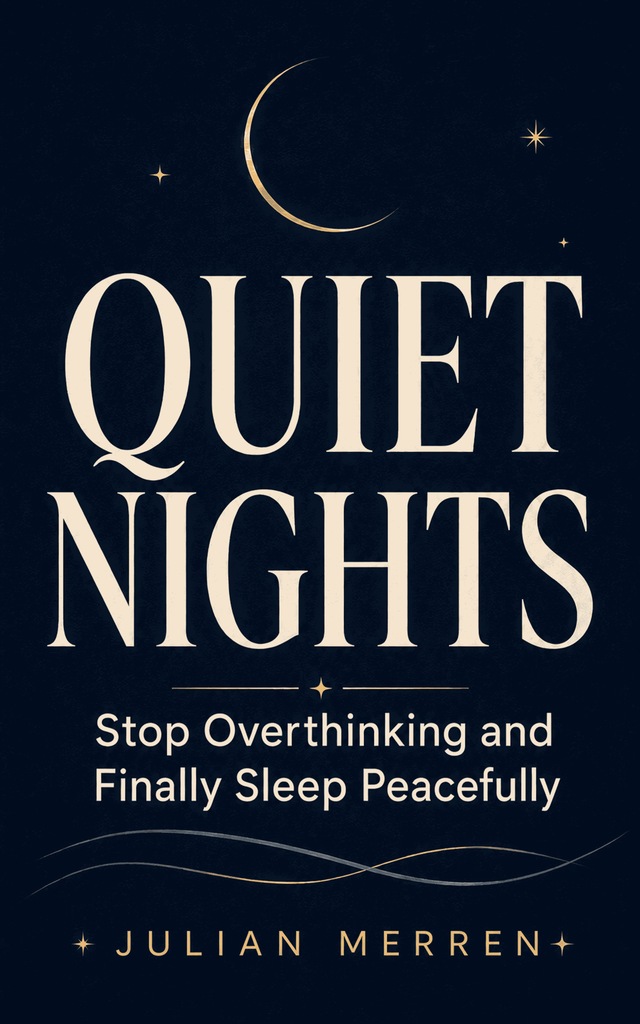
Quiet Nights: Stop Overthinking and Finally Sleep Peacefully by Julian Merren is particularly suited to readers whose overthinking intensifies once the lights go out.
Rather than treating bedtime as an isolated problem, Quiet Nights focuses on understanding nighttime overthinking and developing practical ways of responding to a busy mind.
It fits naturally among the best books for calming your mind before bed because its subject is specifically that difficult transition between wanting to rest and having a mind that isn’t ready to cooperate.
The aim isn’t to demand silence from your thoughts. It’s to develop a calmer relationship with them and create an evening approach that feels less like a battle.
If nighttime is when your overthinking tends to take over, you can learn more about Quiet Nights here.
Best for: Readers whose racing thoughts become particularly noticeable at bedtime.
6. The Little Book of Mindfulness — Patrizia Collard
Not everyone wants something substantial to read at night.
Sometimes a book that can be picked up for a few minutes is far better suited to the moment.
Patrizia Collard’s The Little Book of Mindfulness introduces accessible mindfulness exercises and ideas intended to bring attention back towards the present.
That makes it useful when your mind is mentally living in tomorrow rather than where you actually are.
You can read a small section rather than feeling committed to another long chapter.
Best for: Readers wanting short, gentle reflections before sleep.
7. The Things You Can See Only When You Slow Down — Haemin Sunim
Even the title captures something important about nighttime overthinking.
Our lives rarely provide natural stopping points anymore. There is always another notification, another piece of information and another task available.
Haemin Sunim’s book offers reflections on slowing down, relationships, rest and how we experience the world around us.
Its shorter passages also make it well suited to evening reading when you don’t necessarily want to tackle something intellectually demanding.
Best for: Readers wanting something reflective and reassuring rather than instructional.
How to choose your bedtime book
The right book depends on what is keeping your mind active.
If you’re worried because you aren’t sleeping, start with The Sleep Book.
If you’re caught inside your own thinking, try Don’t Believe Everything You Think.
If you’re constantly battling unwanted thoughts, The Happiness Trap may be useful.
If your evenings are filled with “what if?” questions, explore The Worry Trick.
If overthinking specifically becomes worse at bedtime, Quiet Nights is the most directly focused choice.
And if you simply want something gentle to accompany the final part of your evening, The Little Book of Mindfulness or The Things You Can See Only When You Slow Down may suit you better.
Make reading part of your evening — not another obligation
One of the easiest mistakes is turning a helpful bedtime habit into another thing we believe we must do correctly.
Keep it simple.
You might dim the lights, put your phone somewhere out of reach, make a caffeine-free drink and read a few pages.
When you begin feeling sleepy, stop.
You haven’t failed if you only read three pages. You haven’t failed if your thoughts occasionally wander. And you don’t need to finish an entire self-help book before you’re allowed to benefit from an idea you discovered on page twenty.
Consistency matters more than perfection.
If sleep difficulties are persistent or significantly affecting everyday life, books can complement professional support but shouldn’t replace individual advice from an appropriately qualified healthcare professional.
A quieter way to end the day
Your mind doesn’t need to become completely empty before you’re allowed to rest.
Sometimes what helps is simply giving it somewhere gentler to go.
The best books for calming your mind before bed can offer perspective, reassurance and practical ideas while creating a natural boundary between daytime activity and nighttime rest.
Choose the book that most closely matches what happens in your mind when everything becomes quiet. Read slowly. Take what helps and leave what doesn’t.
And if nighttime overthinking is the particular pattern you’re trying to understand, Quiet Nights by Julian Merren was created specifically around that experience.
Explore Quiet Nights and more resources for anxiety and overthinking