
You know exactly what you mean.
Then you start talking and the word you need simply isn’t there.
You replace it with “thing”. You describe something as “good” when you meant something much more specific. You begin a sentence confidently, pause halfway through and realise the word sitting perfectly in your thoughts has disappeared before reaching your mouth.
Then, five minutes later, it comes back.
If you’ve been looking for books to find the right words, the answer isn’t necessarily to memorise hundreds of impressive new ones.
A useful vocabulary isn’t about sounding clever.
It’s about having enough familiar, accessible words to express what you already think and feel.
These five books approach that challenge from different directions.
1. Word Power Made Easy — Norman Lewis
If you’d like to expand the number of words available to you, Word Power Made Easy is an obvious place to begin.
Norman Lewis’s long-established vocabulary guide takes a structured approach to building knowledge of English. Rather than presenting endless lists to memorise, it uses thematic sections, word origins, pronunciation, reviews and exercises designed to make unfamiliar words easier to understand and retain. Penguin Books
But there’s an important distinction worth making.
Knowing a word and being able to use it naturally in conversation aren’t quite the same thing.
A word becomes much more useful when you’ve encountered it repeatedly, understand its meaning and have used it yourself.
So don’t measure progress by how many words you recognise.
Notice how many are beginning to appear naturally when you speak.
Best for: readers who want to systematically broaden their working vocabulary.
2. The Well-Spoken Thesaurus — Tom Heehler
Sometimes you don’t need an entirely new idea.
You need a better way to express an ordinary one.
The Well-Spoken Thesaurus by Tom Heehler combines a style guide with an extensive thesaurus section designed to help readers find more effective alternatives for familiar words and phrases. Wikipedia
That’s useful because many of us rely heavily on a surprisingly small collection of everyday words.
Everything becomes:
“good”
“bad”
“interesting”
“nice”
“really”
“very”
There’s nothing wrong with simple language. In fact, simple language is often clearer.
The problem comes when the word isn’t precise enough to communicate what you actually mean.
Something wasn’t merely “good”.
Perhaps it was useful, thoughtful, effective, enjoyable or reassuring.
Each creates a slightly different meaning.
Best for: people who notice themselves repeatedly reaching for the same familiar words.
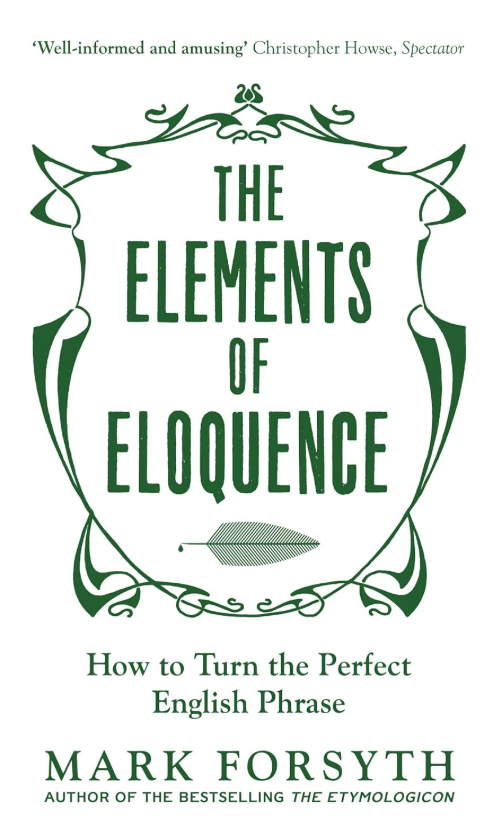
3. The Elements of Eloquence — Mark Forsyth
Finding better words isn’t only about vocabulary.
It’s also about understanding how words work together.
Mark Forsyth’s The Elements of Eloquence explores rhetorical techniques behind memorable phrases and demonstrates how arrangement and style can transform otherwise ordinary language. PenguinRandomhouse.com
You certainly don’t need to turn every conversation into a carefully crafted speech.
But the book highlights something useful:
The words themselves are only part of expression.
Order matters.
Rhythm matters.
Contrast matters.
Sometimes the phrase you’re searching for doesn’t require a more sophisticated word. It requires a better arrangement of the simple words you already know.
That can change how you think about becoming more articulate.
The goal isn’t to make your vocabulary impressive.
It’s to make your meaning clearer.
Best for: readers fascinated by why certain combinations of words sound natural, memorable and effective.
4. Think Faster, Talk Smarter — Matt Abrahams
There’s another version of the “right words” problem.
You know plenty of words.
You simply can’t access them when somebody puts you on the spot.
Matt Abrahams’ Think Faster, Talk Smarter focuses on spontaneous communication—those moments when you don’t have time to prepare exactly what you’re going to say. His supporting materials describe the book’s techniques as practical approaches for communicating when you’re on the spot. Matt Abrahams
That’s an important part of this topic because vocabulary isn’t always the problem.
Pressure can be.
You may explain something beautifully when you’re relaxed, yet struggle when somebody suddenly asks for your opinion in a meeting.
One helpful habit is to stop treating every pause as something that needs filling.
Give yourself a moment.
Think.
Then answer.
The right word has a better chance of appearing when you’re not desperately racing to avoid two seconds of silence.
Best for: people who find the words easily afterwards but struggle to find them in the moment.
5. Articulate — Julian Merren
And that brings us to the broader problem.
Sometimes you have the thought.
You have the vocabulary.
You even know roughly what you want to say.
But somehow the pieces don’t come together quickly enough when you’re actually speaking.
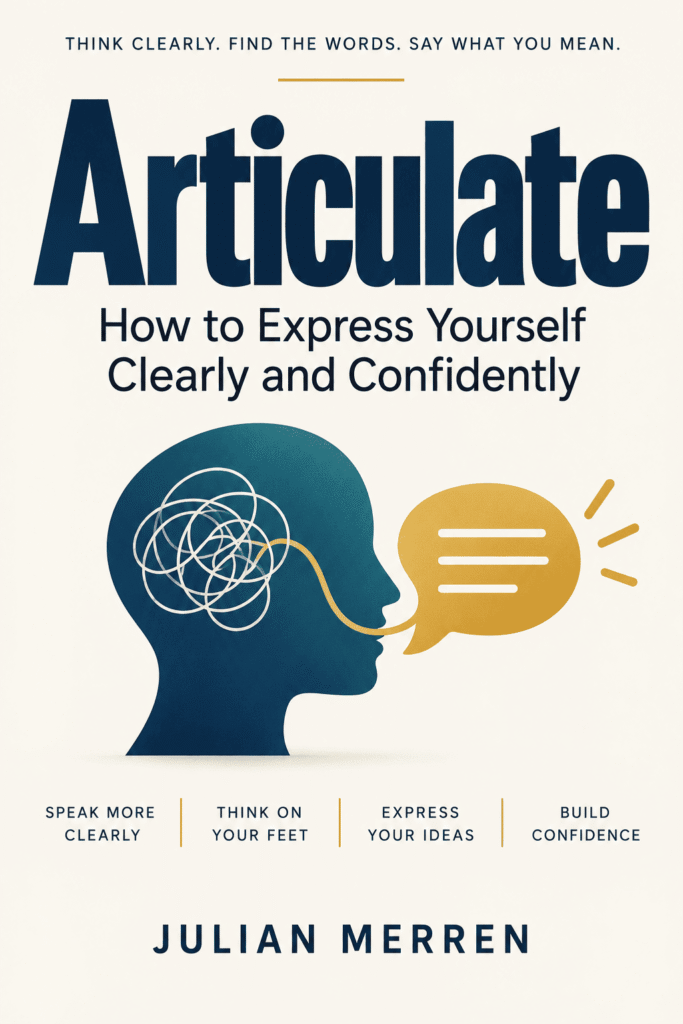
Articulate: How to Express Yourself Clearly and Confidently by Julian Merren is designed around these everyday moments.
Finding the right words is part of a larger communication skill.
It means learning to organise the thought before speaking, make your point without rambling, explain things clearly, think on your feet and become more comfortable when the perfect sentence doesn’t immediately appear.
One of the simplest things you can practise is replacing the question:
“What’s the perfect word?”
with:
“What’s the clearest way I can say this?”
They’re not always the same thing.
If you’d like practical help turning your thoughts into clearer words and expressing yourself more confidently, you can explore Articulate here:
Discover Articulate by Julian Merren
Why Books to Find the Right Words Aren’t Really About Sounding Smarter
This distinction matters.
A larger vocabulary can certainly give you more choices.
But more complicated language doesn’t automatically create better communication.
In fact, Toastmasters recommends choosing words that are precise and clear, while also warning that jargon and unfamiliar terminology can create barriers for the listener. Toastmasters International
Think of vocabulary as a toolbox.
You don’t need the biggest toolbox in the room.
You need the right tool when you need it.
That means developing words you can actually use.
How to Build a Vocabulary You Can Speak
Reading helps, but there’s a difference between a recognition vocabulary and a working vocabulary.
When you encounter a useful new word, don’t simply look up its definition and move on.
Try this:
- Understand what the word means in context.
- Think of a simpler word you might normally use instead.
- Create your own sentence using the new word.
- Say that sentence aloud.
- Look for a natural opportunity to use the word again during the week.
Toastmasters similarly encourages learning a word, understanding it and actually using it as a way of expanding language skills. Toastmasters International
That’s how a word begins moving from something you recognise to something you can retrieve when you need it.
Stop Searching for Impressive Words
There’s one final trap.
You can become so concerned about sounding articulate that you make speaking harder.
You reject the ordinary word because it seems too simple.
Then you search for something better.
Meanwhile, the conversation has moved on.
Clear speakers don’t necessarily use unusual words.
They use appropriate ones.
Sometimes the right word really is the simple one.
If “help” communicates exactly what you mean, you don’t need to replace it with something grander.
The purpose of vocabulary is expression, not performance.
The Right Word Is the One That Makes Your Meaning Clear
The frustration of knowing what you mean but being unable to say it can make you believe you need an enormous vocabulary.
Usually, the goal is more practical.
You want more useful words available to you.
You want to retrieve them more easily.
And you want to feel comfortable using simple language when simple language does the job.
The best books to find the right words can help you expand your vocabulary, understand how language works and become more deliberate about the words you choose.
But don’t just collect words.
Use them.
Speak them.
Make them familiar.
Because ultimately, the right word isn’t the one that sounds the most impressive.
It’s the one that helps another person understand what you mean.