
There’s a particular kind of frustration that comes from having a career that looks perfectly reasonable on paper but no longer feels right.
Maybe you’ve been doing the same work for years. Perhaps you’re good at it, the pay is decent, and walking away would mean giving up a lot of security. Yet somewhere in the background is a thought you can’t quite silence:
Do I really want to keep doing this for another ten or twenty years?
Feeling stuck doesn’t necessarily mean you need to resign, retrain or start again. Sometimes what you need first is enough distance from your everyday routine to understand what’s actually bothering you.
That’s where the right book can help.
The best books to read when you feel stuck in your career don’t simply tell you to “follow your passion”. They can help you ask better questions, recognise possibilities you may have overlooked and work out what a realistic next step might look like.
Here are five worth considering.
1. Designing Your Life — Bill Burnett and Dave Evans
One of the hardest parts of feeling stuck is believing you need to discover the one correct answer before you can do anything.
Designing Your Life takes a very different approach.
Bill Burnett and Dave Evans apply ideas from design thinking to life and career decisions. Rather than expecting yourself to know exactly what your future should look like, their approach encourages experimentation, curiosity and the exploration of different possible futures.
That can be particularly useful when your problem isn’t that you have no options — it’s that you don’t know which option is right.
Instead of asking:
What should I do with the rest of my life?
You can begin asking smaller questions.
What might I enjoy exploring?
What could I test?
What would another version of my working life look like?
Those questions are much easier to work with because they don’t require you to solve the next twenty years before taking your first step.
Best for:
Anyone who feels paralysed because they’re trying to find the perfect career decision before making a move.

2. The Squiggly Career — Helen Tupper and Sarah Ellis
The traditional idea of a career is remarkably tidy: choose a profession, climb the ladder, become more senior and eventually retire.
Real careers are often nothing like that.
In The Squiggly Career, Helen Tupper and Sarah Ellis explore a more flexible way of thinking about working life — one that can involve movement between roles, industries and opportunities rather than a single predictable climb upwards.
That perspective can be particularly helpful if you feel as though changing direction means your previous years of work have somehow been wasted.
They haven’t.
Experience accumulates. Skills travel. Relationships travel. Knowledge travels.
Something you learnt ten years ago may turn out to be surprisingly valuable in a completely different role tomorrow.
Your next chapter doesn’t have to resemble your last one for the last one to have mattered.
Best for:
Readers who have outgrown the idea that a successful career must follow one straight path.
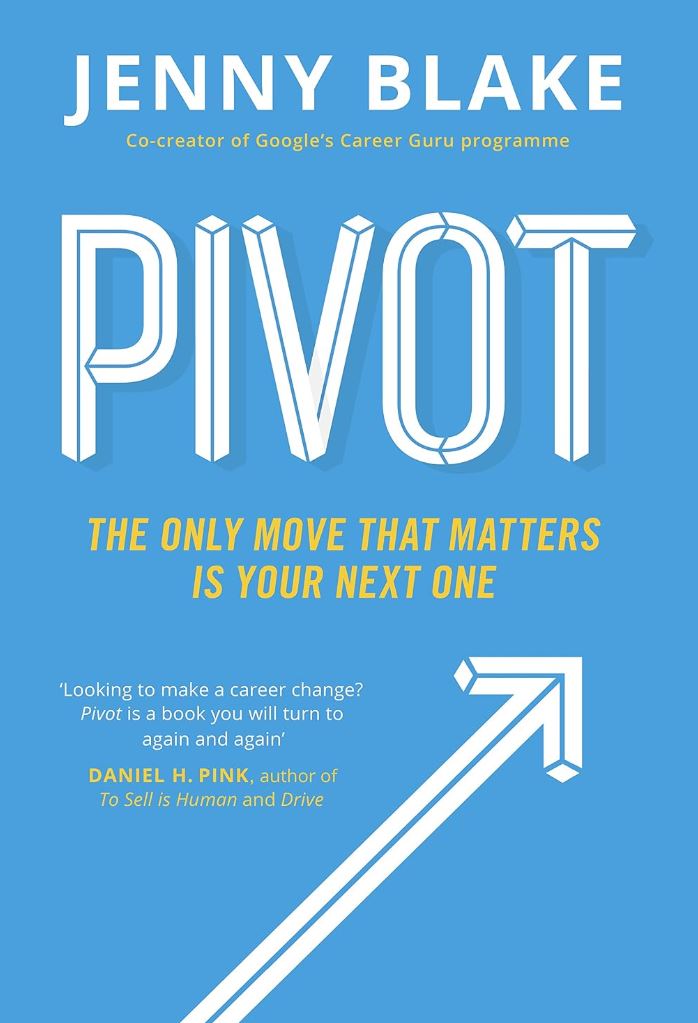
3. Pivot — Jenny Blake
Sometimes you don’t want a completely different life.
You just know that the one you have needs to move.
That makes Jenny Blake’s Pivot particularly relevant. The book focuses on making career changes by building from the strengths, experience, interests and connections you already have rather than assuming change requires abandoning everything.
This is an important distinction.
When people feel trapped at work, it’s easy to think in extremes:
Stay exactly where I am, or leave everything behind.
But there is a large amount of territory between those two choices.
You might change teams.
Change roles.
Move to another employer.
Develop a new skill.
Start a side project.
Reduce your hours.
Explore an adjacent industry.
Sometimes a relatively small shift can change your working life considerably.
Best for:
Someone who wants meaningful change but would rather build on what they already have than begin from zero.
4. Working Identity — Herminia Ibarra
If you’ve spent twenty years saying, “I’m an accountant”, “I’m an engineer”, “I work in IT” or “I’m a teacher”, changing careers can feel like more than changing jobs.
It can feel like changing who you are.
That’s part of what makes Herminia Ibarra’s Working Identity interesting.
The book explores professional reinvention and the process of moving from one working identity towards another. One of its useful ideas is that career clarity doesn’t always arrive before action.
Sometimes clarity develops because you start experimenting.
Take a course.
Help with a project.
Talk to somebody doing the work you’re considering.
Volunteer.
Freelance.
Shadow someone.
Test an idea on a small scale.
Each experiment gives you information that sitting at home wondering what you should do may never provide.
You don’t have to become the new version of yourself overnight.
You can meet that person gradually.
Best for:
Mid-career readers who know their old professional identity no longer fits but aren’t yet sure what should replace it.
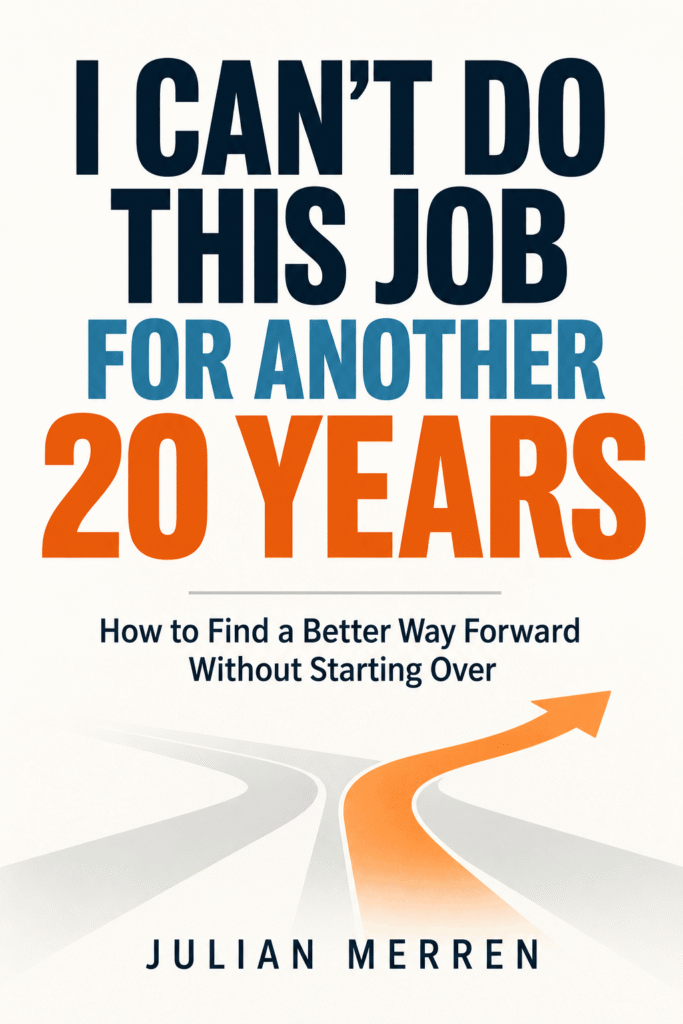
5. I Can’t Do This Job for Another 20 Years — Julian Merren
Sometimes the most useful starting point isn’t asking:
What career should I change to?
It’s asking:
What exactly am I trying to change?
That question sits at the heart of I Can’t Do This Job for Another 20 Years by Julian Merren.
The book is for people who have already built a career and accumulated years of experience but have reached the point where continuing on the same path no longer feels right.
Rather than encouraging you to quit and start again, it helps you separate the different things that might be causing the problem.
Is it the work itself?
The employer?
Your role?
The hours?
The environment?
The pressure?
Or have your priorities simply changed?
That distinction matters because a problem that can be solved by changing roles doesn’t require you to abandon an entire career.
The book also explores the skills and experience you can take with you, the realities of money and security, testing alternatives before making a major leap, and deciding how much change you actually need.
Its underlying idea is simple:
Make the next move, not the forever move.
If that sounds like where you are right now, you can discover I Can’t Do This Job for Another 20 Years →
Best for:
Anyone who feels stuck but doesn’t want to throw away years of experience, financial security or everything they’ve already built.
What to Do When You Feel Stuck in Your Career
Reading five books won’t make the decision for you — and that’s probably a good thing.
What they can do is help you stop seeing your situation as a choice between staying miserable and starting your life again.
There are usually more possibilities than that.
As you read, pay attention to the ideas that keep pulling at you.
You might discover that you don’t actually want a different career. You want more autonomy.
Or less stress.
Or more meaningful work.
Or a different environment.
Or simply something new to learn.
Before deciding what to change, try writing down three things:
- What do I want less of in my working life?
- What do I want more of?
- What am I not willing to lose to get there?
Those answers begin to put boundaries around the problem.
And boundaries make a vague feeling of being stuck much easier to work with.
Which Book Should You Start With?
If you’re looking for books to read when you feel stuck in your career, choose the one that most closely matches the question currently going around in your head.
If you can imagine several possible futures but don’t know which to pursue, Designing Your Life is a useful starting point.
If the traditional career ladder no longer makes sense, try The Squiggly Career.
If you want to build from what you already have, Pivot fits that situation particularly well.
If you’re wrestling with professional identity and reinvention, Working Identity takes a deeper look at that transition.
And if your thought is simply:
“I can’t keep doing this for another twenty years, but I don’t want to throw away everything I’ve built either.”
Then I Can’t Do This Job for Another 20 Years was written around exactly that dilemma.
You don’t need to know what the rest of your working life looks like today.
Sometimes you just need enough clarity to make the next good move.