

You’ve spent years building your career. You have experience, responsibilities and perhaps a salary that provides a reasonably comfortable life.
From the outside, things might look perfectly fine.
But somewhere along the way, the work that once interested you has started to feel strangely empty.
You turn up, complete your responsibilities, deal with the usual problems and head home. Then you do it all again.
There’s nothing necessarily wrong with your job. You might even be quite good at it.
But you can’t shake the feeling that something is missing.
If you’ve started wondering whether there’s such a thing as meaningful work for someone in your position, you’re certainly not alone in asking the question.
And finding an answer doesn’t always mean quitting your job, changing industries or discovering some extraordinary hidden passion.
Sometimes it begins by reconsidering what matters to you, how you want to spend your working years and whether your current career still reflects those priorities.
These five books offer different perspectives on finding purpose, questioning conventional success and creating a more satisfying working life.
Why Meaningful Work Doesn’t Have to Mean Your Dream Job
We’re often encouraged to believe that the ideal career is one we’re passionate about.
Find something you love, we’re told, and everything else will fall into place.
But real working lives are rarely that straightforward.
You might enjoy helping people but have no desire to work in healthcare. You might value creativity but prefer to keep your artistic interests separate from your income.
Or perhaps you simply want a reliable job that gives you enough freedom to enjoy the rest of your life.
There’s nothing wrong with that.
Work can provide meaning through contribution, relationships, learning, independence or financial security.
You can research into what makes work meaningful.
It doesn’t have to become the centre of your identity.
The challenge is understanding which of those things matters most to you now.
And that’s where these books can help.

1. The Good Enough Job — Simone Stolzoff
Your Career Doesn’t Have to Provide All Your Purpose
One of the most useful ideas in The Good Enough Job is that work doesn’t have to fulfil every emotional and personal need in your life.
Simone Stolzoff examines the way modern working culture can encourage people to build their identities around their careers.
We often introduce ourselves through our job titles, measure progress through promotions and feel uncomfortable when our work doesn’t seem particularly inspiring.
But what happens when we expect too much from our jobs?
We may overlook the satisfaction available through relationships, hobbies, family, community and experiences outside the workplace.
This doesn’t mean accepting work that makes you miserable.
It means recognising that a worthwhile life doesn’t necessarily require a deeply fulfilling career.
For someone who’s spent years searching for the perfect professional role, that can be a refreshing perspective.
Perhaps your job doesn’t need to be your greatest passion.
Perhaps it needs to provide reasonable security, manageable demands and enough space for the things that genuinely matter to you.
Why it’s worth reading: It challenges the assumption that professional success and personal fulfilment must come from the same place.
Best for: Readers who feel pressured to find their life’s purpose through their career.
2. So Good They Can’t Ignore You — Cal Newport

Purpose Can Develop Through Skill and Experience
If you’ve ever been told to follow your passion, So Good They Can’t Ignore You offers a different perspective.
Cal Newport questions the idea that identifying a pre-existing passion is necessarily the best way to build a satisfying career.
Instead, he explores the importance of developing valuable skills and using that expertise to gain greater control over your working life.
This is particularly relevant if you’ve already spent fifteen or twenty years in a profession.
You may have developed abilities that could help you negotiate more interesting responsibilities, explore specialised roles or work in a different environment.
Rather than assuming you must discover an entirely new calling, you might investigate how your existing expertise could support a more satisfying direction.
Of course, not every workplace will provide those opportunities.
And some careers require significant changes before they become sustainable.
But Newport’s ideas encourage readers to look at the value of what they’ve already built.
Why it’s worth reading: It offers an alternative to the pressure of discovering one perfect passion before making career decisions.
Best for: Experienced professionals who want greater satisfaction and autonomy without necessarily abandoning their existing skills.
3. Designing Your Life — Bill Burnett and Dave Evans
Explore Different Versions of a Fulfilling Career
Sometimes the hardest part of feeling unfulfilled at work is not knowing what would make things better.
You might recognise that your current role no longer suits you, but struggle to describe what you’d rather do.
Designing Your Life by Bill Burnett and Dave Evans approaches this uncertainty through design thinking.
Rather than expecting readers to discover one perfect career, the book encourages them to explore possibilities, develop ideas and learn through experimentation.
This can be useful when you’re questioning the direction of your working life.
Perhaps you’re interested in mentoring, teaching, consulting or moving into a different industry.
Instead of making an immediate commitment, you could speak with people already doing that work or explore small opportunities to experience it.
You might discover an interest worth developing.
Or you might realise that the reality isn’t as appealing as you imagined.
Either outcome helps you make a more informed decision.
Why it’s worth reading: It turns uncertainty into a practical process of exploring possibilities rather than waiting for a sudden moment of clarity.
Best for: People who want more satisfying work but aren’t sure what that might look like.
4. Drive — Daniel H. Pink
Understand What Makes Work Feel Worthwhile
Why can two people performing similar jobs have completely different experiences of their work?
One might feel engaged and motivated, while the other feels disconnected and frustrated.
In Drive, Daniel H. Pink explores motivation, with particular attention to autonomy, mastery and purpose.
These ideas offer a useful framework for examining your own working life.
Autonomy concerns having some control over how you work.
Mastery involves developing your abilities and improving at something that matters.
Purpose connects your efforts to a broader reason for doing the work.
Think about your current job.
Do you have enough freedom to make decisions?
Are you still learning and developing?
Can you see how your work contributes to something useful?
If the answer to all three questions is no, it may help explain why your career feels less satisfying than it once did.
Importantly, recognising what’s missing can help you identify the type of change that might make a difference.
You may need different responsibilities, greater independence or opportunities to develop new skills.
You don’t necessarily need an entirely different profession.
Why it’s worth reading: It provides a helpful way to think about what contributes to motivation and satisfaction at work.
Best for: Readers who want to understand why a once-satisfying career has begun to feel unfulfilling.
5. I Can’t Do This Job for Another 20 Years — Julian Merren
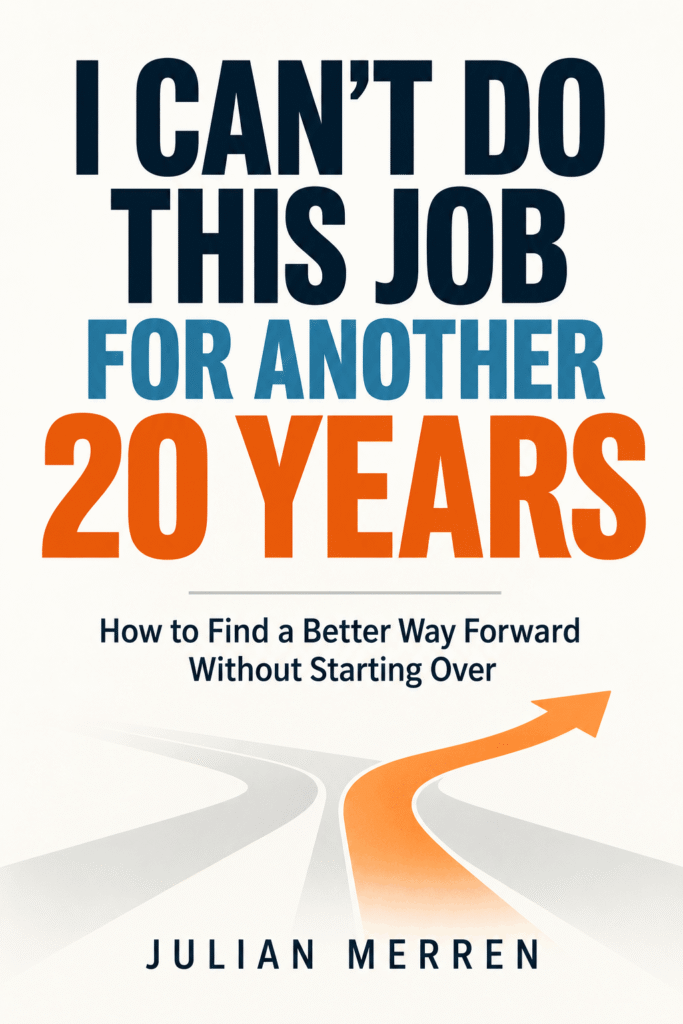
Find a Better Way Forward Without Throwing Everything Away
Sometimes the search for purpose begins with a simple realisation.
I don’t want to spend another twenty years doing exactly what I’m doing now.
But knowing you want something different doesn’t automatically mean you know what needs to change.
That’s the question explored in I Can’t Do This Job for Another 20 Years by Julian Merren.
Written for people who’ve spent years building a career, the book encourages readers to examine what’s no longer working before making a major decision.
Perhaps your job no longer reflects your priorities.
Maybe you’re tired of the pressure, the hours or the responsibilities.
Or perhaps you’ve reached a stage where professional advancement simply doesn’t interest you as much as it once did.
The book explores practical ways to understand those feelings, recognise transferable skills and consider realistic alternatives.
It also acknowledges an important reality: financial responsibilities don’t disappear just because you’re unhappy with your career.
For someone with a mortgage, family commitments or retirement plans, a gradual transition may be more sensible than an immediate resignation.
The aim isn’t necessarily to find the perfect job.
It’s to identify a better direction that fits the life you want to build.
Why it’s worth reading: It helps experienced workers think through career dissatisfaction and explore practical changes without assuming they must start again.
Best for: People who want a more satisfying second half of their working lives but need to make thoughtful, realistic decisions.
Explore the book: I Can’t Do This Job for Another 20 Years by Julian Merren.
How to Find More Meaningful Work in Your Current Career
Before deciding that your entire career needs replacing, it may be worth investigating whether some changes could improve the work you’re already doing.
Here are four useful starting points.
1. Identify What Actually Matters to You
Think about the aspects of working life you value most.
Is it independence? Helping others? Learning? Financial stability? Creativity? Time with family?
Choose three priorities that matter to you today, rather than the ones you believed were important ten or fifteen years ago.
Your answers may reveal why your current role no longer feels right.
2. Separate the Work From the Working Conditions
You might enjoy the profession itself but dislike the environment in which you’re practising it.
For example, someone who enjoys solving technical problems may feel exhausted by constant interruptions or unpredictable hours.
Someone who enjoys managing people may struggle in an organisation where they have little authority to make improvements.
Understanding that difference matters.
Changing employers or responsibilities may address the problem without requiring a completely new career.
3. Look for Small Opportunities to Reconnect
Greater satisfaction doesn’t always require a dramatic move.
You might volunteer to mentor a colleague, contribute to a project you find interesting or develop a skill you’ve neglected.
You could also explore whether another team or department offers work that better matches your interests.
Small changes won’t solve every problem, but they can help you discover what you want more of.
4. Remember That Meaning Can Exist Outside Work
If your job provides stability and leaves you with enough time and energy for family, friendships, hobbies or community involvement, that may already be an important part of a satisfying life.
You don’t have to turn every personal interest into a profession.
Sometimes the healthiest change is adjusting how much of your identity and happiness you expect your career to provide.
Final Thoughts: A Better Career Doesn’t Have to Be a Perfect Career
Finding meaningful work doesn’t necessarily involve discovering a hidden talent, pursuing a lifelong passion or abandoning everything you’ve spent years building.
Sometimes it’s about recognising that your priorities have changed.
Sometimes it’s about finding more autonomy, developing new skills or working in an environment that better suits you.
And sometimes it’s about accepting that your career can be one valuable part of your life without needing to define your entire existence.
These five books approach the question from different directions, but they share an encouraging message: you have options.
If your career no longer feels as fulfilling as it once did, you don’t have to make a dramatic decision tomorrow.
Start by understanding what you’re missing and what you want more of.
And if you’re ready to explore practical ways to build a better working future, I Can’t Do This Job for Another 20 Years by Julian Merren may be a useful next read.
You don’t need a perfect career. You need a working life that makes sense for the person you are today.