

The house is quiet. The lights are off. You finally have a chance to rest — and suddenly your mind decides it is time to review everything.
A conversation from three days ago. Something you need to do tomorrow. A decision you haven’t made. A problem you cannot solve at midnight. Then comes the thought that makes everything worse: I really need to get to sleep.
If this sounds familiar, finding the right books to read when overthinking at night can give you something more useful than another evening spent fighting with your thoughts.
The right book won’t magically switch off your mind. What it can do is help you understand why thoughts become so persistent, change your relationship with worry and create a calmer approach to bedtime.
If nighttime worry has become a regular pattern, you may also find our guide on [how to break the cycle of nighttime worry] helpful. It explores practical ways to respond when your thoughts become louder just as you’re trying to sleep.
Here are five books worth exploring if your brain seems to become busiest just when the rest of the world goes quiet.
Why does overthinking feel worse at night?
During the day, your attention has somewhere to go.
There are conversations, work, errands, messages and dozens of small distractions competing for your attention. At night, many of those distractions disappear.
That can leave plenty of room for unfinished thoughts to come forward.
Worry can also become tangled up with sleep itself. Once you begin thinking, What if I can’t sleep tonight?, the pressure to fall asleep may become another thing to worry about.
Sleep Foundation notes that stress and anxiety can contribute to sleep difficulties, while worrying about not sleeping can itself make falling asleep more difficult.
This is one reason reading can be such a useful part of an evening wind-down routine. Rather than trying to force your mind into silence, a thoughtful book can gently redirect your attention and introduce a different way of looking at the thoughts keeping you awake.
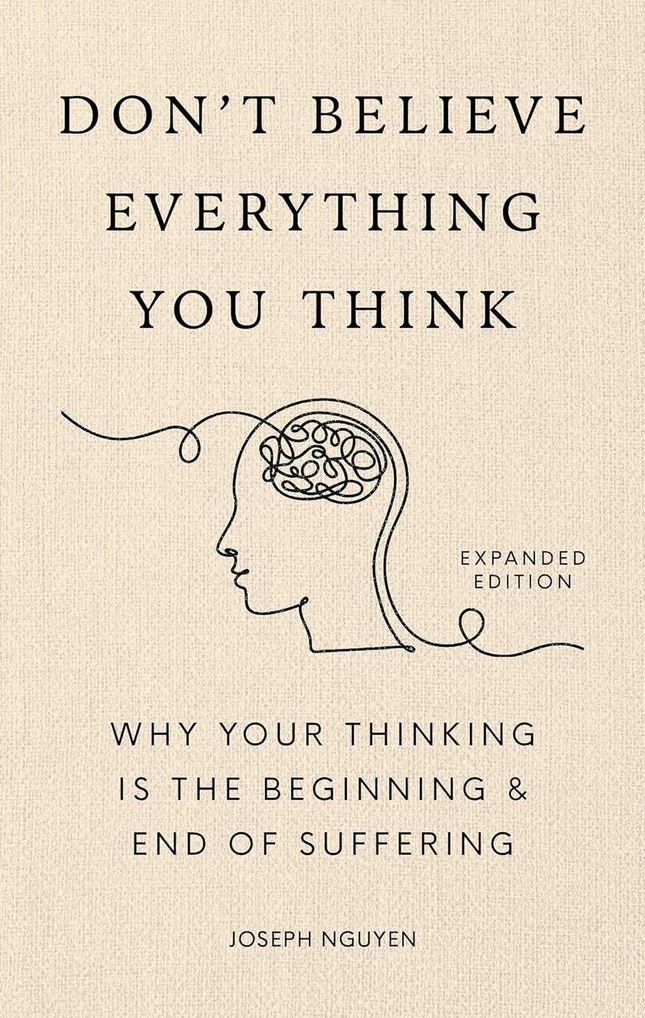
1. Don’t Believe Everything You Think — Joseph Nguyen
If your nights are dominated by analysing, replaying and mentally trying to solve everything, Don’t Believe Everything You Think is an interesting place to begin.
Nguyen’s central theme is the distinction between having thoughts and becoming caught up in them. Rather than treating every thought as something requiring analysis or action, the book encourages readers to reconsider how much authority they give their thinking.
The expanded edition also includes journalling prompts and contemplative exercises designed around letting go of negative, repetitive thinking.
That makes the book particularly relevant for someone whose mind becomes caught in loops at bedtime.
You may recognise patterns such as:
- replaying conversations and wondering what you should have said
- imagining future problems that haven’t happened
- repeatedly questioning decisions you’ve already made
- trying to think your way into certainty
- worrying about how tired you’ll feel tomorrow
The book isn’t specifically a sleep manual. Its value for an overthinker lies in its broader message: not every thought requires your participation.
Sometimes the most peaceful response to a thought is simply allowing it to pass.
2. The Sleep Book — Guy Meadows
The Sleep Book approaches the problem from the other direction.
Instead of concentrating primarily on overthinking, Guy Meadows focuses on our relationship with sleep itself.
The book uses ideas drawn from mindfulness and Acceptance and Commitment Therapy (ACT). Its approach challenges the exhausting habit of trying harder and harder to make yourself sleep.
That matters because sleep is unusual: effort isn’t always helpful.
You can make yourself finish a task, clean the kitchen or go for a walk. You cannot command yourself to fall asleep in quite the same way.
For someone lying awake thinking, Why am I still awake? I have to sleep. Tomorrow will be terrible, that shift in perspective can be valuable.
Rather than turning bedtime into another performance you have to get right, The Sleep Book encourages a different relationship with wakefulness, uncomfortable thoughts and the pressure surrounding sleep.
One of the most useful books to read when overthinking at night
This is particularly worth considering if your original worries have gradually been replaced by worry about sleep itself.
You may no longer simply be thinking about tomorrow’s meeting. You are thinking about tomorrow’s meeting, noticing that you’re still awake, calculating how many hours remain until morning and then worrying about functioning on too little sleep.
That cycle can turn the bedroom into a place associated with frustration rather than rest.
Changing that relationship can be an important part of moving towards calmer nights.
3. The Worry Trick — David A. Carbonell
Some thoughts keep returning because your brain is looking for certainty.
What if something goes wrong?
What if I made the wrong choice?
What if this feeling doesn’t go away?
In The Worry Trick, psychologist David A. Carbonell explores the way anxiety can draw us into repeatedly engaging with frightening possibilities.
Published by New Harbinger, the book draws on Acceptance and Commitment Therapy and cognitive behavioural approaches. Rather than encouraging readers simply to suppress anxious thoughts, Carbonell focuses on recognising the patterns that keep worry going.
This can be especially relevant at bedtime because worrying often disguises itself as problem-solving.
You feel as though another ten minutes of thinking might finally produce the answer.
Usually, another question appears instead.
Recognising that pattern can help you distinguish between a problem you can genuinely act upon and a worry your mind is repeatedly asking you to revisit.
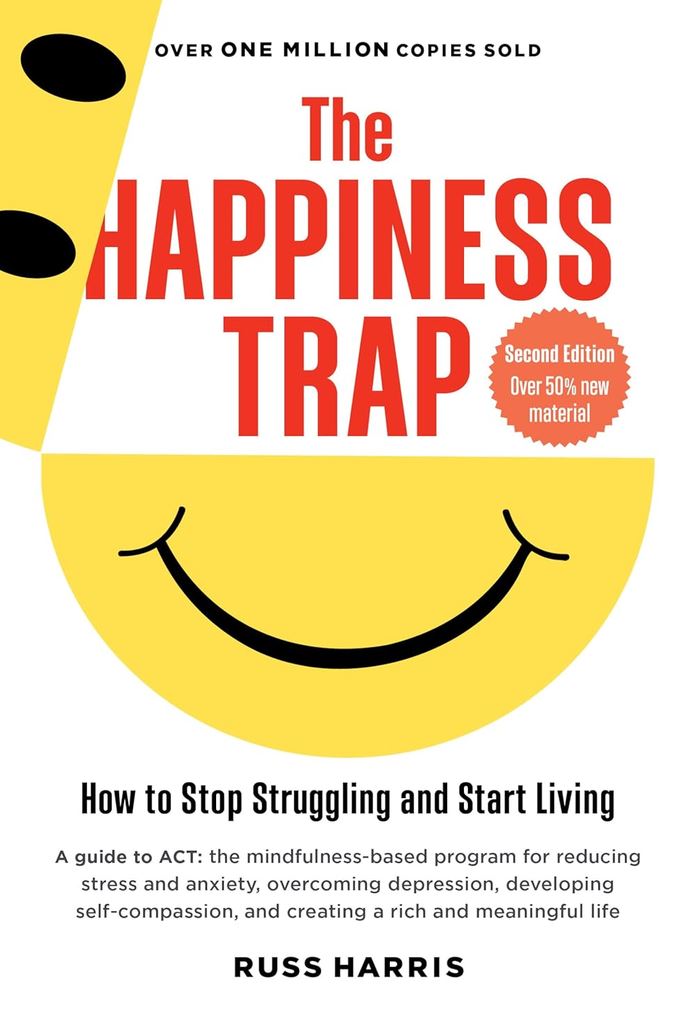
4. The Happiness Trap — Russ Harris
Russ Harris’s The Happiness Trap is another accessible introduction to ideas from Acceptance and Commitment Therapy.
Its relevance to nighttime overthinking comes from an important principle: uncomfortable thoughts and feelings do not always need to be eliminated before you can move forward.
That is quite different from the battle many overthinkers have every evening.
We often tell ourselves:
I need to clear my mind.
I need to stop thinking.
I shouldn’t feel anxious.
And then we become frustrated because the thoughts are still there.
ACT offers another possibility — learning how to make room for difficult internal experiences without allowing them to dictate everything you do.
For bedtime overthinking, that can mean moving away from How do I get rid of this thought? towards Can I allow this thought to be here without solving it tonight?
It sounds like a small distinction.
In practice, it can completely change the conversation you are having with your own mind.
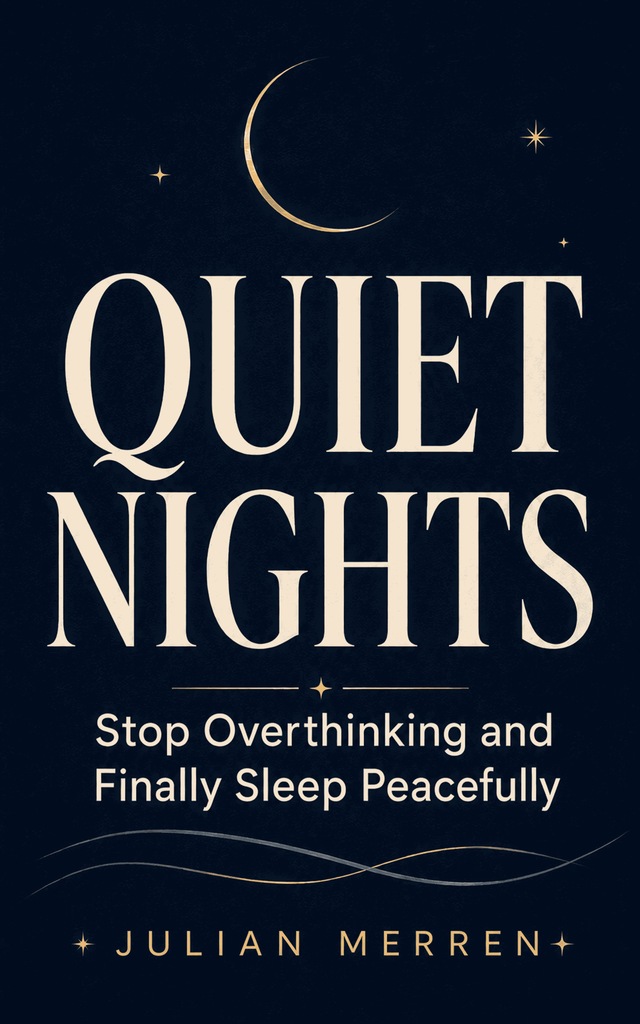
5. Quiet Nights — Julian Merren
The final recommendation brings the ideas back specifically to those quiet hours when overthinking and sleep collide.
Quiet Nights: Stop Overthinking and Finally Sleep Peacefully by Julian Merren was created for readers who find that bedtime becomes the moment when everything they have been carrying through the day suddenly demands attention.
Rather than treating a busy mind as something that needs to be defeated, the book focuses on practical, gentle steps for creating a calmer relationship with your thoughts and your nighttime routine.
It is particularly suited to readers looking for something they can work through gradually rather than simply another collection of sleep tips.
The goal isn’t to make your mind perfectly empty.
It is to make nighttime feel less like a battle.
If that is the kind of support you’re looking for, you can explore Quiet Nights and other resources for anxiety and overthinking on Books That Shape.
Reading is helpful — but don’t turn it into another sleep rule
There is one final point worth remembering.
If you decide to introduce reading into your bedtime routine, try not to turn it into another rigid formula:
I must read for exactly twenty minutes or I won’t sleep.
That simply gives an overthinking mind another rule to monitor.
Instead, think of reading as a transition.
Choose something calming rather than highly stimulating. Keep the environment comfortable and the lighting gentle. You might read a few pages, write down a thought you want to return to tomorrow and then put the book aside when you begin feeling sleepy.
The NHS suggests that writing worries down and setting aside dedicated “worry time” can help people manage thoughts that might otherwise race when they’re trying to sleep.
That creates an important boundary:
This matters — but I don’t have to solve it tonight.
Which book should you start with?
Among these books to read when overthinking at night, the best starting point depends on what is actually keeping you awake.
If you become trapped in your own thoughts, begin with Don’t Believe Everything You Think.
If worrying about sleep has become part of the problem, try The Sleep Book.
If your thoughts are dominated by “what if?” questions, The Worry Trick may be particularly relevant.
If you’re constantly fighting uncomfortable thoughts and feelings, explore The Happiness Trap.
And if you want a gentle resource focused specifically on overthinking around bedtime, take a closer look at Quiet Nights.
Most importantly, don’t judge yourself for having a busy mind.
You don’t have to win an argument with every thought before you’re allowed to rest. Sometimes the more helpful skill is learning which thoughts deserve your attention now — and which ones can wait until morning.
And perhaps that is where a good book earns its place on the bedside table.