
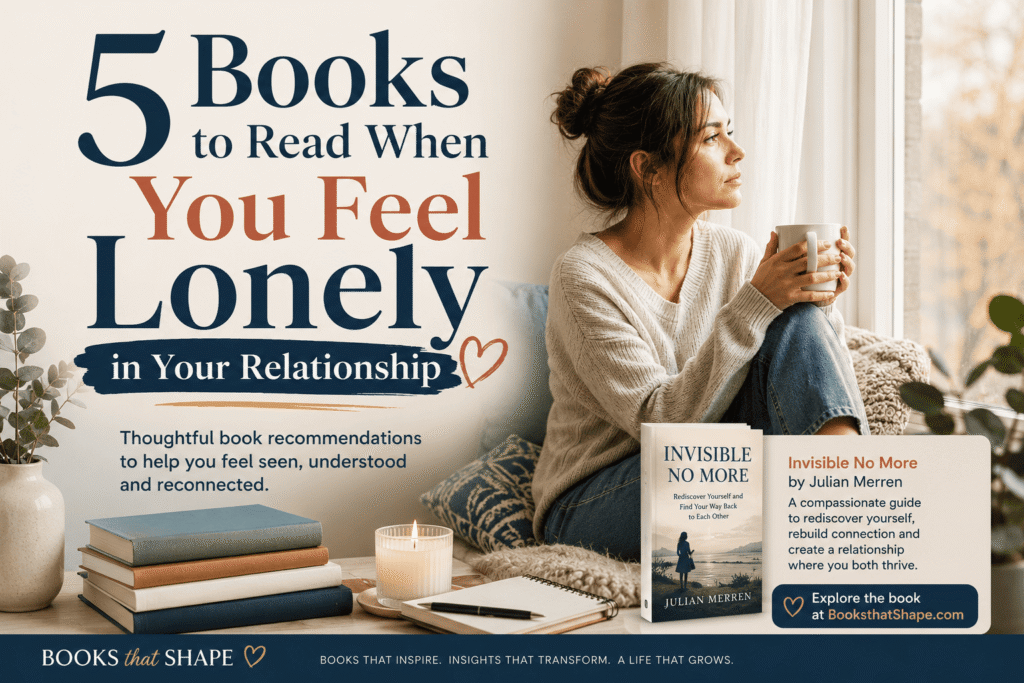
There is something particularly difficult about feeling lonely when you’re sitting beside the person you love.
You may share a home, a bed, responsibilities and years of memories. You might talk every day about work, children, bills and what needs to be done tomorrow.
Yet somewhere beneath all that activity, something feels missing.
You don’t necessarily want to leave.
You may still love your partner deeply.
You simply want to feel close to them again.
If you’re searching for books to read when you feel lonely in your relationship, the five below approach emotional disconnection from different directions. Some help couples understand why connection fades, while others focus on communication, attachment, emotional needs and rediscovering yourself within the relationship.
Most importantly, they can give you language for something that can be surprisingly difficult to explain:
How can I love someone and still feel so alone?

Why Can You Feel Lonely When You’re Not Alone?
Relationship loneliness isn’t necessarily about physical separation.
You can spend every evening together and still feel emotionally distant.
The Gottman Institute describes relationship loneliness as something that can emerge when emotional intimacy weakens. It identifies factors such as unresolved conflict, poor communication and unmet emotional needs as possible contributors to that disconnection.
Sometimes it happens gradually.
Conversations become practical.
Affection becomes less frequent.
Phones fill the quiet moments.
Work consumes more attention.
Children and responsibilities dominate conversations.
Eventually, you may know exactly what your partner is doing tomorrow but have little idea what they’ve been thinking or feeling lately.
That doesn’t automatically mean the relationship is over.
It may mean the emotional connection needs attention.
And sometimes a good book provides a surprisingly gentle way to begin that conversation.
The Gottman Institute also offers a useful guide to why loneliness happens in relationships and how couples can reconnect.
1. Hold Me Tight — Dr Sue Johnson
Best for understanding emotional disconnection
Hold Me Tight is an excellent starting point when you still care deeply about each other but can’t understand why you’ve become emotionally distant.
Sue Johnson developed Emotionally Focused Therapy, and the book explores relationships through the importance of emotional responsiveness and secure connection.
Rather than concentrating only on the surface argument, Hold Me Tight encourages couples to look underneath recurring disagreements.
Because sometimes the argument isn’t really about dishes, phones, money or whose turn it was to do something.
Underneath it may be a deeper question:
Are you still there for me?
That’s what makes this book especially relevant when loneliness has entered a relationship.
You may not need more conversation.
You may need more meaningful connection.
Read this if: you love each other but repeatedly end up feeling misunderstood, distant or emotionally disconnected.
2. The Seven Principles for Making Marriage Work — John Gottman and Nan Silver
Best for rebuilding everyday connection
Not every struggling relationship needs one enormous breakthrough.
Sometimes reconnection happens through small moments repeated consistently.
That’s one of the reasons The Seven Principles for Making Marriage Work remains such a useful relationship book.
John Gottman’s work places considerable importance on friendship, knowing your partner’s inner world, managing conflict and responding to everyday attempts at connection.
The Gottman Institute describes these small attempts to gain a partner’s attention, affection or support as bids for connection. Turning towards those bids helps build emotional connection and trust.
Think about how easily those moments can disappear.
“Look at this.”
“How was your day?”
“Come and sit with me.”
“Do you remember when…?”
Individually, they seem insignificant.
Collectively, they can become the fabric of a relationship.
Read this if: your relationship feels more functional than affectionate and you’d like practical ways to start reconnecting.
3. Attached — Amir Levine and Rachel Heller
Best for understanding why you respond differently to distance
Two people can experience exactly the same relationship very differently.
One partner senses emotional distance and immediately wants reassurance.
The other feels pressure and pulls away.
The first person becomes more anxious.
The second retreats further.
And suddenly both people feel misunderstood.
Attached introduces readers to adult attachment theory and explores how different attachment tendencies can influence romantic relationships.
One of its strengths is helping readers consider why certain relationship behaviours trigger such powerful emotional responses.
It can also encourage an important shift in perspective.
Instead of asking:
“What’s wrong with my partner?”
you begin asking:
“What pattern are we creating together?”
That can open the door to a much more constructive conversation.
Read this if: one of you tends to pursue connection while the other withdraws, or relationship uncertainty creates significant anxiety.
4. The 5 Love Languages — Gary Chapman
Best for exploring different ways of expressing affection
Sometimes both people believe they’re showing love.
Neither person feels loved.
One partner demonstrates affection by helping around the house.
The other desperately wants conversation and attention.
One values physical affection.
The other expresses care through gifts or practical support.
The 5 Love Languages popularised a simple framework for thinking about different preferences for giving and receiving affection.
It shouldn’t be treated as a scientific diagnosis or rigid classification system.
Its usefulness is simpler than that.
It gives couples a reason to ask:
“What actually makes you feel loved?”
That’s a worthwhile question.
Because after years together, it’s surprisingly easy to assume we already know the answer.
Read this if: you both care about each other but frequently feel that your efforts at affection aren’t reaching the other person.
5. Invisible No More — Julian Merren
Best for feeling seen again without losing yourself
Sometimes loneliness inside a relationship isn’t only about missing your partner.
It’s also about missing yourself.
You may have spent years being a partner, parent, organiser, supporter and problem-solver.
Somewhere along the way, your own interests, confidence and needs became quieter.
That’s the territory explored in Invisible No More: Rediscover Yourself and Find Your Way Back to Each Other by Julian Merren.
The book approaches reconnection from two directions:
finding yourself again and finding your way back to each other.
It explores themes including identity, confidence, boundaries, communication, appreciation and friendship, alongside practical reflections and conversation starters.
That’s an important distinction.
Feeling lonely doesn’t necessarily mean your only task is getting your partner to pay more attention.
Sometimes reconnection also involves rebuilding a life in which you feel present again.
Your interests.
Your friendships.
Your voice.
Your confidence.
Your needs.
And then bringing that fuller version of yourself back into the relationship.
Read this if: you’re thinking both “I miss myself” and “I miss us.”
You can explore Invisible No More and other relationship resources through Books That Shape — Relationships.
Which Book Should You Start With?
If you’re unsure, think about what’s creating the greatest distance.
Choose Hold Me Tight if emotional security and recurring arguments are the biggest issues.
Try The Seven Principles for Making Marriage Work if you want practical ways to rebuild everyday friendship and connection.
Consider Attached if you’re caught in a cycle where one person pursues and the other withdraws.
Try The 5 Love Languages if you both make an effort but seem to express and receive affection differently.
And choose Invisible No More if relationship loneliness has become intertwined with losing touch with yourself.
You don’t need to read all five.
Choose the one that most closely describes what you’re experiencing now.
Books Can Start Conversations
There’s another reason relationship books can be valuable.
Sometimes saying:
“I read something interesting today…”
feels much easier than:
“We need to talk about our relationship.”
A book gives you something outside the relationship to discuss.
You can ask:
“Does this sound like us?”
“Do you ever feel this way?”
“What makes you feel connected to me?”
“What do you miss about us?”
“What could we do differently?”
Those questions aren’t accusations.
They’re invitations.
And invitations are often a much better place to begin.
Small Moments Can Matter More Than Grand Gestures
When loneliness has been building for months or years, it’s tempting to believe the solution must be equally dramatic.
A holiday.
A romantic weekend.
A major relationship conversation.
Those things may help.
But everyday connection matters too.
The Gottman Institute recommends practices such as recognising bids for connection, having regular relationship check-ins and creating rituals of connection as ways couples can work on emotional closeness.
So begin somewhere manageable.
Put the phones away for twenty minutes.
Ask a question you haven’t asked lately.
Go for a walk together.
Sit beside each other instead of on opposite sides of the room.
Share something you’ve been thinking about.
Ask what your partner has been thinking about.
Small moments don’t solve every relationship problem.
But they can create opportunities for connection.
Feeling Lonely Doesn’t Automatically Mean Love Has Gone
Perhaps this is the most important thing to remember.
Loneliness is information.
It’s telling you that something you value—connection, attention, understanding, affection or companionship—feels absent.
What happens next depends on your individual relationship.
For some couples, honest conversations and deliberate changes may begin closing the distance. Others may benefit from support from a qualified couples therapist, particularly when disconnection has become persistent or difficult to discuss constructively.
But recognising the loneliness matters.
So does talking about it.
The best books to read when you feel lonely in your relationship won’t decide what you should do.
They can do something potentially more useful.
They can help you understand what you’re feeling, give you language for conversations you’ve struggled to begin and suggest new ways of seeing familiar patterns.
Start with one book.
Share one idea.
Ask one honest question.
And see where the conversation takes you.