
There is something frustratingly familiar about feeling tired all evening, only for your mind to suddenly become wide awake the moment your head reaches the pillow.
A conversation from earlier starts replaying. Tomorrow’s responsibilities appear one by one. An awkward moment from years ago somehow returns for another showing. Before long, you’re trying to solve problems that seemed far less urgent at three o’clock in the afternoon.
If you’re searching for how to stop overthinking at night, books can provide more than another collection of quick tips. The right ones can help you understand why thoughts become so persistent, change how you respond to them and develop a calmer relationship with the final hours of your day.
Here are seven books that approach nighttime overthinking from different angles.
1. Quiet Nights — Julian Merren
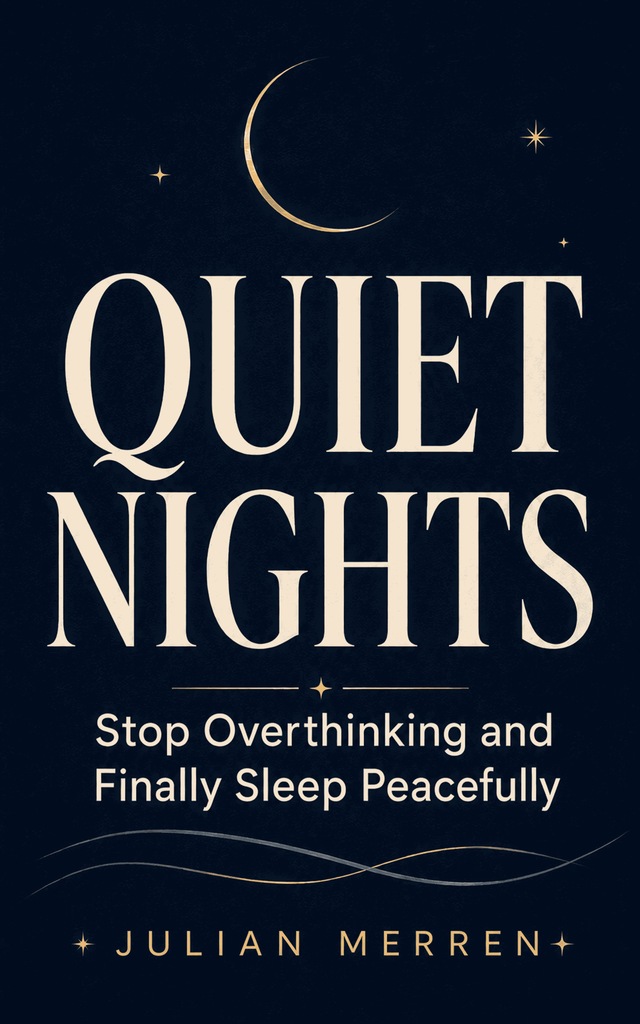
We’ll begin with the book most directly connected to the problem.
Quiet Nights: Stop Overthinking and Finally Sleep Peacefully by Julian Merren was created specifically around those evenings when the body feels ready for rest but the mind refuses to follow.
Rather than expecting you to somehow eliminate every thought before falling asleep, the book focuses on practical ways of responding to nighttime overthinking and creating a gentler transition between the activity of the day and sleep.
That’s an important distinction.
Trying desperately to make yourself stop thinking can sometimes give those thoughts even more attention. A more useful goal can be learning how to recognise what’s happening without allowing every thought to become another problem requiring immediate attention.
Best for: Readers whose overthinking becomes particularly noticeable once they get into bed.
If that’s the pattern you recognise in yourself, you can explore Quiet Nights by Julian Merren.
2. Don’t Believe Everything You Think — Joseph Nguyen
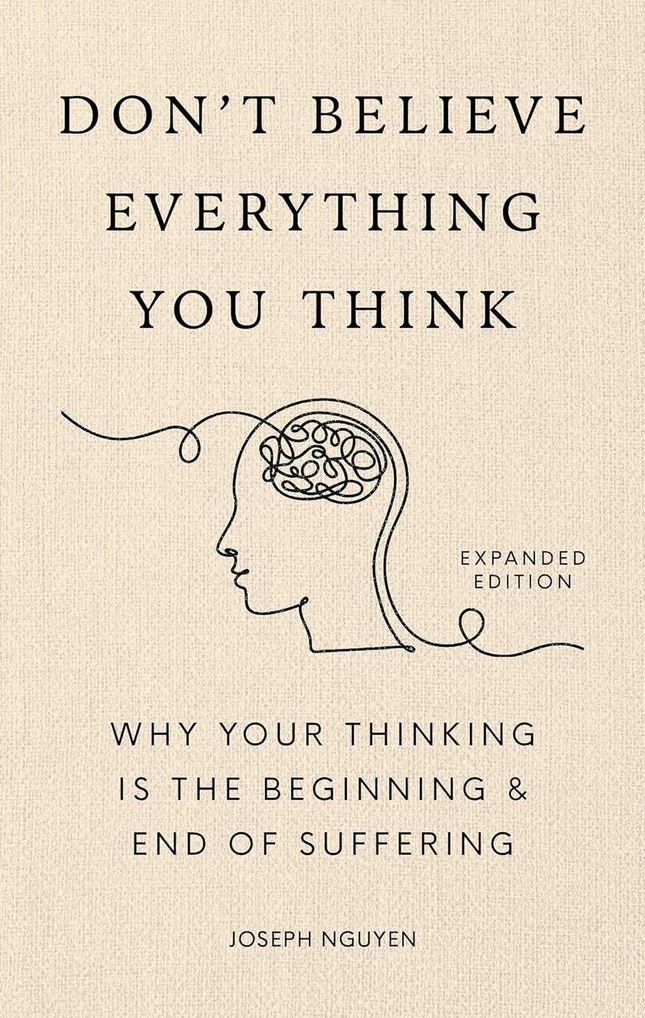
One reason overthinking can become exhausting is that we tend to treat thoughts as though they automatically deserve our attention.
A thought appears and we investigate it.
Then we analyse our analysis.
Before long, we’ve constructed an entire chain of thinking from something that might have disappeared if we’d simply allowed it to pass.
Don’t Believe Everything You Think explores our relationship with thinking and the suffering that can arise when we become caught up in it.
For nighttime overthinkers, the underlying idea is particularly relevant: having a thought doesn’t mean you have to follow it.
Best for: People who analyse their own thoughts until one concern becomes ten.
3. The Sleep Book — Guy Meadows
Sometimes the problem isn’t only worrying at night.
We begin worrying about sleep itself.
You notice you’re still awake. You look at the clock. You calculate how many hours remain before morning. Then you start wondering how exhausted you’ll feel tomorrow.
Now there’s another problem to solve.
The Sleep Book by Guy Meadows approaches sleep using principles associated with Acceptance and Commitment Therapy and explores what can happen when we stop struggling so intensely against wakefulness.
It makes this an interesting companion for readers who have turned bedtime into something they feel they must somehow get right.
Best for: Anyone who has begun worrying about not sleeping while trying to sleep.

4. The Happiness Trap — Russ Harris
The Happiness Trap isn’t specifically a sleep book, which is one reason it belongs on this list.
Russ Harris introduces readers to ideas from Acceptance and Commitment Therapy, including ways of relating differently to difficult thoughts and feelings rather than constantly trying to eliminate them.
That can be enormously relevant at bedtime.
A peaceful mind doesn’t necessarily mean an empty mind.
You can notice a thought without investigating it, experience uncertainty without resolving it tonight, and allow an uncomfortable feeling to exist without treating it as an emergency.
Best for: Readers who find themselves constantly fighting unwanted thoughts.
5. The Worry Trick — David A. Carbonell
Worry has an unusual talent for making itself sound useful.
If I think about this long enough, I’ll finally work it out.
Sometimes that’s true.
Often, however, worry simply produces another question.
The Worry Trick explores the patterns behind persistent worry and why some of our natural attempts to escape anxious thinking can keep the cycle going.
That’s particularly useful at night, when there are fewer distractions competing for our attention.
Best for: People whose nighttime thoughts are dominated by uncertainty and “what if?” scenarios.
6. The Things You Can See Only When You Slow Down — Haemin Sunim
Not every bedtime book needs to feel like something you’re studying.
Sometimes you need a book that simply changes the pace.
The Things You Can See Only When You Slow Down offers reflections around mindfulness, relationships, rest and the speed at which we move through everyday life.
Its format makes it particularly well suited to evening reading.
You can read a small section without feeling obliged to finish a lengthy chapter. There’s no target to reach and nothing to accomplish.
And perhaps that’s exactly what some overthinkers need before bed: something that doesn’t give the mind another assignment.
Best for: Readers looking for something gentler and more reflective at the end of the day.
7. Why Has Nobody Told Me This Before? — Dr Julie Smith
Understanding your own patterns can make them feel less mysterious.
In Why Has Nobody Told Me This Before?, clinical psychologist Dr Julie Smith presents accessible ideas and tools around difficult emotions, worry, motivation, self-doubt and other everyday psychological challenges.
It’s broader than nighttime overthinking, but that’s also its strength.
Sometimes the thoughts keeping us awake aren’t really about sleep. They began earlier — with stress, uncertainty, a difficult interaction or something we’ve been carrying throughout the day.
A book that helps us better understand those patterns can therefore complement books focused specifically on bedtime.
Best for: Readers wanting a broader toolkit for understanding their thoughts and emotions.
How to Stop Overthinking at Night Without Turning Reading Into Another Task
Here’s something worth remembering.
You don’t need to read all seven books.
And you certainly don’t need to create an elaborate evening routine involving seventeen steps, herbal tea at precisely 9:14 and thirty pages of compulsory self-improvement.
That can turn relaxation into another performance.
Instead, choose the book that most closely matches why your mind stays active.
If you’re primarily struggling with nighttime thought loops, start with Quiet Nights.
If you believe and analyse almost every thought, consider Don’t Believe Everything You Think.
If worrying about sleep has become part of the problem, The Sleep Book may be the better starting point.
If uncertainty drives your thinking, explore The Worry Trick.
And if you simply want your evenings to feel slower, The Things You Can See Only When You Slow Down might be all you need.
Give Your Mind Somewhere Quieter to Go
Reading isn’t a magic switch for an overactive mind.
But it can create something useful: a transition.
Instead of moving directly from emails, social media, work or television into bed, a few pages can provide a quieter space between the activity of the day and sleep.
The NHS recommends allowing time to relax before bed and notes that writing down worries or tomorrow’s tasks may help clear the mind when worries interfere with sleep.
You might combine that with ten or fifteen minutes of reading.
Not because you have to.
Simply because you’re giving your attention somewhere gentler to land.
And if you’ve been wondering how to stop overthinking at night, perhaps the first step isn’t trying harder to stop thinking.
It might be understanding your thoughts a little better and learning that not every one of them needs to accompany you into tomorrow.
If nighttime overthinking is the problem you most recognise, you can discover Quiet Nights: Stop Overthinking and Finally Sleep Peacefully by Julian Merren.
And remember, books can be valuable tools for understanding and self-reflection, but persistent anxiety or sleep difficulties that affect everyday life are worth discussing with an appropriately qualified healthcare professional. The NHS similarly recommends seeking professional guidance when ongoing sleep problems are affecting daily life.