
There is a particular kind of relationship conversation that seems to go wrong before it has really begun.
You raise something that’s bothering you.
Your partner hears criticism.
They defend themselves.
You feel dismissed, so you push harder.
They become more defensive.
Ten minutes later, you’re no longer talking about the original problem. You’re arguing about how you’re arguing.
If this feels familiar, relationship books about communication without blame can offer something more useful than advice to simply “communicate better”. They can help you understand why ordinary concerns turn into accusations, why defensiveness appears so quickly and how to express what you need without attacking the person you love.
Here are five books that approach that challenge from different directions.
Why Blame Changes the Conversation
Imagine you want more help around the house.
You could say:
“You never help me with anything.”
Or:
“I’m feeling overwhelmed with everything that needs doing. Could you help me with dinner tonight?”
The underlying frustration may be almost identical.
But the conversations you’re inviting are very different.
The Gottman Institute distinguishes between a complaint about a specific behaviour and criticism directed at a partner’s character. It recommends a gentler opening that describes what is happening, expresses a feeling and asks positively for what’s needed.
That doesn’t mean hiding frustration or pretending everything is fine.
Communication without blame isn’t about becoming endlessly agreeable.
It’s about making the problem the problem — rather than making your partner the problem.
1. Nonviolent Communication — Marshall B. Rosenberg
Best for changing the language of difficult conversations
Nonviolent Communication isn’t specifically a marriage book, but its central framework makes it highly relevant to couples.
One of its most useful ideas is separating observation from judgement.
Consider:
“You’re selfish.”
That’s a judgement about a person.
Compare it with:
“When plans are made without asking me, I feel left out.”
Now you’re describing an experience.
That distinction matters because blame tends to invite defence. Once someone feels they’re being judged as a person, they may stop listening to the actual concern.
Rosenberg’s approach broadly encourages people to identify:
- What happened
- What they’re feeling
- What they need
- What they’re requesting
The simplicity can be deceptive. Expressing a genuine need without slipping into accusation takes practice.
But it’s a useful framework when conversations regularly become:
“You always…”
followed immediately by:
“Well, you never…”
Read this if: you want a practical structure for expressing difficult feelings and needs more clearly.
2. Fight Right — John Gottman and Julie Schwartz Gottman
Best for couples caught in recurring arguments
Fight Right begins from a reassuring premise: conflict itself isn’t necessarily evidence that something has gone wrong.
Two people sharing a life are going to disagree.
The more useful question is what happens during those disagreements.
John and Julie Gottman’s work explores patterns including criticism, defensiveness, contempt and withdrawal, while offering alternative ways of navigating conflict.
One particularly relevant concept is the soft start-up.
The Gottman Institute recommends describing the situation without judgement, saying how you feel and asking for what you need rather than beginning with criticism.
For example:
“You don’t care about spending time with me.”
might become:
“I’ve been missing our time together lately. Could we plan an evening for just us?”
The second statement still communicates dissatisfaction.
But it also tells your partner what you actually want.
That’s an important distinction.
Read this if: you and your partner keep having different versions of the same argument.
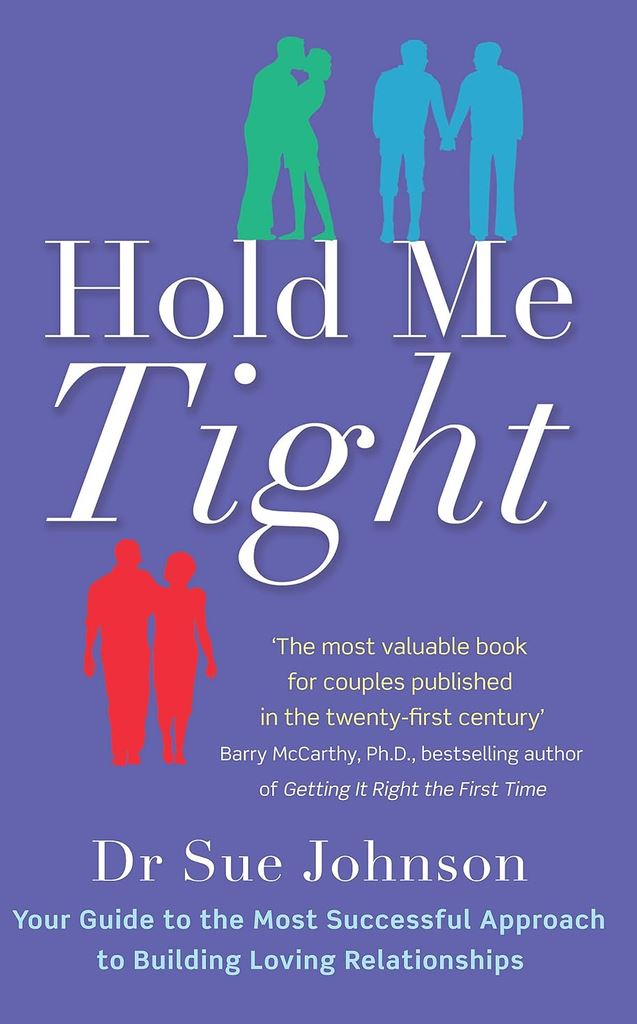
3. Hold Me Tight — Dr Sue Johnson
Best for understanding what’s underneath the blame
Sometimes blaming language is only the surface of a conversation.
“You don’t care.”
might mean:
I don’t feel important to you.
“You’re never here.”
might mean:
I miss you.
“Why do I have to do everything?”
might contain:
I feel alone carrying this.
Hold Me Tight: Seven Conversations for a Lifetime of Love approaches relationships through attachment and Emotionally Focused Therapy. Sue Johnson’s official site describes the book as helping couples build stronger, more secure relationships through an understanding of attachment and emotional connection.
This perspective can be valuable because simply removing accusatory words isn’t always enough.
You need to understand what you’re trying to communicate instead.
Blame often carries a more vulnerable message underneath it.
Learning to recognise that message can change the conversation from:
Who’s responsible for this?
to:
What are we actually needing from each other?
Read this if: your arguments seem to contain more emotion than the immediate issue should reasonably explain.
4. Difficult Conversations — Douglas Stone, Bruce Patton and Sheila Heen
Best for conversations you’ve been avoiding
Not every difficult relationship conversation is an argument.
Sometimes the problem is that the conversation never happens.
You postpone it because you’re worried about your partner’s reaction.
You rehearse what you’ll say.
Then you decide tonight isn’t the right night.
Days become weeks.
Meanwhile, resentment quietly grows.
Difficult Conversations comes from authors associated with the Harvard Negotiation Project and explores how to approach conversations that feel risky or emotionally charged. Penguin describes the book as a guide to developing effective communication and achieving more constructive dialogue.
Although it isn’t exclusively about romantic relationships, that’s part of its strength.
Its ideas can apply whenever two people see the same situation differently.
And couples frequently do.
You may be convinced you’re discussing what objectively happened.
Your partner may have experienced the event completely differently.
Moving away from:
“My version is correct.”
towards:
“Why did we experience this so differently?”
can open conversations that blame tends to close.
Read this if: there is something important you need to discuss but don’t know how to begin.
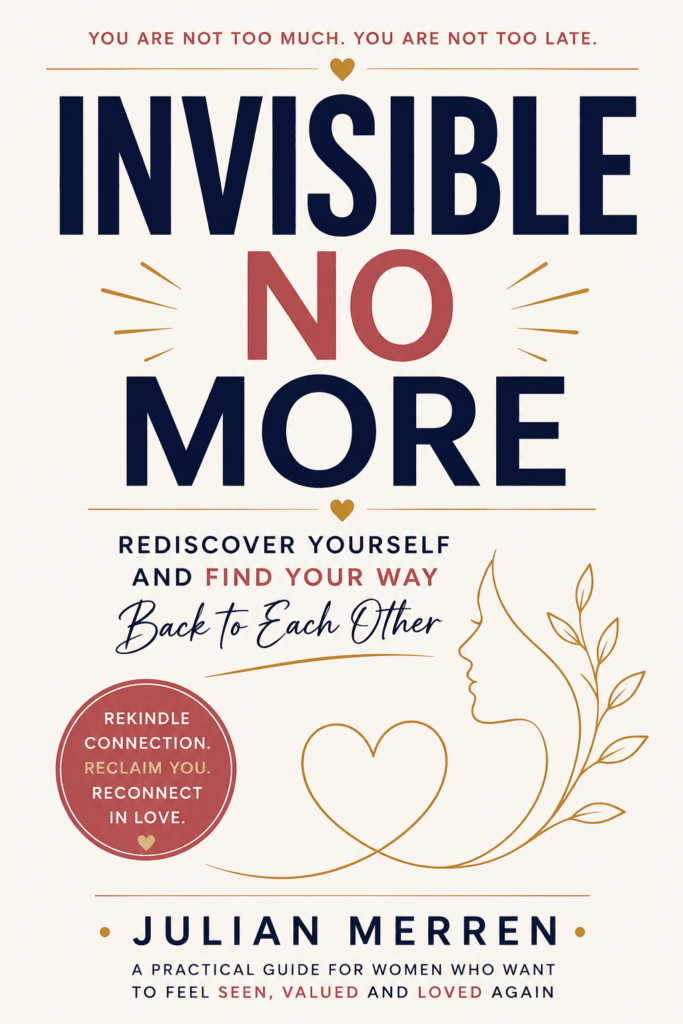
5. Invisible No More — Julian Merren
Best for expressing your needs after you’ve spent too long suppressing them
There’s another communication problem that doesn’t initially look like blame.
Silence.
You avoid arguments.
You accommodate.
You keep things to yourself.
You say:
“It’s fine.”
“Don’t worry about it.”
“It doesn’t matter.”
Until one day, something small happens and years of unspoken frustration come pouring out.
That’s where Invisible No More: Rediscover Yourself and Find Your Way Back to Each Other by Julian Merren fits differently into this list.
The book explores rediscovering yourself while creating opportunities to reconnect with your partner, including themes around communication, boundaries, appreciation, confidence and friendship.
Because communicating without blame isn’t simply about choosing gentler words.
You also need to speak before resentment becomes the only voice left.
If you’ve gradually stopped expressing what you want because keeping the peace feels easier, rediscovering your own needs can be an important part of communicating more openly.
Read this if: you tend to suppress your feelings until frustration eventually takes over.
You can explore Invisible No More and other relationship resources through Books That Shape — Relationships.
What the Best Relationship Books About Communication Without Blame Have in Common
Although these books approach communication differently, several themes repeatedly emerge.
Talk about the behaviour, not the person’s character
There’s an enormous difference between:
“You forgot to call.”
and:
“You’re inconsiderate.”
One identifies something that happened.
The other defines the person.
Explain what you need
It’s easy to become extremely clear about what we don’t want.
“Stop ignoring me.”
But what would you like instead?
“Could we have twenty minutes tonight without our phones and actually catch up?”
Now your partner has something concrete to respond to.
Become curious before becoming defensive
When you feel criticised, your instinct may be to immediately explain why the other person is wrong.
Try becoming curious first.
“What made you feel that way?”
You can explain your perspective afterwards.
Remember the purpose of the conversation
Before beginning a difficult discussion, ask yourself:
What am I hoping happens when this conversation ends?
If the answer is:
“I want them to admit I’m right.”
you may be preparing for a courtroom rather than a conversation.
If it’s:
“I want us to understand what’s happening and decide what to do next.”
you’re starting somewhere very different.
A Simple Way to Begin Without Blame
The Gottman Institute offers a particularly useful structure for raising concerns gently: describe the situation, express how you feel and state what you need positively.
In everyday language, you might think of it as:
What happened → How I feel → What I need
For example:
“We’ve had plans cancelled twice this month. I’ve been feeling disappointed because I miss spending time together. Could we protect Saturday evening for us?”
Compare that with:
“You always put everything else before me.”
The first version isn’t weaker.
In many ways, it’s more courageous.
You’ve stopped hiding behind accusation and said what actually matters.
Better Conversations Aren’t About Perfect Words
None of these relationship books about communication without blame will make every difficult conversation easy.
You’ll still become frustrated sometimes.
You’ll occasionally say something badly.
Your partner will too.
Good communication isn’t about two people calmly producing perfectly constructed sentences at all times.
It’s about noticing when blame, defensiveness or silence have taken over — and learning how to find your way back.
Sometimes that means softening the beginning.
Sometimes it means listening longer.
Sometimes it means admitting you were wrong.
And sometimes it means finally saying something you’ve been afraid to say.
The aim isn’t to remove disagreement from your relationship.
It’s to create a relationship where disagreement doesn’t automatically make either person the enemy.
Because when the goal changes from winning against each other to understanding each other, the conversation changes too.