
There are times when thinking stops feeling useful.
A conversation from yesterday gets replayed for the tenth time. A decision that should be straightforward becomes a list of increasingly complicated possibilities. You finally get into bed, only for your mind to decide that this is the perfect moment to revisit everything that happened during the day.
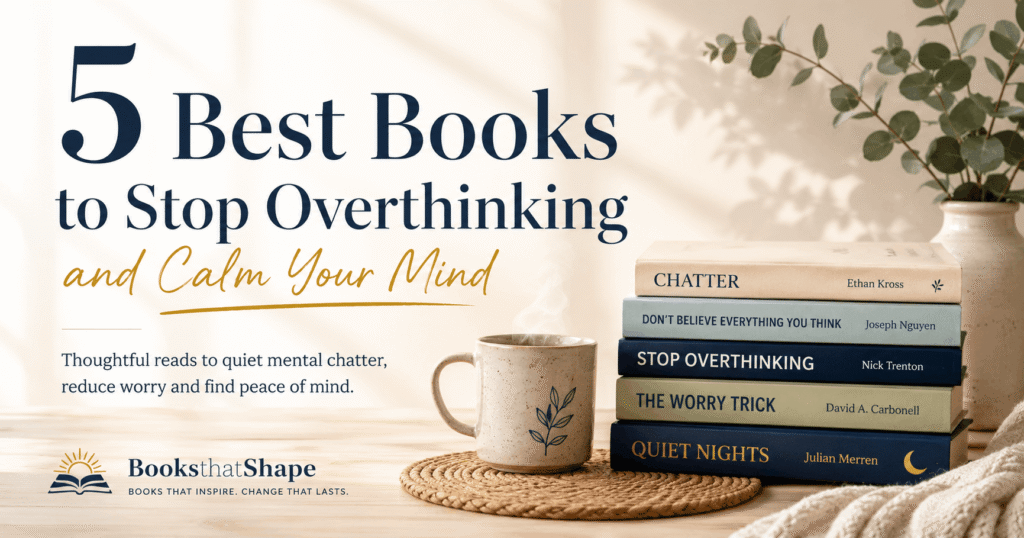
If that sounds familiar, finding the best books to stop overthinking can be a useful place to begin.
The right book won’t magically silence every unwanted thought. What it can do is help you understand why certain thoughts seem to demand so much attention, offer a different perspective on them, and introduce practical ways of responding when your mind gets caught in a loop.
The five books below approach overthinking from different angles. Some focus on mental chatter, others on worry, habits of thought or finding greater calm. That variety matters because there isn’t one single form of overthinking — or one approach that suits everyone.

1. Chatter by Ethan Kross
Best for understanding the voice inside your head
Most of us have an internal voice. Sometimes it’s helpful, allowing us to plan, reflect and make sense of our experiences.
At other times, it seems determined to keep an unwanted thought alive.
Chatter: The Voice in Our Head, Why It Matters, and How to Harness It by psychologist Ethan Kross explores this internal dialogue and what happens when it becomes repetitive and unhelpful.
This is a particularly interesting choice if your overthinking tends to involve replaying conversations, criticising yourself after an event or mentally revisiting something you wish you’d handled differently.
Rather than treating your inner voice simply as an enemy that needs to disappear, Kross looks at ways of changing how you relate to it.
That makes Chatter a good starting point for readers who don’t just want another instruction to “stop thinking so much”. They want to understand what their mind is actually doing.
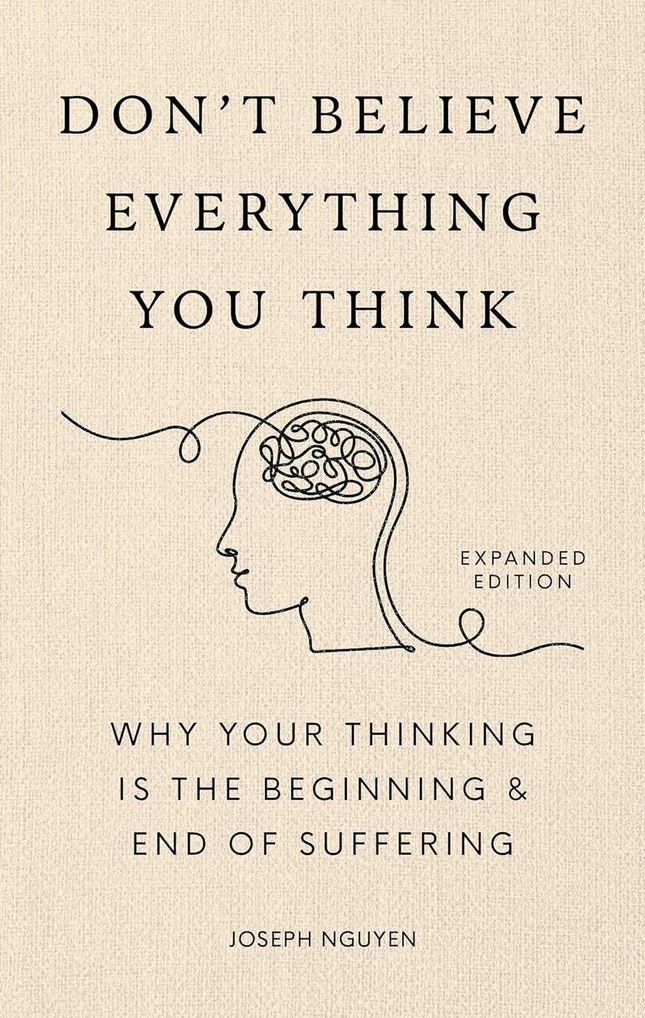
2. Don’t Believe Everything You Think by Joseph Nguyen
Best for questioning the authority of your thoughts
One reason overthinking can become exhausting is that every thought begins to feel important.
A possibility becomes a prediction. A worry starts feeling like a warning. A passing doubt becomes something that apparently needs to be analysed immediately.
Joseph Nguyen’s Don’t Believe Everything You Think takes aim at that relationship with thought.
The central appeal of the book is contained in its title: having a thought doesn’t automatically make the thought true, useful or deserving of your continued attention.
The book draws from philosophy, spirituality and psychology and is written as an accessible guide rather than a dense academic examination of thinking. Its publisher describes it as addressing anxiety, self-doubt, self-sabotage and overthinking.
For someone who habitually treats every thought as a problem requiring a solution, that’s an important perspective.
3. Stop Overthinking by Nick Trenton
Best for readers who want practical techniques
Sometimes understanding overthinking isn’t enough. You want something you can actually do when you notice yourself falling into the same mental pattern again.
That’s where Stop Overthinking by Nick Trenton fits particularly well.
Trenton’s approach is strongly practical, concentrating on mental habits, stress and techniques designed to interrupt repetitive thinking. An official companion workbook has also been published, with exercises around staying present, managing stress and developing a healthier relationship with your thoughts.
This makes it a useful choice for readers who prefer actionable self-help.
It may also suit someone who has already recognised their tendency to overthink but keeps wondering:
“Fine — but what am I supposed to do when it starts?”
Having a small collection of techniques to experiment with can be more useful than expecting yourself to suddenly become someone who never worries.
4. The Worry Trick by David A. Carbonell
Best for people caught in recurring “what if?” thinking
Overthinking and worrying frequently travel together.
What if I made the wrong decision?
What if something goes wrong?
What if that person misunderstood me?
What if I can’t sleep tonight?
Trying desperately to obtain certainty can sometimes give the worry even more attention.
Psychologist David A. Carbonell’s The Worry Trick focuses specifically on this relationship with worry and anxiety. Rather than simply encouraging readers to argue with every frightening possibility, the book explores why our attempts to defeat worry can sometimes keep us entangled with it.
This is an especially relevant choice for the future-focused overthinker — the person whose mind constantly tries to anticipate what might happen next.
You can also explore these practical ways to tackle persistent worries from NHS Every Mind Matters
It’s worth remembering that some worry is a normal part of life. The NHS similarly notes that worry cannot be eliminated completely, while suggesting techniques such as writing concerns down and setting aside dedicated “worry time” to prevent them dominating the day.
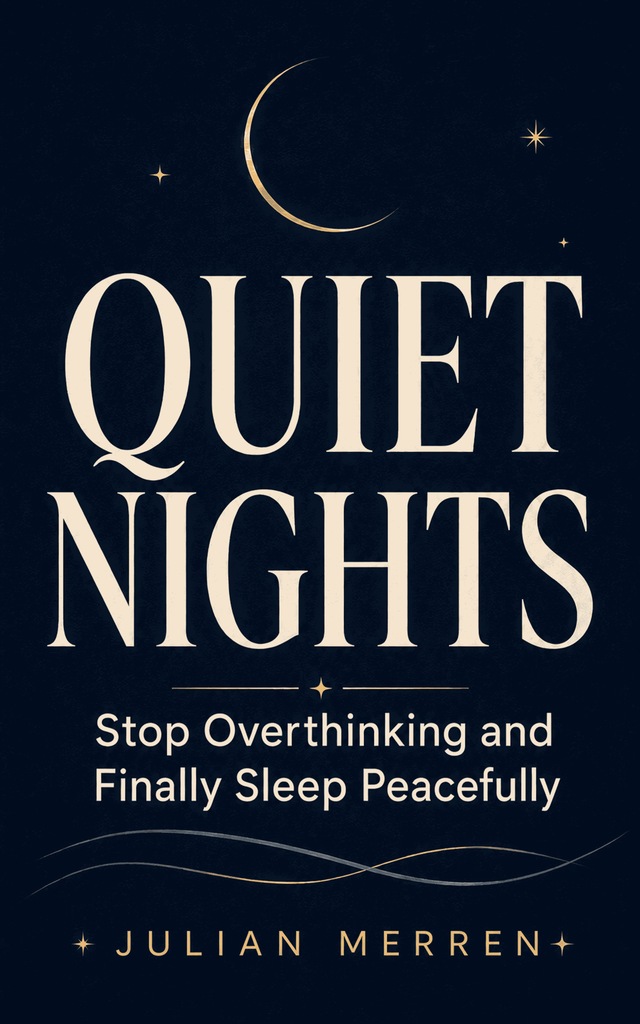
5. Quiet Nights by Julian Merren
Best for overthinking that becomes louder at night
Overthinking can happen at any time, but nighttime creates its own particular challenge.
During the day there are conversations, responsibilities, errands, emails and dozens of small distractions competing for attention.
Then everything becomes quiet.
Suddenly the conversation you had six hours ago deserves another analysis.
Tomorrow’s problems arrive early.
And things that seemed manageable at four in the afternoon can feel considerably larger at midnight.
Quiet Nights: Stop Overthinking and Finally Sleep Peacefully by Julian Merren was written specifically around that intersection between an overactive mind and the struggle to settle at night.
Rather than positioning overthinking as something that simply needs to be switched off on command, Quiet Nights focuses on understanding nighttime thought patterns and developing practical ways of creating a calmer transition towards sleep.
If evenings are when your overthinking causes you the most difficulty, you can explore Quiet Nights here:
Quiet Nights by Julian Merren
How to Choose Among the Best Books to Stop Overthinking
These five books overlap, but they’re not identical.
A better question than “Which is the best book?” may be:
“What does my overthinking actually look like?”
If you constantly replay conversations and criticise yourself afterwards, Chatter may be a particularly good match.
If you automatically believe the stories your mind creates, consider Don’t Believe Everything You Think.
If you want practical exercises and techniques, Stop Overthinking may suit you.
If your thoughts revolve around uncertainty and endless “what if?” scenarios, look at The Worry Trick.
And if your mind becomes particularly active once your head hits the pillow, Quiet Nights is the most directly focused on that experience.
Choosing a book that matches the pattern behind your overthinking is likely to be more useful than simply choosing whichever title promises the fastest solution.
Reading About Overthinking Is Only the Beginning
There’s an interesting trap here.
An overthinker can even overthink how to stop overthinking.
You can buy five books, watch twenty videos, save thirty articles and spend weeks searching for the perfect technique.
Eventually, though, something has to move from the page into everyday life.
Choose one book.
Read it slowly.
When an idea feels particularly relevant, stop and experiment with it before rushing to the next chapter.
You might keep a simple note containing:
- the situations that most often trigger repetitive thinking;
- thoughts or worries that regularly return;
- one technique from your reading that you’d like to practise;
- what seems to make your mind quieter rather than busier.
The goal isn’t to monitor every thought. It’s simply to begin noticing patterns.
A Calmer Relationship With Your Thoughts
The aim doesn’t need to be having a perfectly quiet mind.
Thinking, reflecting and anticipating are useful human abilities. The difficulty comes when thought stops helping and begins circling the same territory without taking you anywhere new.
That’s why the best books to stop overthinking tend to offer something more useful than “think positively”. They help you step back, recognise what’s happening and develop a different relationship with the thoughts demanding your attention.
Start with the book that most closely resembles your own experience.
And if those mental loops become especially persistent when the lights go out, Quiet Nights by Julian Merren was created specifically for that part of the day.
Discover Quiet Nights and learn more
If persistent worry, anxiety or sleep difficulties are significantly affecting everyday life, self-help books can complement rather than replace individual support from an appropriately qualified health professional.