

There is a difference between wanting to be rich and wanting to feel secure.
For many people, financial security isn’t about luxury, early retirement or reaching some enormous investment target.
It’s knowing that the next unexpected bill won’t send everything into chaos.
It’s having some money set aside.
It’s knowing where your money is going.
It’s gradually reducing debt rather than watching it grow.
And perhaps most importantly, it’s feeling that you’re moving in the right direction.
If you’re looking for books about financial security, the most useful reads aren’t necessarily those promising the highest investment returns. Sometimes a good financial book simply helps you create more breathing room between yourself and the next problem.
These five books approach that challenge from different angles.
1. The Index Card — Helaine Olen and Harold Pollack
Best for making personal finance feel manageable
One reason people can feel financially insecure is that personal finance often seems unnecessarily complicated.
There’s always something else you’re apparently supposed to understand.
Investments. Insurance. Retirement. Debt. Mortgages. Taxes. Emergency savings.
You can easily reach the point where you don’t know what to tackle first.
The Index Card by Helaine Olen and Harold Pollack takes almost the opposite approach.
Its central appeal is simplicity: many of the most important principles of personal finance don’t need to be enormously complicated.
That’s particularly valuable if you’ve been avoiding your finances because everything feels too difficult.
You don’t necessarily need to master every part of personal finance before you can improve your position.
You need to understand the fundamentals and begin applying them consistently.
Read this if: financial complexity is stopping you from taking action.
2. The One-Page Financial Plan — Carl Richards
Best for turning vague financial worry into a clearer direction
You can worry about money for years without ever clearly defining what you’re trying to achieve.
That’s one reason The One-Page Financial Plan by Carl Richards belongs on this list.
The idea of simplifying your financial life into something you can actually understand is incredibly useful when you feel uncertain about the future.
Rather than treating money as a collection of disconnected decisions, financial planning asks you to think about the bigger picture.
What matters to you?
What are you trying to protect?
What would you like your money to make possible?
And what needs to happen next?
You don’t need a fifty-page document to begin answering those questions.
Sometimes getting your priorities onto one page is enough to make your financial life feel less intimidating.
Read this if: you know you need a financial plan but don’t know where to begin.
3. Broke Millennial — Erin Lowry
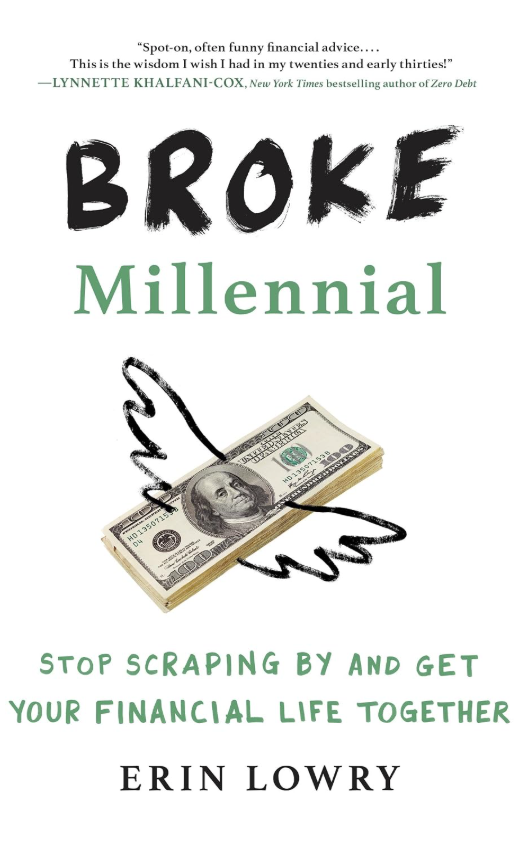
Best for getting comfortable with everyday money decisions
Despite the title, you don’t necessarily need to be a millennial to find useful ideas in Broke Millennial.
Erin Lowry approaches money in an accessible, conversational way, covering many of the everyday financial situations that people can find uncomfortable or confusing.
And that matters because financial security isn’t created only through investments.
It begins much closer to home.
Understanding your money.
Talking about it.
Making decisions deliberately rather than avoiding them.
Knowing where you stand.
These may not sound as exciting as discovering the next great investment, but they’re often what gives everything else a stronger foundation.
A person who understands their everyday financial life is in a much better position to start thinking about longer-term wealth.
Read this if: you want personal finance explained in a more approachable way.
4. The Simple Path to Wealth — JL Collins
Best for connecting today’s security with tomorrow’s independence
Once you’ve created some stability in your everyday finances, another question eventually appears:
What comes next?
That’s where The Simple Path to Wealth by JL Collins becomes useful.
Collins is known for advocating a relatively straightforward approach to long-term wealth building rather than treating investing as something that needs constant attention.
And there’s an important connection here.
Financial security isn’t only about protecting yourself from this month’s unexpected expense.
It’s also about gradually building a future in which you’re less dependent on the next pay cheque.
That takes time.
But simplicity can make the process easier to stick with.
The more complicated your financial system becomes, the easier it is to feel that you aren’t doing enough.
Sometimes a straightforward plan followed consistently is far more useful.
Read this if: you’re ready to move beyond short-term stability and start thinking about long-term financial independence.
5. From Financial Regret to Financial Freedom — Julian Merren
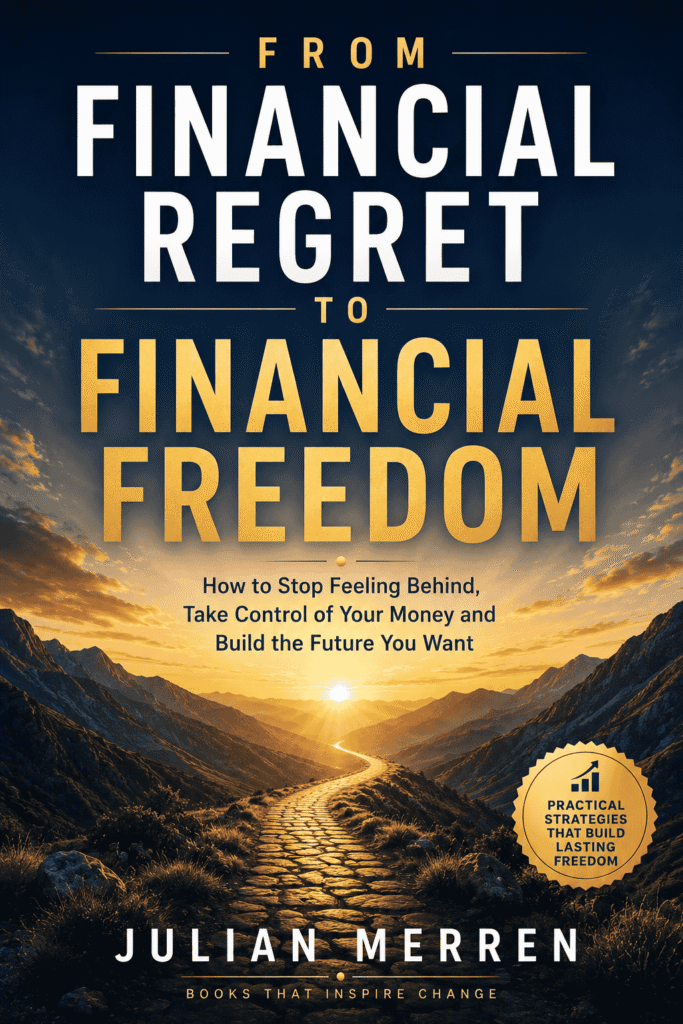
Best for building security when you feel you’re starting late
There’s one problem the other books don’t address quite as directly.
What if you’re reading all of this and thinking:
This sounds great — but I should have done it twenty years ago.
That’s where From Financial Regret to Financial Freedom by Julian Merren fits particularly well.
The book begins with the emotional weight of financial regret and feeling behind before moving towards practical areas such as understanding your current financial position, finding money within what you’re already earning, building a financial safety net, breaking the debt cycle, beginning to build wealth and creating a clearer financial freedom plan.
That makes financial security an important part of the journey rather than something that appears only after you’ve accumulated substantial wealth.
You begin by making your financial foundation stronger.
Then you build from there.
If you’re more concerned about what you haven’t done with money than what you’ve already achieved, you can explore From Financial Regret to Financial Freedom and see whether it fits where you are now.
What the Best Books About Financial Security Have in Common
Although these books approach money differently, there’s a common theme running through them.
Financial security isn’t one thing.
It has layers.
You might think of those layers as:
- understanding where your money goes;
- knowing what you owe;
- creating some room between income and spending;
- building emergency savings;
- reducing expensive debt;
- protecting yourself against unexpected costs;
- investing consistently for the future; and
- knowing what you’re actually trying to achieve.
You don’t have to complete every layer at once.
In fact, trying to do everything simultaneously can make the process feel even more overwhelming.
Start with the weakest part of your financial foundation.
Then strengthen it.
An Emergency Fund Can Change the Way a Problem Feels
One of the clearest examples of financial security is an emergency fund.
An unexpected car repair is annoying when you have money set aside for it.
The same repair can become a financial crisis when you don’t.
That’s the purpose of a safety net.
It doesn’t prevent unpleasant things from happening.
It changes your ability to deal with them.
Australia’s Moneysmart describes an emergency fund as money set aside for urgent or unexpected costs and suggests three months of expenses as a useful target. Importantly, it also encourages people to begin even if they can initially save only a small amount.
That second point matters.
You don’t become financially secure the day you finally reach the perfect number.
Security can begin growing with the first amount you deliberately put aside.
Which Book Should You Start With?
Choose according to the problem you’re trying to solve.
If personal finance feels too complicated, start with The Index Card.
If you need to turn vague goals into a clearer plan, try The One-Page Financial Plan.
If you want an approachable introduction to everyday money management, consider Broke Millennial.
If you’re ready to think beyond your immediate safety net towards long-term independence, The Simple Path to Wealth may be the better choice.
And if past mistakes or starting later in life are making you feel financially vulnerable, From Financial Regret to Financial Freedom is the most directly relevant.
You don’t need all five sitting beside your bed.
Start with the one that addresses the weakest point in your financial life.
Financial Security Is Built Before It Is Felt
Perhaps that’s the most important idea to take away from these books about financial security.
Feeling secure isn’t necessarily about reaching a magical number.
It’s about knowing that your financial position is becoming stronger.
An emergency fund that’s larger than it was six months ago.
A debt balance that’s smaller.
A retirement contribution that’s now automatic.
A spending plan you actually understand.
A financial decision you no longer avoid.
None of these things transforms your financial life overnight.
Together, however, they create something valuable.
Resilience.
And that may be a much better financial goal than simply trying to become richer.
Choose one book.
Find one weakness in your financial foundation.
And take one step towards making it stronger.