
Relationships don’t always fall apart dramatically.
Sometimes they simply become quieter.
You still share a home. You still care about each other. You discuss work, bills, appointments, children, shopping and everything that needs to happen tomorrow.
But somewhere along the way, the conversations that once made you feel close become less frequent.
Affection becomes less spontaneous. Curiosity fades. You start operating efficiently as a team while feeling surprisingly lonely as a couple.
If that sounds familiar, the best relationship books for couples who feel disconnected can offer something surprisingly valuable: not a magical solution, but a different way of understanding what’s happening between you.
Here are seven books that approach reconnection from very different angles.
1. Hold Me Tight — Sue Johnson
Best for rebuilding emotional connection
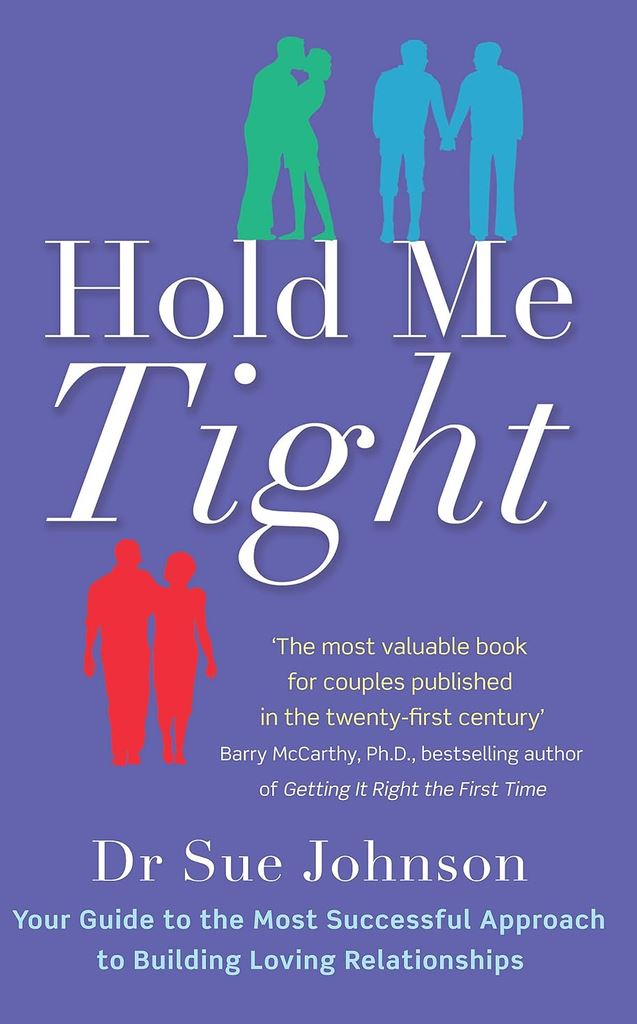
Hold Me Tight: Seven Conversations for a Lifetime of Love is based on the work of psychologist Sue Johnson, developer of Emotionally Focused Therapy.
Rather than concentrating only on the surface disagreement, Johnson’s approach looks towards the deeper emotional needs underneath relationship conflict.
That can be particularly useful when couples repeatedly have versions of the same argument.
One person criticises.
The other withdraws.
The first person pushes harder.
The second retreats further.
Eventually, you’re arguing about the argument.
Hold Me Tight centres its approach around seven conversations designed to help couples recognise these patterns and develop a safer emotional connection.
Start here if: you still love each other but struggle to reach each other emotionally.
2. The Seven Principles for Making Marriage Work — John Gottman and Nan Silver
Best for understanding the everyday habits of strong relationships
John Gottman’s work takes a somewhat different approach.
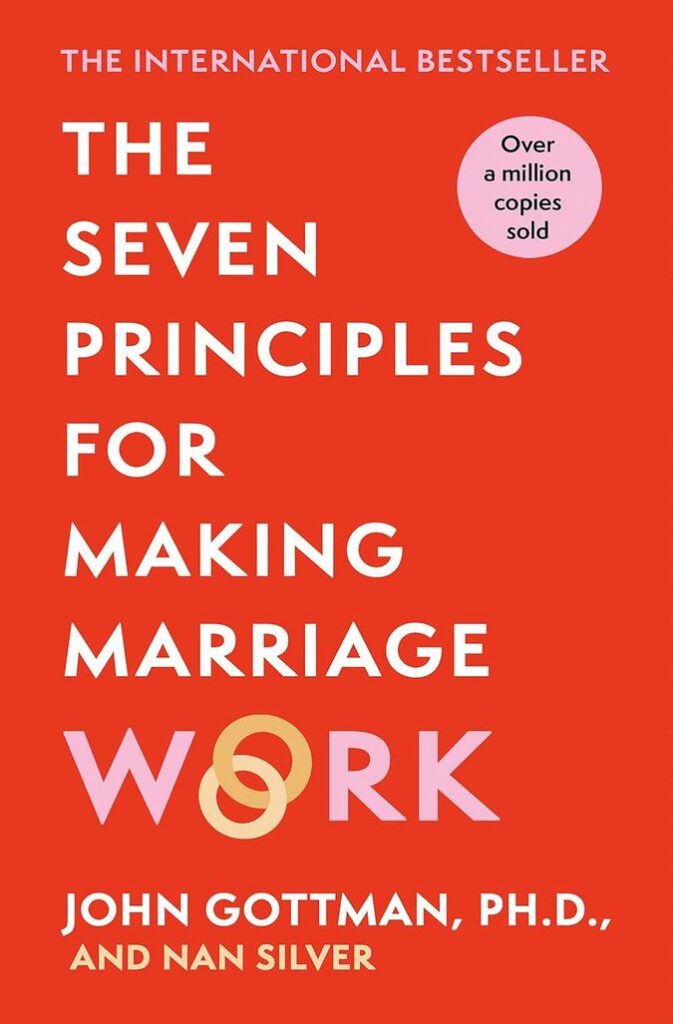
Instead of looking only at major relationship problems, The Seven Principles for Making Marriage Work examines the everyday patterns that influence how couples relate.
The book includes practical exercises and questionnaires alongside Gottman’s principles for creating and maintaining a stronger relationship.
That’s useful because relationship distance isn’t always caused by one enormous problem.
Sometimes it’s hundreds of tiny moments.
Not asking the follow-up question.
Looking at your phone instead of your partner.
Forgetting to say thank you.
Stopping doing things together.
Becoming less interested in each other’s worlds.
None seems particularly significant by itself.
Together, they can gradually change how a relationship feels.
Start here if: you’d like practical ways of examining the everyday health of your relationship.
3. Us — Terrence Real
Best when you’ve stopped feeling like you’re on the same team
Arguments have an unfortunate ability to turn two people who love each other into opponents.
Who started it?
Who’s right?
Who needs to apologise?
Who’s giving more?
Who’s the problem?
Us: Getting Past You & Me to Build a More Loving Relationship by Terrence Real challenges this adversarial way of relating.
Real encourages readers to move beyond the separate corners of “you” and “me” and towards a more collaborative relationship mindset. His approach includes recognising automatic reactions and developing relational skills that help partners work together rather than against each other.
Sometimes that’s exactly what a disconnected couple needs to remember:
The relationship isn’t you versus your partner.
You’re supposed to be on the same side.
Start here if: disagreements increasingly feel like competitions somebody has to win.
4. Eight Dates — John Gottman, Julie Schwartz Gottman, Doug Abrams and Rachel Carlton Abrams
Best for couples who’ve stopped having meaningful conversations
You probably still talk to your partner.
The question is: what do you talk about?
Who needs picking up?
What do we need from the supermarket?
Did you pay that bill?
What time are we leaving?
Long-term relationships can become remarkably efficient while meaningful conversation quietly disappears.
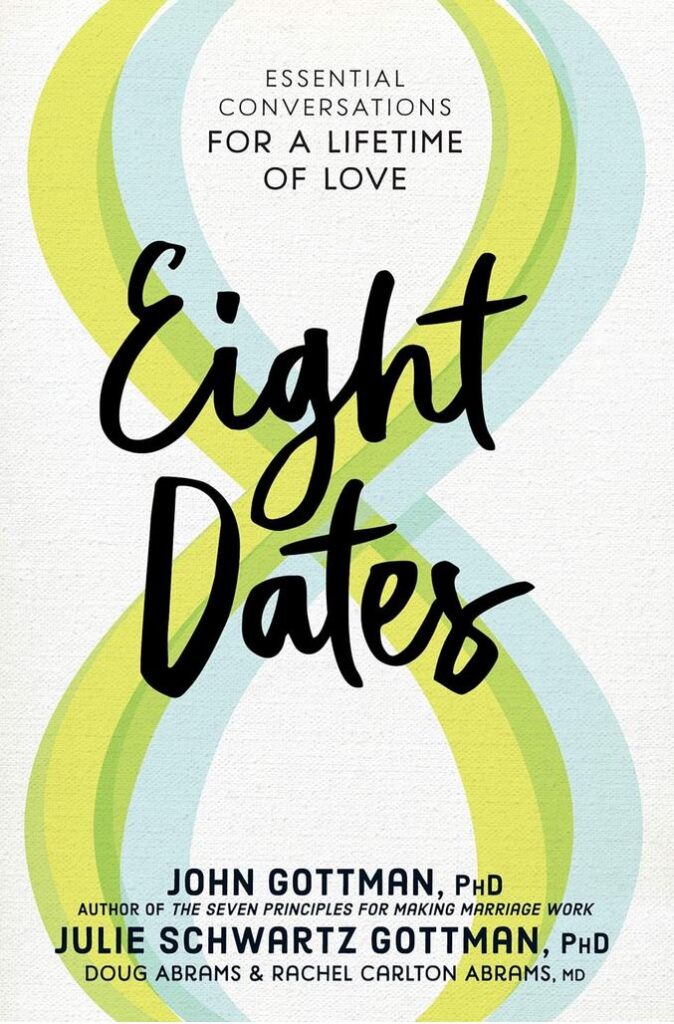
Eight Dates gives couples a reason to change that.
The book structures eight dates around important relationship subjects including trust, conflict, sex, money, family, adventure, spirituality and dreams, with activities and prompts intended to keep couples talking and curious about each other.
Perhaps its most valuable underlying idea is wonderfully simple:
You haven’t finished getting to know your partner.
People change.
The person sitting beside you today isn’t exactly the person you met years ago.
Neither are you.
Start here if: your conversations have become dominated by logistics and everyday responsibilities.
5. The Rough Patch — Daphne de Marneffe
Best for couples going through a difficult season of life
Sometimes relationship problems don’t exist in isolation.
They’re happening while you’re raising children.
Building careers.
Supporting ageing parents.
Dealing with money.
Watching your own priorities change.
Wondering what happened to the person you used to be.
A difficult period doesn’t automatically mean you’ve chosen the wrong partner.
Sometimes life itself has become difficult.
The Rough Patch: Marriage and the Art of Living Together by psychologist Daphne de Marneffe is particularly relevant to couples navigating the pressures and transitions that can accompany midlife and long-term commitment.
Rather than looking for a quick relationship trick, it considers the challenge of balancing individual development with the demands of sharing a life.
Start here if: your relationship became harder as the rest of life became more complicated.
6. Mating in Captivity — Esther Perel
Best when emotional connection remains but desire has faded
There’s another kind of distance couples don’t always find easy to discuss.
You may still be affectionate.
Still care deeply about one another.
Still function well together.
But the romantic or sexual energy that once felt effortless has changed.
Mating in Captivity explores the tension between the security of committed relationships and the individuality, novelty and separateness that can play a role in sustaining desire.
One of the interesting ideas this raises is whether becoming extremely familiar with each other can sometimes reduce the curiosity that was naturally present at the beginning.
Perhaps closeness doesn’t require two people to become identical.
Maintaining interests, experiences and parts of life that belong to each individual can give partners something new to continue discovering.
Start here if: you still feel like good companions but miss the romantic dimension of your relationship.
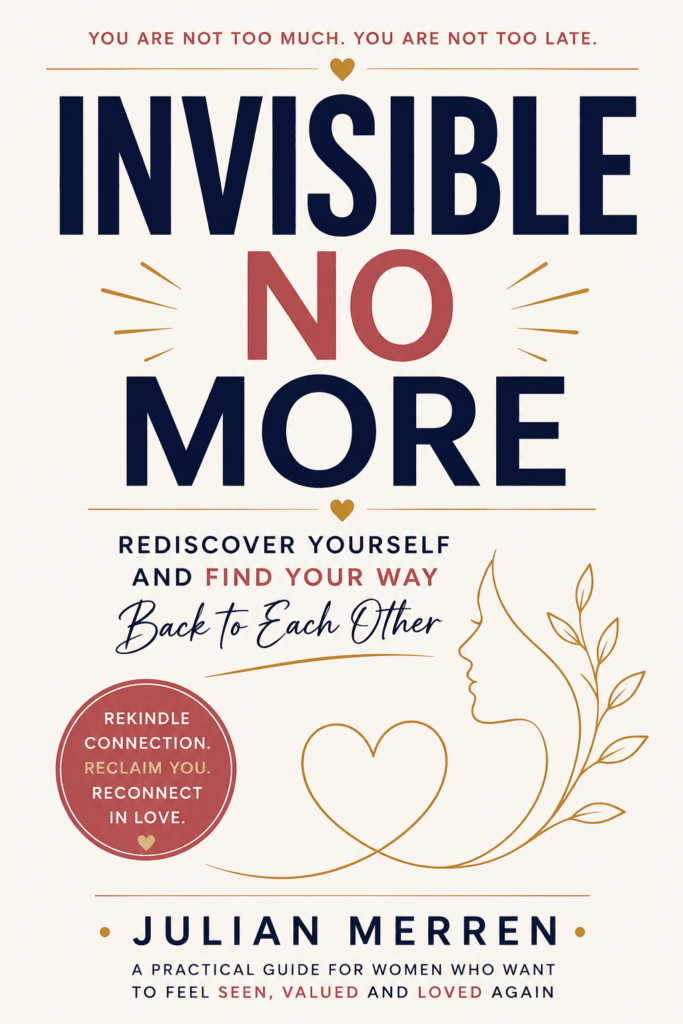
7. Invisible No More — Julian Merren
Best when you’ve lost connection with yourself as well as your partner
Sometimes finding your way back to your partner begins somewhere unexpected.
With yourself.
You may have spent years becoming increasingly good at fulfilling roles.
Partner.
Parent.
Worker.
Organiser.
Carer.
Problem-solver.
Everyone relies on you.
Yet somewhere beneath all those responsibilities is a quieter thought:
I don’t feel like myself anymore.
That’s the territory explored in Invisible No More: Rediscover Yourself and Find Your Way Back to Each Other by Julian Merren.
The book is written particularly for women who feel unseen within a long-term relationship and want to rediscover their own identity while exploring the possibility of renewed connection with their partner.
It considers themes including confidence, boundaries, communication, friendship, appreciation and emotional connection.
And that adds an important perspective to this list.
Reconnecting isn’t always about learning how to become a better couple.
Sometimes you need to remember who the two people inside the couple actually are.
If that experience feels familiar, you can discover Invisible No More by Julian Merren.
Start here if: you miss your partner, but you’ve also realised that you miss yourself.
Choosing Among the Best Relationship Books for Couples Who Feel Disconnected
You don’t need to read seven relationship books.
Start with the problem that feels closest to your own experience.
If you’re struggling with emotional security and recurring patterns, try Hold Me Tight.
For everyday relationship habits, start with The Seven Principles for Making Marriage Work.
If you’ve become opponents rather than teammates, consider Us.
If you’ve stopped really talking, try Eight Dates.
For a relationship struggling under midlife pressures and change, consider The Rough Patch.
If desire and individuality are the missing pieces, Mating in Captivity offers a different perspective.
And if you’ve lost yourself while trying to hold everything together, Invisible No More may speak most directly to where you are.
Finding Your Way Back Doesn’t Mean Going Backwards
There’s something worth remembering when we talk about reconnecting.
The goal isn’t necessarily to recreate your relationship as it was five, ten or twenty years ago.
Those people don’t exist anymore.
You’ve both experienced things.
Changed.
Learned.
Lost things.
Gained things.
Developed different needs.
Finding your way back to each other can therefore mean something much more interesting than returning to the past.
It can mean discovering each other again.
The best relationship books for couples who feel disconnected can’t do that work for you. What they can do is give you language for something you’ve struggled to explain, reveal a pattern you hadn’t noticed or provide a question worth asking over dinner tonight.
Sometimes one question is enough to begin:
What do you miss about us?
Then listen to the answer.
And perhaps ask another.