
Have you ever known exactly what you wanted to say, only to struggle when it was time to put the thought into words?
Perhaps you start explaining something and realise halfway through that you’ve wandered away from your original point. Maybe you use more words than you intended, struggle to find the right expression or think of the perfect response several minutes after the conversation has ended.
It can be frustrating, particularly when you know your thoughts are clearer than they sounded.
The good news is that speaking clearly isn’t simply something you’re either naturally good at or you’re not. Communication is a skill that can be practised and developed. Toastmasters, for example, describes successful communication as something that improves through applying clear principles and continued practice.
If you’re looking for books to become more articulate, the most useful choices aren’t necessarily books filled with impressive vocabulary. Often, they’re books that help you organise your thoughts, choose your words more deliberately, understand conversations and communicate your point without burying it.
Here are five worth exploring.
1. It’s the Way You Say It — Carol A. Fleming
Carol A. Fleming’s It’s the Way You Say It: Becoming Articulate, Well-Spoken, and Clear is perhaps the most directly matched book on this list.
Fleming is a speech pathologist and personal communication coach, and the book takes a practical approach to understanding how other people hear you. It covers areas including vocal patterns, grammar, vocabulary, non-verbal communication and common speaking difficulties, alongside exercises designed to help readers improve.
What makes this particularly useful is its emphasis on more than simply choosing better words.
Becoming articulate is partly about what you say, but it’s also about how your message reaches another person. Pace, tone, clarity and delivery can all affect whether a perfectly reasonable thought sounds confident, uncertain, rushed or confusing.
This is a good choice if you’d like to examine your overall speaking style rather than concentrating on only one aspect of communication.
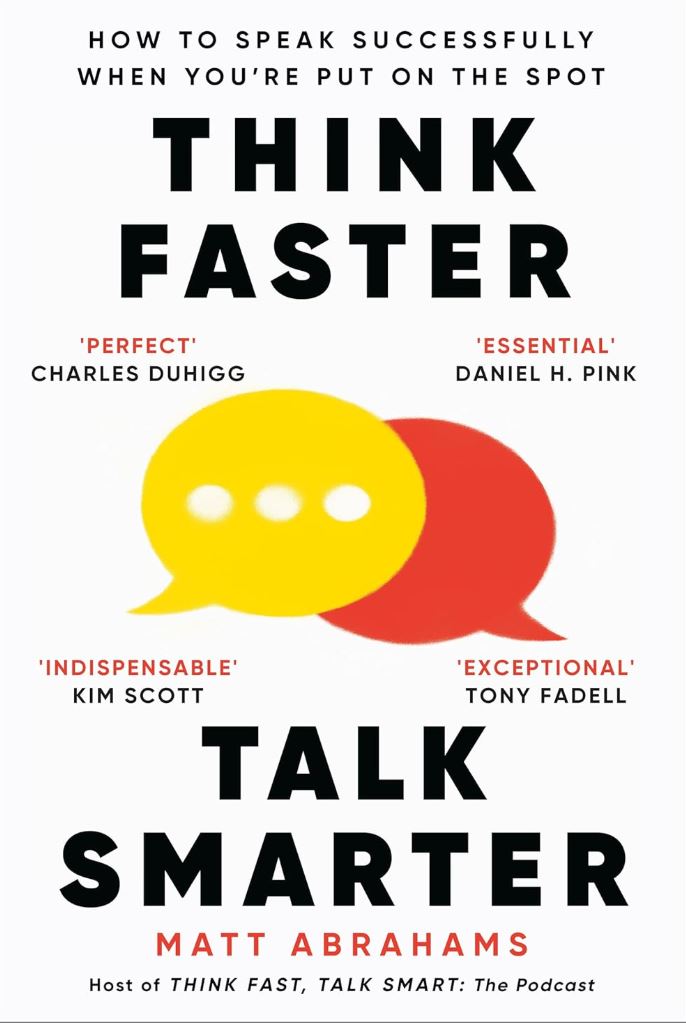
2. Think Faster, Talk Smarter — Matt Abrahams
One of the hardest moments in communication is when you don’t have time to prepare.
Someone asks you a question in a meeting. A conversation suddenly turns to you. You’re asked for an opinion you weren’t expecting to give.
And your mind seems to empty.
Matt Abrahams’ Think Faster, Talk Smarter focuses on communicating effectively in spontaneous situations. Abrahams teaches strategic communication at Stanford, and the book is designed around finding the right words when you have to respond in the moment.
That’s an important part of articulation because clear communication rarely happens under perfect conditions.
You can prepare for a presentation. You can’t prepare a script for every question, conversation, meeting or unexpected encounter.
Learning to give yourself a moment to think, organise an answer and communicate it without chasing perfection can make everyday speaking considerably easier.
If your biggest frustration is “I know the answer until somebody puts me on the spot”, this is an especially relevant read.
3. The First Minute — Chris Fenning
Some people don’t struggle to find something to say.
They struggle to stop.
A simple answer becomes a long explanation. Background information arrives before the actual point. One idea leads to another until the listener has to work out what the conversation was originally about.
Chris Fenning’s The First Minute: How to Start Conversations That Get Results tackles clear and concise communication, particularly at work. Fenning’s approach centres on clear intent, dealing with one topic at a time and getting to the point without unnecessary tangents.
That’s why it belongs among our books to become more articulate.
Being articulate doesn’t mean saying more. In many situations, it means recognising what matters and giving that information enough space to be understood.
This book should particularly appeal to people who find themselves rambling in meetings, overexplaining updates or giving five minutes of context before finally reaching the sentence everyone needed.
4. Supercommunicators — Charles Duhigg
Clear communication isn’t only about expressing yourself.
You also have to understand the conversation you’re actually having.
In Supercommunicators, Charles Duhigg explores why some people are particularly effective at connecting with others. One of the book’s central ideas is that conversations can operate on different levels—including practical, emotional and social—and communication can falter when people are effectively having different kinds of conversations with each other.
That makes this a useful addition to a list about articulation.
You can express a thought beautifully and still fail to communicate if you haven’t understood what the other person needs from the conversation.
Sometimes they want a solution.
Sometimes they want to be heard.
Sometimes you’re debating facts while they’re talking about how something made them feel.
Supercommunicators broadens the subject from How can I speak better? to the equally valuable question: How can we understand each other better?
For readers who want better conversations rather than simply more polished speech, it’s well worth considering.
5. Articulate — Julian Merren
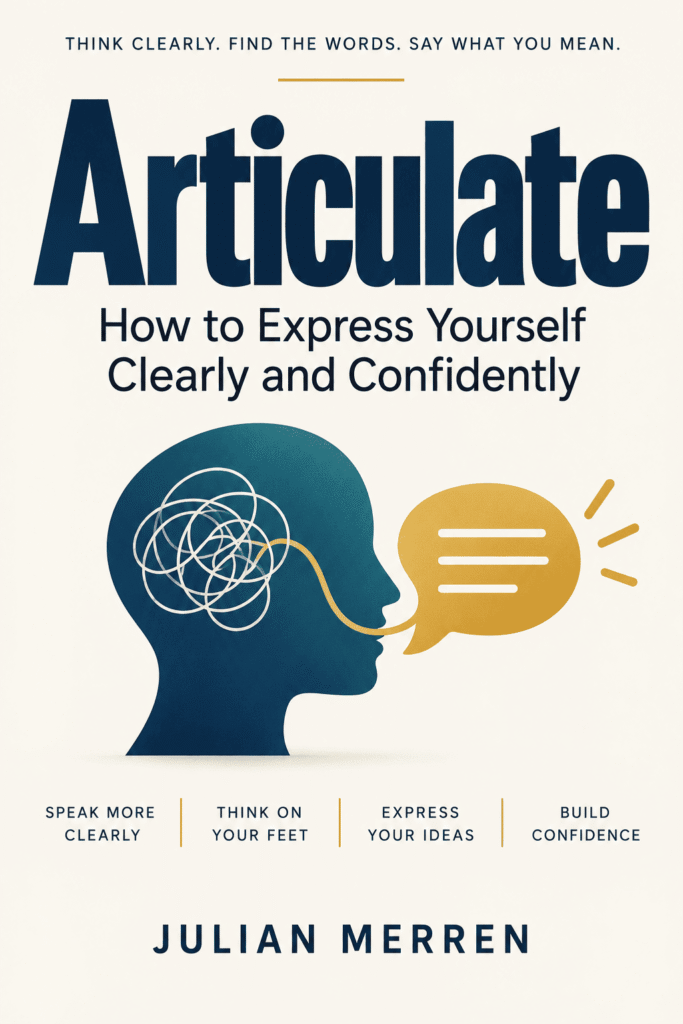
Articulate: How to Express Yourself Clearly and Confidently approaches the problem from a familiar everyday frustration:
You know what you mean. You simply can’t always say it the way you want to.
Rather than trying to make you sound more sophisticated, Articulate focuses on practical communication skills: organising your thoughts before speaking, stopping rambling, finding better words, explaining ideas clearly, thinking on your feet and remaining composed when a conversation carries more pressure.
It also explores listening and conversation skills, because becoming more articulate isn’t simply about becoming a better talker.
The aim is to become easier to understand while still sounding like yourself.
That distinction matters.
You don’t need an enormous vocabulary, a louder personality or perfectly polished sentences. Often, you need a clearer idea of your point, a simple structure for expressing it and enough confidence to stop once you’ve said what you mean.
If that sounds like the communication skill you’d like to develop, you can learn more about Articulate by Julian Merren.
Why Reading Can Help You Become More Articulate
Reading alone won’t automatically turn someone into a clearer speaker.
The real value comes from noticing an idea and then deliberately using it.
You might practise answering a question in two sentences instead of six. Pause before responding instead of filling the silence. Record yourself explaining something for 30 seconds. Replace a vague word with a more precise one. Or concentrate on listening fully before deciding what you’re going to say next.
Small exercises like these turn an interesting communication idea into a usable skill.
That’s also why these five books approach articulation from slightly different directions.
Fleming looks closely at the way you speak. Abrahams helps with spontaneous communication. Fenning concentrates on clarity and concision. Duhigg explores connection and conversation. Articulate brings many of the everyday difficulties together around the practical challenge of thinking clearly, finding the words and saying what you mean.
Which Book Should You Start With?
Start with the communication problem you recognise most strongly.
If you’re concerned about your voice and overall speaking style, Fleming may be the natural starting point. If you freeze when you’re put on the spot, consider Abrahams. If you tend to ramble or bury your point, Fenning offers a particularly focused approach. If you’re interested in understanding conversations and connection, Duhigg takes the subject in a broader direction.
And if your problem is difficult to separate into one category—perhaps you ramble sometimes, lose words at others and simply want to express yourself more clearly in everyday life—Articulate was written around that wider challenge.
The best books to become more articulate won’t give you a new personality.
They can give you better tools for expressing the personality, knowledge and ideas you already have.
And sometimes that’s the real goal: not sounding more impressive, but finally being able to say what you meant to say.
Ready to work on your own communication? Explore Articulate by Julian Merren and start practising the skills that help you think clearly, find the words and say what you mean.