

There is a particular kind of frustration that happens in meetings.
You have something useful to say. You may even have rehearsed the point in your head. But the conversation moves quickly, someone else jumps in, and the moment passes.
Or perhaps you do speak, but you soften your contribution with “I’m not sure, but…” or spend so long explaining your thinking that you lose confidence halfway through.
Then the meeting finishes and the words arrive.
I should have said that.
If this sounds familiar, the right books to speak confidently in meetings can help with more than simply telling you to “be confident”. They can show you how to organise your thoughts, get to the point, handle disagreement and contribute without feeling that every sentence has to be perfect.
Here are five books worth exploring if you’d like your voice to be heard more often at work.
1. The First Minute — Chris Fenning
One reason speaking in meetings can feel difficult is that we often think we need to explain everything before arriving at our point.
That can lead to long introductions, unnecessary background and the uncomfortable feeling that everyone is waiting for us to get somewhere.
The First Minute by Chris Fenning is particularly relevant because it focuses on getting important information across clearly and quickly.
That principle works beautifully in meetings.
Instead of beginning with:
“I’ve been looking at this for the last couple of days, and there are quite a few things we probably need to consider…”
you might begin with:
“I think we should delay the launch by one week. There are two issues we need to resolve first.”
Now everyone knows where you’re going.
You haven’t necessarily become more confident. You’ve simply made your message easier to deliver.
And that can sound like confidence.
Try this before your next meeting
Write down the one sentence you most want people to remember.
Not five points. Not your entire argument.
Just one.
If the opportunity arises, start there.

2. The Pyramid Principle — Barbara Minto
If your difficulty isn’t speaking up but organising what you want to say, The Pyramid Principle offers another useful approach.
Barbara Minto’s framework centres on structuring ideas logically, beginning with the main message and supporting it with the information underneath.
You don’t need to turn every workplace conversation into a formal presentation to benefit from that principle.
Imagine someone asks:
“Do you think we should change suppliers?”
Instead of thinking aloud for two minutes before eventually reaching your conclusion, you could structure your response:
Point: “Yes, I think we should.”
Reason: “Reliability has become the biggest problem.”
Support: “We’ve had three delays this quarter, and two affected customers.”
That structure gives your thoughts somewhere to go.
For people who lose confidence because several ideas arrive at once, learning to organise those ideas can make speaking considerably easier.
3. The Next Conversation — Jefferson Fisher
Confidence in meetings isn’t only about presentations or formal updates.
Sometimes the difficult moments are conversational.
Someone disagrees with you. A colleague interrupts. Your suggestion is challenged. A discussion becomes tense, and suddenly you’re concentrating more on how you sound than on what you actually want to say.
The Next Conversation by Jefferson Fisher explores how to communicate more deliberately in everyday interactions, particularly when conversations become difficult.
That makes it useful for someone who can speak perfectly well when everything is relaxed but finds it harder when there is disagreement in the room.
One important shift is to stop treating confidence as dominance.
You don’t need to speak louder than everyone else. You don’t need the quickest comeback. And you don’t need to win every disagreement.
Calm, clear communication can be far more effective.
The aim isn’t to overpower the room.
It’s to be able to say what you mean without abandoning your point the moment somebody pushes back.
4. Get to the Point! — Joel Schwartzberg
Meetings reward clarity.
People are processing agendas, deadlines, questions, competing opinions and whatever meeting comes next. A useful contribution can easily disappear inside too much explanation.
Joel Schwartzberg’s Get to the Point! focuses on identifying and communicating an actual point rather than simply presenting information.
This matters because one of the easiest ways to undermine your own confidence is to begin speaking without knowing exactly where you’re going.
You start with one thought.
Then add another.
Then remember something else.
And suddenly you’re wondering how to finish.
If you’re looking for books to speak confidently in meetings, this is an important distinction: sometimes what feels like a confidence problem is really a clarity problem.
Before contributing, ask yourself:
What is my point?
Then say it.
You can explain afterwards.
5. Articulate — Julian Merren
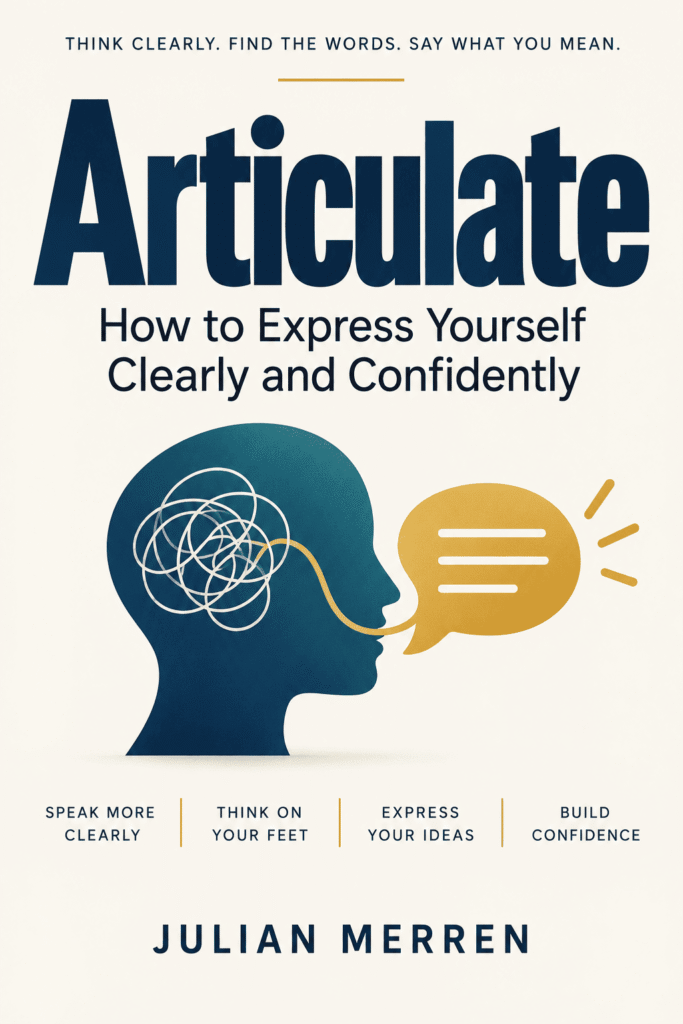
Articulate: How to Express Yourself Clearly and Confidently by Julian Merren approaches the problem from a familiar everyday experience: knowing what you mean but struggling to express it clearly in the moment.
That can become particularly noticeable at work.
You may understand the subject perfectly well but still hesitate when somebody suddenly asks for your opinion. You might rush because everyone is listening, lose your train of thought or overexplain because you’re trying so hard to make yourself understood.
Articulate focuses on becoming better at turning thoughts into clear spoken language — organising what you mean, finding the words and delivering your point without unnecessary clutter.
A simple approach worth practising is:
Pause → Point → Explain
Pause long enough to decide what you actually want to say.
State your point.
Then add only the explanation needed to support it.
That tiny gap between being asked a question and beginning your answer can make a considerable difference.
You don’t have to fill every silence immediately.
If clearer, more confident everyday communication is something you’d like to work on, you can discover Articulate by Julian Merren.
What the Best Books to Speak Confidently in Meetings Have in Common
There is an interesting thread running through all five books.
Speaking confidently isn’t necessarily about becoming more outgoing.
Often, it’s about removing the things that make speaking harder.
That might mean:
- knowing your main point before you begin;
- putting the important information first;
- using a simple structure when several thoughts compete for attention;
- becoming comfortable with a short pause;
- contributing without waiting for the perfect wording;
- practising speaking aloud rather than only rehearsing silently.
That last point is worth paying attention to.
You can think through conversations endlessly, but speaking is a skill that benefits from actually speaking.
Toastmasters International similarly recommends practising aloud and provides opportunities to build speaking confidence in a supportive, lower-pressure environment. Its guidance specifically connects this type of practice with becoming more prepared for meetings, presentations and everyday conversations. Toastmasters International
A Simple Meeting Habit to Try This Week
You don’t need to transform the way you communicate overnight.
Before your next meeting, write down two useful contributions you could make.
Perhaps one is a question.
The other might be an opinion, observation or suggestion.
Then give yourself one small goal:
Say one of them.
Not brilliantly.
Not perfectly.
Just clearly.
If somebody asks you a question unexpectedly, resist the urge to begin answering immediately.
Give yourself a moment and ask:
What’s the main thing I want them to understand?
Then start there.
You can even practise this before the meeting.
Take one likely question and answer it aloud. Then do it again, but this time try to make your first sentence clearer.
The goal isn’t to memorise a script.
It’s to become more comfortable turning a thought into spoken words.
Confidence Doesn’t Mean Having an Instant Answer
There’s another trap worth avoiding.
We often assume confident people always know what to say immediately.
They don’t.
A short pause can actually help you produce a better answer than rushing into the first sentence that enters your head.
If somebody asks for your opinion, there is nothing wrong with taking a moment.
You might even say:
“Give me a second to think about that.”
Then think.
That is very different from panicking internally because you believe silence means you’ve failed.
You don’t need an instant answer.
You need a useful one.
You Don’t Have to Be the Loudest Person in the Meeting
The person who speaks most isn’t automatically the person who communicates best.
You can be naturally quiet and still make strong contributions.
You can take a moment to think and still sound assured.
You can disagree without becoming confrontational.
And you can speak less while saying more.
The goal isn’t to turn yourself into somebody else.
It’s to make it easier for the ideas already in your head to reach the people around the table.
These books to speak confidently in meetings approach that challenge from different directions — from organising your thoughts and getting to the point to handling difficult conversations and expressing yourself more clearly.
Start with the problem that sounds most like yours.
Then, at your next meeting, don’t set yourself the impossible goal of suddenly becoming the most confident speaker in the room.
Set yourself a smaller one.
Make one useful contribution clearly.
Then build from there.
And if knowing what you mean but struggling to say it clearly is the part you recognise most, take a closer look at Articulate by Julian Merren.