

There are conversations we can have without giving them a second thought.
And then there are the ones we rehearse in our heads for days.
Perhaps you need to tell somebody they’ve hurt your feelings. Maybe you disagree with a decision at work, need to set a boundary with a family member or want to raise an issue you’ve been avoiding.
You know the conversation matters.
But you also know it could become uncomfortable.
What if they react badly? What if you get emotional? What if you can’t find the right words when the moment arrives?
Sometimes we avoid these conversations because we don’t know how to begin. Other times, we say too much, become defensive or walk away wishing we’d handled things differently.
If you’re looking for books about difficult conversations, the following five titles offer useful perspectives on communicating when the stakes feel higher than usual.
They won’t make every discussion easy. But they can help you approach challenging moments with greater preparation, clarity and understanding.
1. Difficult Conversations — Douglas Stone, Bruce Patton and Sheila Heen
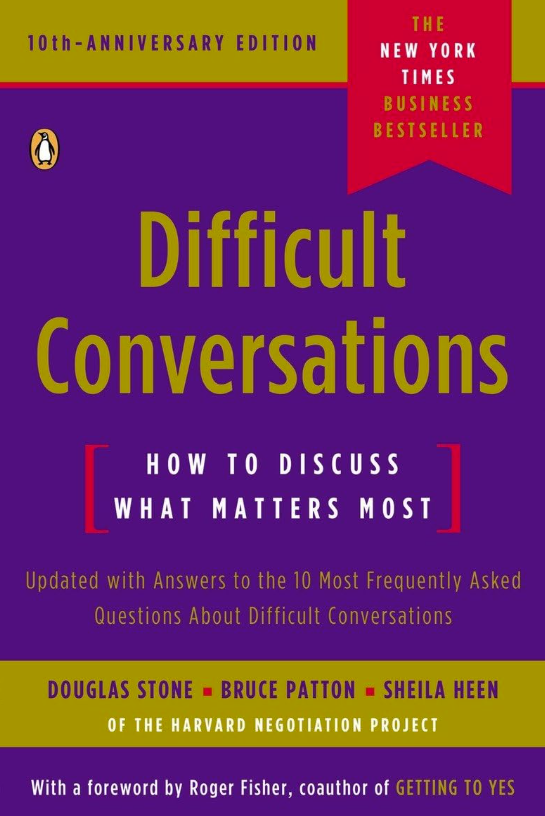
Best for: Understanding why important conversations become so complicated.
Some conversations are difficult because of what needs to be said.
Others become difficult because two people understand the same situation very differently.
Difficult Conversations explores what happens when people disagree about events, experience strong feelings or believe something important about themselves is being challenged.
One of its most useful ideas is recognising that we often enter a conversation convinced we already understand what happened.
But the other person may have experienced the situation differently.
Imagine telling a colleague:
“You never listen to my suggestions.”
They may immediately become defensive.
After all, from their perspective, they might believe they’ve considered your ideas carefully.
A more constructive starting point could be:
“I’ve noticed that a few of my suggestions haven’t been discussed, and I’d like to understand why.”
You’re still raising the concern.
But you’re also making room for another perspective.
Try this: Replace accusations with observations
Before a difficult conversation, separate what you actually observed from what you’ve assumed.
Instead of deciding that somebody deliberately ignored you, describe what happened and explain how it affected you.
Then invite their perspective.
The aim isn’t to abandon your concerns.
It’s to create a conversation where both people have an opportunity to understand what’s happening.
Why read it? If discussions frequently turn into arguments about who’s right, this book offers a thoughtful approach to exploring disagreement.

2. Thanks for the Feedback — Douglas Stone and Sheila Heen
Best for: Handling criticism and responding without becoming defensive.
Not every difficult conversation begins with something we need to say.
Sometimes we’re the person receiving an uncomfortable message.
Perhaps a manager questions your work.
A friend tells you that something you said was hurtful.
Or somebody offers advice you didn’t ask for.
Even when feedback is intended to be helpful, hearing it can be difficult.
Thanks for the Feedback explores why receiving feedback can trigger strong reactions and how we can become more capable of understanding and evaluating it.
An important distinction is that listening to feedback doesn’t mean automatically agreeing with it.
You can consider somebody’s perspective without accepting every conclusion they’ve reached.
Try this: Ask for a specific example
Imagine your manager says:
“You need to communicate better with the team.”
That’s a broad statement.
You might feel criticised without understanding exactly what needs to change.
Instead of immediately defending yourself, you could ask:
“Could you give me an example of where my communication wasn’t clear?”
Now the conversation has something specific to explore.
You may discover a genuine area for improvement.
Or you may identify a misunderstanding that needs to be discussed.
Either way, asking for clarity is often more productive than reacting to a vague criticism.
Why read it? If receiving feedback makes you uncomfortable or defensive, this book offers practical ways to approach those moments more thoughtfully.
3. The Book of Boundaries — Melissa Urban
Best for: Saying what you need without unnecessary guilt or overexplaining.
Some difficult conversations aren’t really about disagreement.
They’re about asking for something to change.
Perhaps a family member repeatedly makes demands on your time.
A colleague expects you to respond to messages outside working hours.
Or somebody continues raising a subject you’ve already said you’re uncomfortable discussing.
Setting a boundary can feel difficult because we’re often concerned about disappointing people.
We soften our words.
We offer lengthy explanations.
And sometimes we agree to things we don’t actually want to do.
The Book of Boundaries by Melissa Urban focuses on communicating personal limits clearly and respectfully.
It includes practical language for situations where people need to express what they will and won’t accept.
Try this: State the boundary without building a long defence
Imagine a colleague regularly asks you to stay late with very little notice.
You might feel tempted to explain every reason why you can’t help.
But a simpler response could be:
“I can’t stay late today. If you need my help tomorrow, let me know and we’ll work out a time.”
You’re being respectful.
You’re also being clear.
Of course, boundaries sometimes require further discussion, particularly in relationships or workplaces where responsibilities overlap.
But you don’t always need an elaborate justification to communicate a reasonable limit.
Why read it? If you struggle to say no, communicate your needs or stop overexplaining your decisions, this book offers useful guidance.
4. Nonviolent Communication — Marshall B. Rosenberg
Best for: Expressing difficult feelings without turning the conversation into an attack.
When emotions are involved, the way we describe a problem can make a significant difference.
Consider the statement:
“You never care about what I need.”
Even when that sentence comes from genuine frustration, the other person may hear it as an accusation.
And once they become defensive, the original concern can get lost.
Nonviolent Communication by Marshall B. Rosenberg explores an approach to communication built around observations, feelings, needs and requests.
Rather than concentrating entirely on what another person has done wrong, it encourages us to express what we’re experiencing and what we’re asking for.
Try this: Explain the impact and make a clear request
Imagine somebody repeatedly interrupts you during conversations.
Instead of saying:
“You’re always so rude.”
You might try:
“When I’m interrupted before I’ve finished speaking, I feel frustrated because I want the chance to explain my point. Could you let me finish before responding?”
That doesn’t guarantee the other person will respond positively.
But it makes your concern easier to understand.
You’ve described the behaviour, explained its impact and made a specific request.
The goal isn’t to avoid every disagreement.
It’s to communicate difficult feelings without unnecessarily escalating the situation.
Why read it? If emotional conversations often become arguments, this book offers a different way to express concerns and understand others.
5. Articulate — Julian Merren
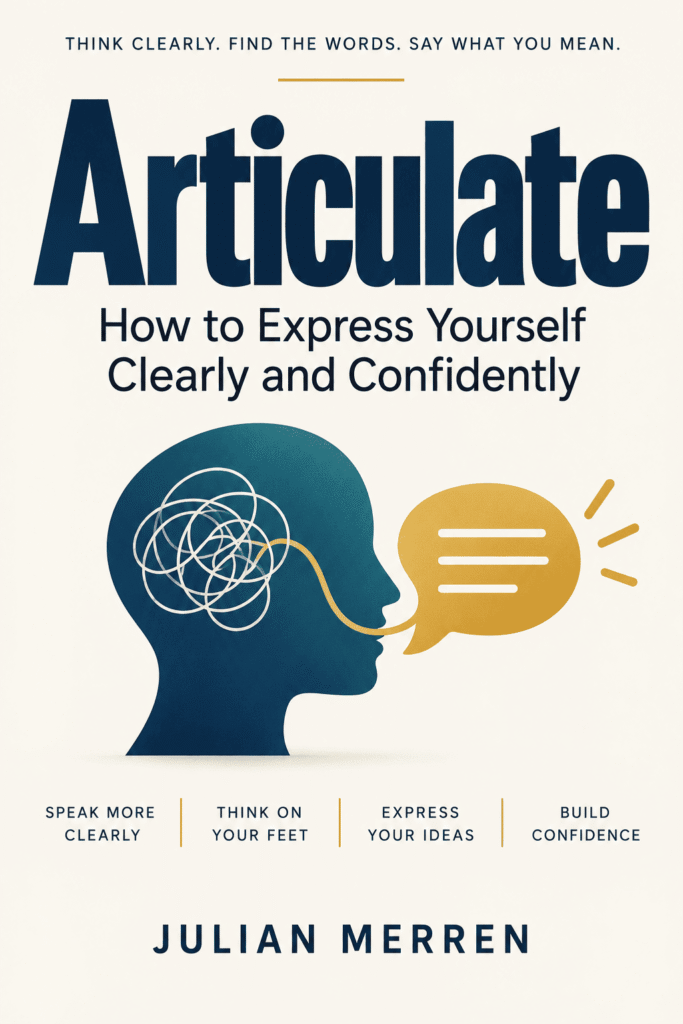
Best for: Finding the right words when a conversation feels important.
Even when you understand the principles of good communication, putting them into practice can be difficult.
You might know that you should remain calm, explain your concerns clearly and listen to the other person’s perspective.
But when the conversation actually begins, your thoughts become tangled.
You start speaking too quickly.
You add unnecessary details.
Or you forget the point you wanted to make.
Articulate: How to Express Yourself Clearly and Confidently by Julian Merren focuses on practical ways to organise your thoughts, find the right words and communicate more effectively.
These skills can be particularly valuable when you’re nervous about saying something important.
One useful approach is:
Pause. Point. Explain.
Pause briefly before speaking.
Identify the central message you want to communicate.
Then explain it using the details that genuinely matter.
Try this: Prepare your opening sentence
Imagine you need to tell a friend that something they said upset you.
You could spend several minutes explaining the entire situation before revealing what’s bothering you.
Or you could begin with:
“There’s something from our last conversation that’s been bothering me, and I’d like to talk about it.”
Now you’ve established the purpose of the discussion.
You can explain what happened and how you felt without trying to fit everything into your opening sentence.
Being articulate doesn’t mean having a perfect response to every difficult moment.
It means developing the ability to express what matters, even when the words don’t come easily.
Why read it? If you know what you want to say but struggle to communicate clearly under pressure, Articulate addresses that challenge directly.
You can discover Articulate by Julian Merren here.
What the Best Books About Difficult Conversations Have in Common
Although these books approach communication differently, they share an important lesson.
A difficult conversation doesn’t have to become a battle.
You can disagree without attacking somebody.
You can express disappointment without blaming.
You can set a boundary without being deliberately unkind.
And you can listen to another perspective without automatically abandoning your own.
That doesn’t mean every conversation will end with agreement.
Sometimes people will continue to see things differently.
Sometimes a boundary won’t be respected.
And sometimes the healthiest outcome is recognising that further discussion isn’t productive.
The goal isn’t to control somebody else’s response.
It’s to communicate your own position as clearly and respectfully as possible.
Five Questions to Ask Before a Difficult Conversation
Before raising something important, give yourself a few minutes to prepare.
Consider these five questions:
- What do I actually want to communicate? Identify the main concern rather than every frustration connected to it.
- What outcome am I hoping for? Are you seeking understanding, a change in behaviour, an apology or a practical decision?
- What might the other person see differently? Consider their perspective without assuming you know exactly what they’re thinking.
- What example would help explain my concern? Choose something specific rather than relying on sweeping statements.
- What will I do if the conversation becomes unproductive? Decide whether you may need to pause, return to the subject later or seek appropriate support.
You don’t need to rehearse every possible response.
In fact, trying to predict an entire conversation can make you more anxious about having it.
Instead, prepare your opening point and remain willing to listen.
Remember That Timing Matters Too
Even the clearest message can be difficult to receive at the wrong moment.
Raising a sensitive issue when somebody is rushing out the door, already upset or surrounded by other people may make the conversation harder than necessary.
Where possible, choose a time when both of you can give the discussion some attention.
You might begin with:
“There’s something I’d like to discuss. Is now a good time, or would later be better?”
That simple question gives the conversation a more considerate starting point.
It also recognises that communication isn’t only about choosing the right words.
It’s about creating reasonable conditions for those words to be heard.
If a conversation involves intimidation, threats or abuse, however, your safety matters more than finding the perfect wording. You don’t need to continue an unsafe discussion simply to resolve it.
Final Thoughts: You Don’t Need Perfect Words
Difficult conversations are part of relationships, workplaces and everyday life.
We can’t avoid every disagreement, disappointment or uncomfortable truth.
But we can become more thoughtful about how we approach them.
The most useful books about difficult conversations remind us that communication involves more than delivering a message.
It involves understanding, listening, setting boundaries and recognising when a conversation needs care.
Start with whichever skill you find most challenging.
And remember that you don’t need to have every sentence planned before speaking.
Sometimes the most important step is simply finding a clear, respectful way to begin.
If expressing yourself under pressure is the part you struggle with most, take a closer look at Articulate by Julian Merren.
Because difficult conversations may never feel completely comfortable.
But finding the words to say what matters is a skill worth developing.