
You finally make a decision. Perhaps you’ve accepted an invitation, applied for a new job, spoken up in a meeting, or simply chosen what you think is the right thing to do.
For a moment, you feel good about it.
Then the questions begin.
What if I made the wrong choice? What if I should have waited? What if someone else would have handled it differently?
Before long, you’re reconsidering something you thought you’d already settled. You ask another person for their opinion, replay the possibilities and wonder why making even relatively simple decisions can feel so exhausting.
If this sounds familiar, learning how to stop second-guessing yourself could help you make decisions with greater confidence and spend less time questioning your judgment afterwards.
The answer isn’t to become someone who never makes mistakes. Nobody can guarantee that every decision will work out exactly as planned.
Instead, it’s about developing a more balanced way to evaluate your choices, recognising when you’ve thought enough and learning to trust yourself even when uncertainty remains.
In this guide, we’ll explore seven practical strategies to help you break the cycle of second-guessing. You’ll also discover a free PDF ebook designed to help you overcome self-doubt and strengthen your confidence.
Why Do You Keep Second-Guessing Yourself?
Second-guessing often begins with a reasonable intention: you want to make the right decision.
You consider the possibilities, weigh the consequences and try to avoid unnecessary mistakes. There’s nothing wrong with that. Thoughtful decision-making is an important part of everyday life.
The difficulty begins when careful consideration turns into endless reconsideration.
Instead of using information to reach a decision, you keep searching for reassurance that your choice is definitely correct.
Unfortunately, certainty isn’t always available.
You can’t know exactly how a conversation will unfold, whether a new opportunity will succeed or how someone might respond to your decision.
For some people, the uncertainty itself becomes uncomfortable. For others, it’s the fear of criticism, regret or disappointing someone.
Previous experiences can also influence how much you trust your own judgment. If you’ve been frequently criticised, dismissed or made to feel that your choices were wrong, making independent decisions may become more difficult.
The result is a familiar cycle.
You make a choice, begin doubting it, search for reassurance, feel temporarily better and then discover another reason to question yourself.
Breaking that pattern starts with recognising when thinking is helping you and when it’s simply keeping you stuck.

1. Separate Useful Thinking From Repetitive Doubt
Not all questioning is unhelpful.
If you’re considering a major financial commitment, changing careers or making an important decision about your health, taking time to examine your options is sensible.
But there’s a difference between evaluating a decision and repeatedly revisiting the same information.
Useful thinking moves you towards a clearer understanding.
Repetitive doubt often takes you back to where you started.
Imagine you’ve been offered a new position at work.
You review the salary, responsibilities, working hours and opportunities for development. You discuss the practical implications with your family and compare the offer with your existing role.
That’s thoughtful decision-making.
But after you’ve considered everything, you find yourself revisiting the same questions without discovering anything new.
Now ask yourself:
Am I gathering useful information, or am I looking for a guarantee that doesn’t exist?
This question can help you recognise when continued analysis has stopped being productive.
You don’t need to ignore genuine concerns. You simply need to notice when your thoughts are going around in circles rather than helping you move forward.
2. Decide What Matters Before Asking Everyone Else
When you’re uncertain, seeking advice can be valuable.
Another person may notice something you’ve overlooked or offer experience you don’t have.
The problem arises when you begin relying on other people’s opinions to make decisions that should reflect your own priorities.
Perhaps you want to take a course, but a friend thinks it’s a waste of time. Your partner has a different suggestion, while someone at work believes you should concentrate on your career.
Suddenly, you’re trying to satisfy three different opinions instead of deciding what matters to you.
Before asking for advice, spend a few minutes identifying your own priorities.
What are you hoping to achieve? What matters most in this situation? Which consequences are you willing to accept?
Then, if you need outside input, seek it from someone whose experience is relevant.
Remember that advice is information, not an instruction.
Other people can help you understand your options, but they don’t always know your circumstances, values or ambitions as well as you do.
Learning to trust your decisions begins with giving your own perspective a place in the conversation.
3. Stop Expecting Every Decision to Feel Completely Certain
One reason people struggle with self-doubt is the belief that a good decision should feel obviously right.
You imagine that if you think long enough, you’ll eventually reach a point where every concern disappears.
But many worthwhile decisions involve uncertainty.
You might feel excited about starting a new job and nervous about leaving something familiar. You might know that setting a boundary is necessary while still worrying about how another person will react.
Having mixed feelings doesn’t automatically mean you’re making the wrong choice.
Sometimes it simply means the decision matters.
Try asking yourself whether you have enough information to make a reasonable decision, rather than waiting until you feel completely confident.
For everyday choices, that might mean considering the available options and choosing the one that best fits your needs.
For important decisions, it may mean seeking appropriate professional advice or gathering further evidence.
The goal isn’t to become reckless or dismiss genuine risks.
It’s to recognise that reasonable confidence and absolute certainty are two very different things.
You can make a thoughtful choice without knowing precisely how everything will turn out.
4. Give Smaller Decisions a Clear Finishing Point
Second-guessing can turn ordinary decisions into surprisingly time-consuming tasks.
You compare products for hours, rewrite messages repeatedly or keep changing your mind about relatively minor plans.
Often, the amount of thinking becomes far greater than the importance of the decision itself.
One practical way to interrupt this habit is to decide how much attention a choice deserves.
If you’re choosing between two restaurants, perhaps five minutes is enough.
If you’re purchasing an expensive appliance, a more detailed comparison makes sense.
The important thing is to match your decision-making effort to the consequences involved.
You can also establish a simple finishing point.
For example, decide that you’ll compare three reasonable options, check the information that matters and make your choice.
Once you’ve done that, stop searching unless new information gives you a genuine reason to reconsider.
This approach isn’t about rushing.
It’s about recognising that some decisions don’t deserve unlimited time and attention.
5. Stop Reopening Decisions Without New Information
Have you ever made a decision, felt comfortable with it and then started doubting yourself a few hours later?
Nothing has changed.
You haven’t discovered a problem or received any new information.
Yet suddenly you’re convinced that you need to reconsider everything.
This is where learning to stop second-guessing yourself becomes particularly useful.
Try creating a simple rule:
I will reconsider this decision when there’s a meaningful reason, not simply because doubt has returned.
Suppose you’ve booked a holiday after researching the destination, checking your budget and confirming the dates.
The following morning, you begin wondering whether another destination might have been better.
Unless something important has changed, reopening the entire decision may only create unnecessary frustration.
Instead, remind yourself why you made the original choice.
You considered the available information and selected something that met your needs.
Could another option also have worked?
Of course.
But the existence of alternatives doesn’t automatically make your decision wrong.
The ability to move forward without constantly reopening settled choices can make everyday life feel considerably less demanding.
6. Learn From Mistakes Without Turning Them Into Personal Judgments
Sometimes second-guessing becomes especially strong after something goes wrong.
You make a decision that doesn’t work out, and your mind immediately begins reviewing everything you should have done differently.
Perhaps you accepted an opportunity that turned out to be disappointing. Maybe you trusted someone who let you down or spent money on something that wasn’t worthwhile.
It’s natural to feel frustrated.
But there’s a difference between learning from an experience and using it as evidence that you can’t trust yourself.
Consider asking three questions.
What information did I have when I made the decision?
Was my reasoning reasonable based on what I knew?
What would I do differently next time?
These questions help you evaluate the decision fairly rather than judging it entirely by the outcome.
A good decision-making process doesn’t guarantee a good result every time.
Sometimes circumstances change. Sometimes information is incomplete. And sometimes things simply don’t work out as expected.
Learning from those experiences is valuable.
Constantly criticising yourself for not predicting the future is not.
The more fairly you evaluate your decisions, the easier it may become to trust yourself when the next choice arrives.
7. Build Self-Trust Through Small Everyday Decisions
Self-trust doesn’t have to begin with a major life-changing decision.
You can practise it in ordinary situations.
Choose what you’d like to do with your afternoon without asking several people whether it’s a good idea. Make a small purchase within your budget without researching every possible alternative. Express a reasonable preference without immediately apologising for having one.
Then allow the decision to stand.
Pay attention to what happens.
You might experience a little discomfort or wonder whether another option would have been better.
That’s an opportunity to practise responding differently.
Rather than immediately seeking reassurance, remind yourself that you’ve made a reasonable choice based on the information available.
Over time, these small experiences can help you become more comfortable making decisions independently.
You may also discover that many everyday choices aren’t nearly as consequential as your doubts suggest.
Confidence doesn’t always appear before you act.
Sometimes it develops because you’ve repeatedly shown yourself that you can make choices, handle the outcomes and adjust when necessary.
A Simple Exercise: The Decision Review
If second-guessing is something you regularly struggle with, try this exercise the next time you face an ordinary, low-risk decision.
Take a piece of paper and write down the choice you’re considering.
Then answer four questions:
- What am I deciding? Describe the decision clearly without adding unrelated worries.
- What matters most? Identify the two or three factors that should influence your choice.
- What information do I still genuinely need? Separate missing facts from a desire for reassurance.
- When will I make the decision? Choose a reasonable finishing point.
Once you’ve made your choice, record one sentence explaining why.
For example:
I’ve chosen this option because it suits my budget, meets my needs and fits my current priorities.
If you begin questioning yourself afterwards, return to that sentence.
Unless you’ve discovered something important that changes the situation, give yourself permission to move forward.
This isn’t intended for urgent, high-risk or complex decisions that require specialist guidance. It’s a simple way to practise making ordinary choices without becoming trapped in endless reconsideration.
Free PDF Guide: I’m Tired of Doubting Myself
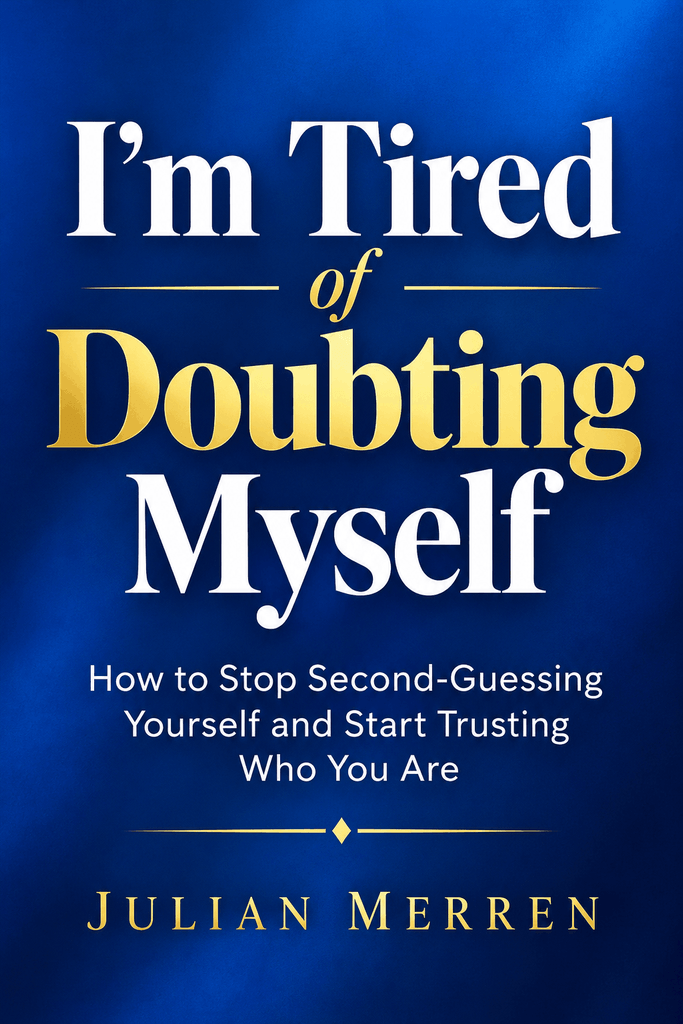
If you’ve been searching for a free PDF guide on how to stop second-guessing yourself, there’s a practical resource waiting for you in the Books That Shape Free Library.
I’m Tired of Doubting Myself: How to Stop Second-Guessing Yourself and Start Trusting Who You Are, by Julian Merren, is a free 41-page ebook for readers who want to build confidence and develop greater trust in their own judgment.
The guide explores common patterns of self-doubt and offers practical ideas for quieting your inner critic, approaching decisions with more confidence and learning to trust yourself.
It’s particularly relevant if you regularly question your choices, worry about making mistakes or feel that other people’s opinions carry more weight than your own.
Rather than promising that you’ll never experience doubt again, the book encourages you to develop a healthier response when uncertainty appears.
You can read it at your own pace and return to the ideas that feel most relevant to your circumstances.
Get I’m Tired of Doubting Myself — Free PDF Ebook
You’ll find the ebook in the Books That Shape Free Library alongside other free personal-growth guides covering habits, relationships, money, confidence and more.
Simply register once and confirm your email address to access the collection. You won’t need to register separately for every book.
When Self-Doubt Becomes Difficult to Manage
Occasionally questioning your decisions is part of everyday life.
However, if persistent self-doubt, anxiety or repetitive thinking is affecting your relationships, work or ability to manage daily responsibilities, speaking with a qualified mental-health professional may be helpful.
Professional support can help you understand the patterns behind excessive worry or reassurance-seeking and explore approaches appropriate to your situation.
Self-help books can provide useful ideas, but they’re not a substitute for individual care when more support is needed.
You Can Trust Yourself Without Getting Everything Right
Learning how to stop second-guessing yourself doesn’t mean becoming completely certain about every decision.
It means understanding that you can make thoughtful choices, accept a reasonable amount of uncertainty and respond constructively when things don’t work out as expected.
You don’t need everyone’s approval before expressing a preference.
You don’t have to revisit every choice simply because another possibility exists.
And you don’t need a perfect record of good decisions before you’re allowed to trust your own judgment.
Start with something small.
Make one reasonable decision today, give yourself permission to move forward and resist the urge to question it without a good reason.
Self-trust grows through experience.
And every time you allow yourself to make a choice and learn from the outcome, you’re giving that trust another opportunity to develop.