

Have you ever explained something that made perfect sense in your head, only to receive a confused look from the person listening?
You knew exactly what you wanted to say. You had a perfectly reasonable point. But somewhere between thinking about it and speaking aloud, the message became tangled.
Perhaps you included too much background information, struggled to find the right words or finished the conversation wishing you’d explained yourself differently.
It’s a frustrating experience, particularly when you know you’re capable of communicating much better.
The good news is that expressing yourself clearly is a skill you can develop. You don’t need an impressive vocabulary, a naturally outgoing personality or the ability to deliver perfectly polished sentences.
You need a few practical habits that help you turn thoughts into words other people can follow.
If you’re searching for a guide on how to express yourself clearly, this article will walk you through seven useful strategies. You’ll also find a free PDF ebook that can help you practise clearer communication in everyday situations.
Why Is It Sometimes Difficult to Express Yourself?

Thinking and speaking are two different activities.
Inside your head, ideas don’t always appear in neat sentences. You might understand something through memories, images, emotions and several connected thoughts.
But when you speak, you have to arrange those ideas into words, one sentence at a time.
Your listener doesn’t automatically know the background. They can’t see the connections you’ve already made, and they may interpret your words differently from how you intended.
Pressure can make this more difficult.
You might communicate comfortably with friends but struggle when speaking to your manager, explaining a disagreement or answering an unexpected question.
Sometimes the problem isn’t a lack of knowledge. It’s trying to manage too many things simultaneously: what you want to say, how you’re saying it, what the other person thinks and whether you’re making a good impression.
The solution isn’t necessarily to speak more.
Often, it’s to become more deliberate about what you’re communicating.
1. Know What You Want the Other Person to Understand
Before explaining something, ask yourself one simple question:
What is the main thing I want this person to understand?
It sounds obvious, but many conversations become confusing because the speaker hasn’t identified the central message.
Imagine you’re explaining to your manager why a project is running behind schedule.
You could begin by describing every meeting, unexpected problem and email exchange from the previous two weeks.
Or you could start with:
“The project will be two days late because we’re waiting for information from the supplier.”
That single sentence immediately gives your listener a useful picture of the situation.
You can explain the details afterwards.
The same principle applies outside work.
If you’re trying to tell a friend that something upset you, begin by identifying what you want them to understand rather than recounting every detail surrounding the event.
Clear communication becomes easier when you know the destination before beginning the explanation.
2. Start With Your Point, Then Add the Explanation
One of the most common communication habits is providing too much background before reaching the actual message.
You might start telling a story, remember an important detail, return to something that happened earlier and eventually arrive at what you wanted to say.
By then, your listener may have forgotten how the conversation began.
Try reversing the order.
Start with your central point. Then provide the information needed to support it.
For example, instead of saying:
“I’ve been thinking about the different things happening over the next few weeks, and with work getting busier and everything else going on, I was wondering if perhaps…”
Try:
“I’d like to move our meeting to Friday because Thursday has become too busy.”
It’s direct, respectful and easy to understand.
Of course, some conversations require sensitivity. You wouldn’t necessarily deliver difficult personal news without some preparation.
But for ordinary explanations, beginning with the main point can prevent unnecessary confusion.
3. Use Simpler Words Without Making Your Message Simplistic
Some people believe that expressing themselves clearly means using more sophisticated language.
They search for impressive words, complicated phrases or professional terminology because they want to sound knowledgeable.
But complicated language doesn’t automatically make an explanation better.
Consider these two statements:
“We need to facilitate an optimisation of our internal communication processes.”
“We need to make it easier for our teams to share information.”
Both may be trying to communicate the same idea, but the second is more direct.
Simple language doesn’t mean your thinking is simple.
It means you’re making your ideas accessible.
When you notice yourself searching for the perfect expression, try asking:
What’s the most straightforward way to say what I mean?
Choose familiar words whenever they communicate the message accurately.
If a technical term is necessary, explain it briefly rather than assuming everyone understands it.
The objective isn’t to impress your listener with your vocabulary. It’s to help them understand your meaning.
4. Give One Idea Enough Space Before Moving to Another
Sometimes people struggle to express themselves because they try to communicate several ideas at once.
They begin explaining one point, remember a related example, introduce another concern and then return to the original subject.
Each idea may be useful individually.
But when they’re delivered together without a clear structure, the listener has to work much harder to follow them.
Imagine you’re explaining why you want to make a change at work.
You might have concerns about workload, communication and the way responsibilities are distributed.
Rather than discussing all three simultaneously, address them individually.
Start with the main issue, explain why it matters and give an example if necessary.
Then move to the next point.
For longer explanations, simple transitions can help:
“There’s another part of this I’d like to explain.”
“The second issue is…”
“Here’s an example of what I mean.”
These small phrases give your listener a sense of direction.
You’re not trying to turn every conversation into a formal presentation. You’re simply making it easier for someone else to follow your thinking.
5. Learn to Express Feelings Without Losing Your Message
Expressing yourself clearly isn’t only about explaining information.
Sometimes you need to communicate disappointment, frustration, concern or something personally important.
These conversations can be especially difficult because emotions influence how we choose our words.
You might avoid expressing your feelings altogether because you don’t want to cause conflict.
Or you might say more than you intended because you’ve been holding those feelings in for too long.
A helpful starting point is to separate what happened from how it affected you.
For example, instead of saying:
“You never listen to anything I say.”
You could try:
“When I’m interrupted before I’ve finished, I feel frustrated because I don’t think I’ve had a chance to explain myself.”
The second statement is more specific.
It describes an observable situation and communicates the impact without automatically assuming the other person’s intentions.
You can then explain what would help:
“I’d appreciate being able to finish my point before we discuss it.”
This approach won’t guarantee agreement, but it gives the other person a clearer understanding of what you’re experiencing and what you’re asking for.
You don’t have to hide your feelings to communicate effectively.
You simply need to give them words that express your meaning rather than burying it.
6. Stop Filling Every Pause With More Words
Silence can feel uncomfortable, particularly when you’re nervous.
Someone asks a question, and you feel pressure to respond immediately.
You begin speaking before you’ve decided what to say. Then, when you reach the end of your answer, you keep explaining because you’re unsure whether you’ve said enough.
Sometimes you even contradict your original point by adding unnecessary qualifications.
One useful habit is learning to become comfortable with brief pauses.
When someone asks a question, give yourself a moment to think.
You can say:
“That’s a good question. Let me think for a moment.”
Or simply pause before answering.
There’s nothing wrong with taking a few seconds to organise your thoughts.
The same principle applies after you’ve made your point.
You don’t need to fill every silence with another explanation.
If your message is clear, give the other person time to respond.
A pause doesn’t automatically mean confusion, disagreement or criticism.
Sometimes it simply means the other person is considering what you’ve said.

7. Check Whether You’ve Been Understood
Clear communication isn’t only about how you speak. It’s also about what the other person takes away from the conversation.
You may believe you’ve explained something perfectly, but your listener could understand it differently.
That doesn’t necessarily mean either person has communicated badly.
People bring different experiences, assumptions and expectations into conversations.
Rather than assuming your meaning has been understood, create room for clarification when it matters.
You might ask:
“Does that explanation make sense?”
“Would it help if I gave an example?”
“Have I explained what I’m asking for clearly?”
For important conversations, it can also help to summarise what you’ve agreed.
For example:
“So we’ll finish the draft by Thursday, and I’ll send it to you for review on Friday.”
That simple confirmation reduces the chance of later misunderstandings.
You can also pay attention to the questions people ask.
If several people repeatedly misunderstand the same explanation, consider whether you’re assuming they know information you haven’t actually provided.
Good communication is not a performance where one person speaks perfectly.
It’s a shared process of reaching understanding.
A Simple Exercise to Practise Clearer Communication
Here’s an exercise you can try before your next important conversation.
Think of something you’ve been struggling to explain. Perhaps it’s an idea at work, a personal concern or a decision you want someone else to understand.
Write down three short statements.
My main point: What do I want this person to understand?
Why it matters: What is the most important reason or explanation?
What happens next: Am I asking for something, offering information or inviting a discussion?
For example:
“My main point is that I need more time to complete the project.”
“The reason is that the original deadline didn’t account for the additional work.”
“I’d like us to agree on a revised deadline.”
Now practise saying those three ideas aloud in your own words.
Notice whether you begin adding unnecessary details or explaining things that don’t support your message.
You don’t have to memorise a script.
The exercise simply gives your thoughts a basic structure so they’re easier to communicate.
Try it with one ordinary conversation this week.
Free PDF Guide: Why Do I Sound Better in My Head?
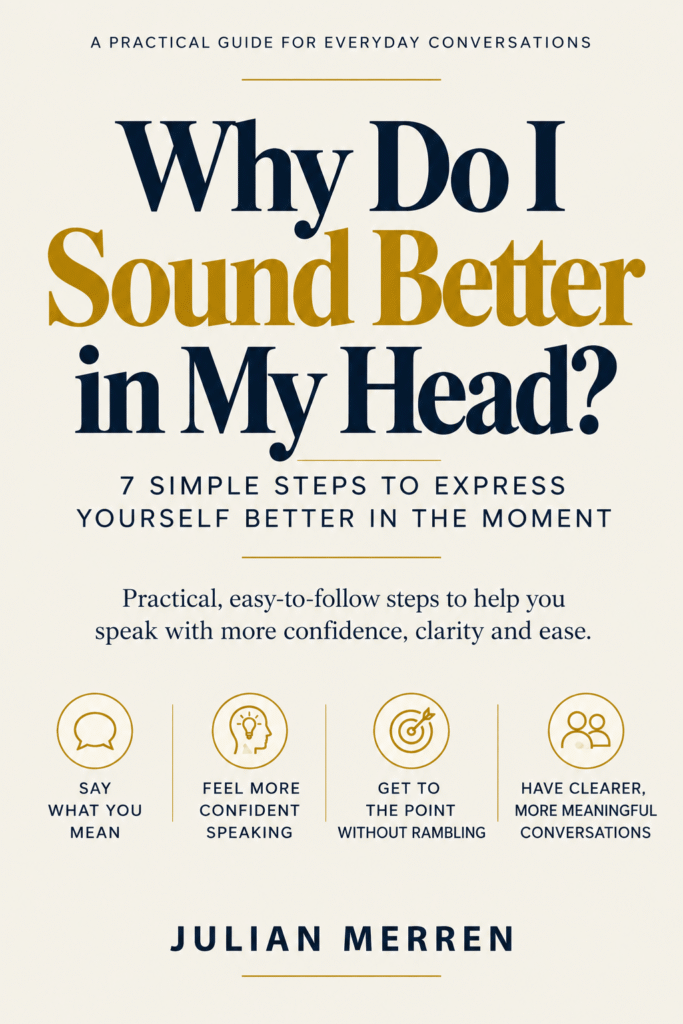
If you’ve been looking for a free PDF guide to help you express yourself more clearly, Books That Shape has a practical resource created for exactly this kind of frustration.
Why Do I Sound Better in My Head?, by Julian Merren, is a free 46-page ebook for people who know what they want to say but struggle to communicate it clearly in the moment.
The guide offers seven simple steps to help you organise your thoughts, reduce rambling and express yourself more effectively in everyday conversations.
It’s particularly relevant if you regularly find yourself overexplaining, losing your train of thought or thinking of the perfect words only after a conversation has ended.
Rather than suggesting you need to become a completely different person, the guide concentrates on making communication more manageable through practical habits and small improvements.
Get Why Do I Sound Better in My Head? — Free PDF Ebook
You’ll find the guide in the Books That Shape Free Library, alongside free ebooks covering confidence, relationships, habits, money and personal growth.
Register once, confirm your email address and gain access to the collection of downloadable PDF guides. You won’t need to register separately for every book.
Becoming Clearer Doesn’t Mean Becoming Someone Else
Learning how to express yourself clearly doesn’t require you to become the loudest person in the room.
You don’t need to speak quickly, dominate conversations or use impressive language.
You simply need to understand what you want to communicate and develop habits that make your meaning easier for others to follow.
Start with your main point. Choose familiar words. Give your ideas room to breathe. And remember that a short pause is often more useful than another unnecessary explanation.
Some conversations will still feel awkward, and sometimes you’ll think of better words afterwards.
That’s perfectly normal.
The aim isn’t flawless communication. It’s making steady progress towards feeling more comfortable expressing what you actually think and mean.
And you can begin with your very next conversation.