

Have you ever held back from saying what you really think because you were worried about how someone might react?
Perhaps you’ve agreed to something you didn’t want to do, changed your behaviour to keep somebody happy, or spent hours wondering whether someone was upset with you.
For many people, the desire to be liked quietly influences everyday decisions. We want approval, avoid disagreement and sometimes sacrifice our own preferences to maintain a favourable impression.
But what if trying to please everyone is one of the very things preventing us from feeling free?
That is the question at the heart of The Courage to Be Disliked by Ichiro Kishimi and Fumitake Koga.
Drawing on the psychology of Alfred Adler, the book challenges familiar beliefs about happiness, self-worth, relationships and the influence of our past.
In this summary and review, we’ll explore its central ideas, consider where its philosophy is most useful, and examine a few arguments that deserve a more cautious interpretation.
What Is The Courage to Be Disliked About?
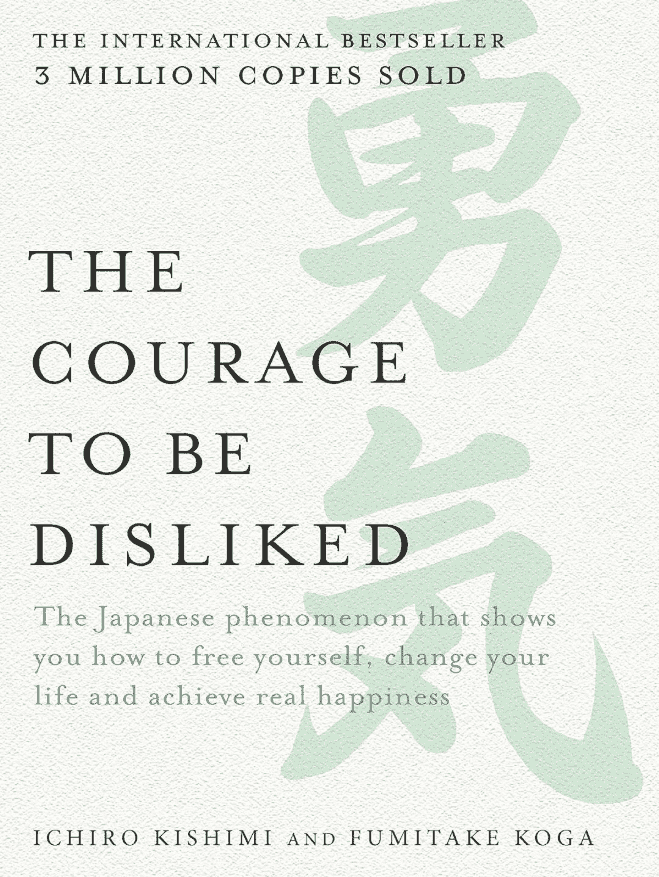
The Courage to Be Disliked explores the possibility that we have more freedom to change our lives than we often believe.
Rather than presenting conventional self-help advice, the authors introduce Adlerian psychology through a series of conversations between a philosopher and a young man.
The young man is frustrated, sceptical and frequently challenges the philosopher’s explanations. Through their discussions, the reader encounters ideas about personal responsibility, feelings of inferiority, approval-seeking and the meaning of happiness.
One of the book’s central arguments is that our lives need not be permanently defined by our past experiences or by other people’s expectations.
It also suggests that much of our unhappiness is connected to interpersonal relationships and the pressure we place on ourselves to gain recognition.
The title captures an important distinction.
Having the courage to be disliked does not mean deliberately upsetting people or becoming indifferent to their feelings. It means accepting that living according to your own values may occasionally disappoint others.
The book ultimately asks whether we can build meaningful relationships without making everybody else’s approval a condition of our happiness.
7 Key Ideas From The Courage to Be Disliked
1. You Cannot Control What Other People Think of You
One of the most liberating ideas in the book is that other people’s opinions are not entirely within our control.
We can behave respectfully, communicate clearly and act with good intentions. What we cannot guarantee is how those actions will be interpreted.
Someone may dislike a decision even when it is reasonable. Another person might misunderstand something we say despite our efforts to explain it.
Trying to control every reaction can become exhausting.
Consider someone who repeatedly agrees to additional work because they fear disappointing their manager.
Their desire to maintain approval may eventually lead to resentment and burnout.
The book encourages a different approach: take responsibility for your behaviour, but recognise that another person’s judgement ultimately belongs to them.
The lesson: You can care about other people without making their approval the measure of your worth.
2. Learn to Separate Your Responsibilities From Everyone Else’s
The concept of separation of tasks is among the book’s most practical contributions.
It involves identifying which responsibilities genuinely belong to you and which belong to somebody else.
For example, you can prepare carefully for a presentation, practise your delivery and communicate your ideas as clearly as possible.
Whether every audience member agrees with you is not something you can completely control.
Similarly, you can offer advice to a friend, but you cannot force them to follow it.
This distinction is particularly useful for people who feel responsible for everybody else’s feelings.
However, separating responsibilities does not mean abandoning people or refusing to consider how our actions affect them.
Healthy relationships still require compassion, cooperation and accountability.
The aim is to recognise the difference between supporting someone and attempting to manage their entire emotional response.
The lesson: Focus your energy on the choices and responsibilities that genuinely belong to you.
3. Your Past Does Not Have to Dictate Your Future
The book challenges the assumption that our previous experiences must determine who we become.
Its argument draws on Adler’s emphasis on goals and purposes rather than explaining behaviour exclusively through past causes.
For instance, someone who avoids speaking in groups might describe themselves as naturally shy because of difficult experiences during childhood.
The book encourages readers to question whether their current behaviour also serves a purpose, such as avoiding embarrassment or rejection.
This can be a useful invitation to recognise patterns that are open to change.
However, this idea requires an important qualification.
Past experiences, particularly trauma, can have lasting psychological and physiological consequences. Recognising that change may be possible does not mean those consequences are imaginary or easily overcome.
The most constructive interpretation is that our history can influence us without necessarily determining every future choice.
The lesson: Your experiences matter, but they do not have to become permanent limits on what you believe is possible.
4. Stop Measuring Your Worth Against Other People
Comparison can quietly undermine confidence.
We compare our careers, relationships, appearance, financial circumstances and achievements with those around us.
Even when life is progressing well, somebody else’s success can make our own progress feel inadequate.
The Courage to Be Disliked examines feelings of inferiority and the problems that arise when life becomes a competition for superiority.
The authors encourage readers to move away from viewing others primarily as rivals.
Imagine two colleagues developing similar skills.
One constantly measures their progress against the other’s achievements. The second focuses on learning, improving and contributing meaningfully.
Both may be ambitious, but their relationship with success is very different.
The book does not suggest abandoning personal goals. Instead, it challenges the belief that becoming valuable requires proving ourselves superior to somebody else.
The lesson: Personal growth becomes more satisfying when progress matters more than comparison.
5. Seeking Approval Can Become a Form of Dependence
Everybody appreciates encouragement and recognition.
The problem begins when our decisions become increasingly dependent on receiving them.
Someone who constantly seeks reassurance may struggle to make choices independently.
They might repeatedly ask whether they made the right decision, whether someone is annoyed with them, or whether their work is good enough.
Although reassurance can provide temporary relief, the underlying uncertainty often returns.
The book argues that living primarily to satisfy other people’s expectations restricts personal freedom.
This does not mean feedback is unimportant.
Constructive criticism can help us improve, and listening to people we trust is valuable.
The difference lies in whether we use feedback as useful information or treat approval as a requirement for feeling acceptable.
The lesson: Appreciation is welcome, but your sense of self-worth should not depend entirely on receiving it.
6. Healthy Relationships Are Built on Equality, Not Superiority
Another interesting concept is the distinction between vertical and horizontal relationships.
Vertical relationships place people above or below one another in terms of personal worth.
Horizontal relationships recognise equal human dignity, even when people have different abilities, responsibilities or levels of experience.
For example, a manager may have greater organisational authority than an employee without being inherently more valuable as a person.
Similarly, parents can provide guidance to their children while respecting their developing independence.
The book questions approaches to relationships built around superiority, inferiority, praise and punishment.
Instead, it emphasises encouragement, mutual respect and contribution.
This perspective can be particularly helpful for people who struggle with criticism or constantly feel they must prove themselves.
The lesson: Respectful relationships do not require one person to feel more important than another.
7. Happiness Is Connected to Contribution and Belonging
Despite its provocative title, The Courage to Be Disliked is not ultimately about withdrawing from other people.
Quite the opposite.
The book introduces Adler’s concept of community feeling: the sense that we belong and can contribute meaningfully to the lives of others.
Rather than seeking recognition simply to prove our value, the authors encourage us to consider how we participate in relationships and communities.
This might involve supporting a colleague, helping a neighbour, listening carefully to a friend or contributing to a shared project.
These actions do not need to attract public recognition to be meaningful.
The distinction matters because independence and connection are not opposing goals.
We can become less dependent on approval while remaining deeply concerned about other people’s wellbeing.
The lesson: Meaningful contribution can provide a healthier sense of belonging than constantly seeking admiration.
What Makes This Book Worth Reading?
One of the book’s greatest strengths is its willingness to challenge assumptions that many readers rarely question.
Rather than simply encouraging positive thinking, it asks uncomfortable questions about responsibility, identity and our dependence on external validation.
The conversational format is another distinctive feature.
The young man’s objections often reflect the resistance readers themselves may feel. This prevents the book from becoming a straightforward collection of motivational statements.
Its discussion of separating responsibilities is particularly valuable.
People who frequently worry about upsetting others may find this concept useful in everyday situations, from workplace disagreements to family expectations.
The book also encourages readers to reconsider the relationship between confidence and acceptance.
Instead of suggesting that confidence comes from becoming universally admired, it proposes that greater freedom may come from accepting that universal approval is impossible.
That is a useful distinction for anyone whose self-esteem depends heavily on how they are perceived.
Where The Courage to Be Disliked May Not Work for Everyone
Although the book offers several valuable perspectives, some arguments are presented in ways that may feel too absolute.
The treatment of trauma is the most significant concern.
The book’s discussion of Adlerian psychology strongly challenges explanations based on past experiences, including trauma. This can minimise the very real and lasting effects that traumatic experiences can have.
Readers should not interpret the book as suggesting that trauma is simply a matter of attitude or personal choice.
Another limitation is that separating responsibilities is easier in theory than in practice.
Relationships involve shared obligations, emotional consequences and circumstances where people’s responsibilities overlap.
The philosophy can also feel overly individualistic if applied without compassion.
Finally, readers looking for a straightforward workbook with structured exercises may find the dialogue format frustrating.
The book is primarily an exploration of ideas rather than a step-by-step programme.
Its greatest value comes from questioning its arguments thoughtfully, not necessarily accepting every conclusion.

Who Should Read The Courage to Be Disliked?
This book may be particularly useful if you:
- Frequently worry about what others think of you.
- Find it difficult to say no without feeling guilty.
- Compare your progress or achievements with other people.
- Depend heavily on reassurance or external recognition.
- Struggle to separate your responsibilities from those of others.
- Want to develop a stronger sense of personal independence while maintaining healthy relationships.
It is especially relevant to readers interested in confidence, self-worth, boundaries and the psychology of personal change.
However, readers seeking support for significant trauma or mental health difficulties should approach some of its psychological claims cautiously. The book is not a substitute for appropriate professional care.
3 Practical Ideas You Can Try
Understanding an idea is useful. Applying it to everyday life is where it can begin to make a difference.
Here are three simple exercises inspired by the book’s themes.
1. Ask Whose Responsibility It Is
The next time you feel anxious about someone’s reaction, ask yourself:
What part of this situation is genuinely my responsibility?
Perhaps your responsibility is to communicate honestly and respectfully.
Their response may be something you can listen to and consider, but not something you can entirely control.
2. Practise One Small Act of Independence
Choose a low-stakes situation where you would normally seek unnecessary approval.
You might express a genuine preference, politely decline an invitation or make a simple decision without repeatedly asking for reassurance.
The aim is not to become confrontational.
It is to discover that disagreement or uncertainty does not always require you to change your decision.
3. Replace Comparison With Contribution
When you catch yourself comparing your achievements with someone else’s, redirect your attention towards something meaningful you can do.
Consider what you can improve, learn or contribute today.
This shifts the focus from proving your worth to participating more positively in your own life.
Why The Courage to Be Disliked Belongs in the Books That Shape Mindset Collection
Mindset influences far more than how we think about ourselves.
It affects how we communicate, approach relationships, make decisions and respond when things do not go according to plan.
The Courage to Be Disliked deserves a place in the Books That Shape Mindset Collection because it explores some of the beliefs that quietly shape our behaviour.
Its ideas about approval-seeking, personal responsibility and self-acceptance encourage readers to question whether they are living according to their own values or continually adjusting themselves to satisfy others.
For anyone interested in developing greater confidence and emotional independence, it offers an interesting starting point.
If Expressing Yourself Is Something You’re Working On
There is a natural connection between the ideas in The Courage to Be Disliked and the communication challenges explored in Articulate by Julian Merren.
Understanding that you cannot control everybody else’s opinion is one thing.
Finding the confidence to express yourself clearly when you are worried about being judged is another.
You might understand the importance of boundaries yet still struggle to say no. You may recognise that disagreement is normal but find yourself rehearsing conversations or second-guessing your words.
Articulate explores these everyday communication difficulties, focusing on expressing thoughts more clearly, speaking with greater confidence and becoming more comfortable making yourself heard.
The two books approach related challenges from different directions: one examines the beliefs that influence our behaviour, while the other focuses on how we communicate.
Final Verdict: Is The Courage to Be Disliked Worth Reading?
Yes, particularly if you are interested in confidence, approval-seeking, personal responsibility and developing a healthier relationship with other people’s opinions.
Its strongest ideas encourage readers to recognise the limits of their control, reconsider unnecessary comparison and build relationships based on mutual respect rather than constant approval.
Not every argument is equally convincing. Its treatment of trauma deserves particular caution, and some philosophical conclusions are more absolute than everyday life allows.
Nevertheless, The Courage to Be Disliked offers an unusual and thought-provoking perspective on personal freedom.
You do not need to agree with every idea to benefit from questioning your assumptions.
Perhaps its most useful message is that becoming more comfortable with yourself does not require everyone else to approve of the person you choose to become.