
You climb into bed feeling exhausted. You’ve been looking forward to sleep all evening, yet the moment your head touches the pillow, your mind becomes unusually alert.
You check the time. Calculate how many hours you have left. Try a breathing exercise. Adjust your pillow. Tell yourself to relax.
Nothing seems to work.
Eventually, the worry about not sleeping becomes more frustrating than whatever kept you awake in the first place.
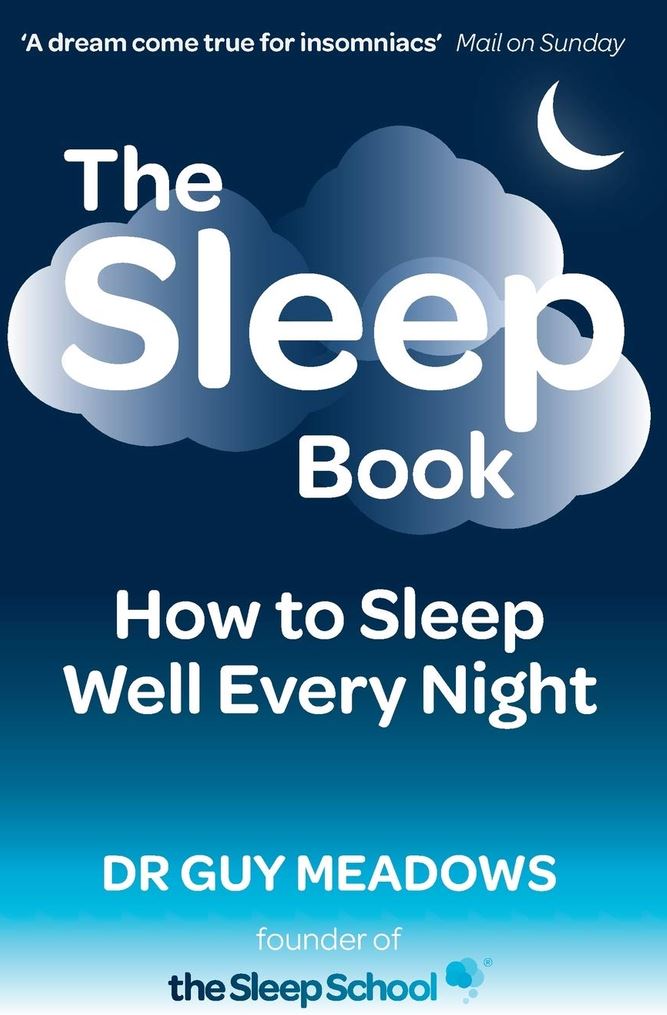
It’s a familiar experience for people struggling with insomnia, and one that Dr Guy Meadows addresses in The Sleep Book: How to Sleep Well Every Night.
Rather than offering another collection of tricks designed to make you fall asleep, Meadows explores a different possibility.
What if constantly trying to control sleep is part of what’s making it difficult?
Drawing on mindfulness and Acceptance and Commitment Therapy (ACT), the book encourages readers to develop a less confrontational relationship with sleeplessness.
In this summary and review, we’ll explore its central ideas, practical strengths, important limitations and whether it’s worth reading if nighttime worry has become a regular problem.
What Is The Sleep Book About?
The Sleep Book is a practical guide to approaching insomnia differently.
Dr Guy Meadows, a sleep physiologist, draws on his work helping people with persistent sleep difficulties to explain how frustration, anxiety and attempts to control sleep can become part of an ongoing cycle.
The book presents a five-week programme built around mindfulness and Acceptance and Commitment Therapy.
ACT is a psychological approach that encourages people to respond more flexibly to uncomfortable thoughts and feelings rather than constantly attempting to eliminate them.
Applied to sleep, this means changing how we respond when we find ourselves awake.
Instead of treating every restless moment as a problem that demands immediate action, Meadows encourages greater acceptance of the experience.
This is not the same as giving up on sleep.
It’s about reducing the struggle that can develop around it.
The book is particularly relevant to people who have experimented with numerous bedtime techniques, only to find that their determination to sleep has become another source of anxiety.
7 Key Ideas From The Sleep Book
1. Trying Too Hard to Sleep Can Keep You Awake
One of the book’s central arguments is that sleep becomes more difficult when we approach it as something that must be achieved through effort.
Unlike many everyday activities, falling asleep isn’t something we can accomplish simply by concentrating harder.
We can create favourable conditions for rest, but we cannot command ourselves to become unconscious.
Imagine lying awake at midnight and repeatedly thinking:
I need to fall asleep right now.
The thought may seem reasonable, especially when you have an important day ahead.
Yet the urgency can make you increasingly alert.
You begin monitoring how awake you feel, checking whether a technique is working and worrying about the consequences of another poor night.
Meadows encourages readers to step away from this constant monitoring.
The lesson: Sleep is not a performance. Reducing the pressure to achieve it may help reduce the anxiety surrounding it.
2. Acceptance Is Different From Giving Up
The idea of accepting sleeplessness can initially sound discouraging.
After all, someone struggling with insomnia doesn’t want to become comfortable with never sleeping properly.
But acceptance, as presented in ACT, doesn’t mean abandoning the desire for better sleep.
It means recognising what is happening in the present moment without continually fighting against it.
Suppose you wake at three in the morning.
Your immediate reaction might be frustration.
You start thinking about how tired you’ll feel tomorrow, how unfair it is to be awake again and what you should do to fix the situation.
An acceptance-based response would acknowledge that you’re awake without turning the experience into a personal battle.
You may still prefer to be asleep.
You simply don’t have to spend every waking moment resisting the fact that you’re not.
The lesson: Accepting the present moment can reduce unnecessary struggle without requiring you to like the situation.
3. You Don’t Have to Believe Every Thought About Sleep
Insomnia often comes with a stream of worrying predictions.
Tomorrow will be a disaster.
I’ll never get back to normal.
If I don’t sleep soon, I won’t cope.
These thoughts can feel convincing, particularly when you’re tired and frustrated.
The book draws on the ACT concept of cognitive defusion, which involves learning to notice thoughts without treating them as unquestionable facts.
For example, instead of becoming absorbed in the prediction that tomorrow will be unbearable, you might recognise it as a worried thought your mind is producing.
The distinction is subtle but useful.
You’re not required to prove the thought wrong or replace it with forced optimism.
You can simply acknowledge its presence.
This creates some distance between having a frightening thought and becoming completely caught up in it.
The lesson: A thought about tomorrow is not necessarily an accurate prediction of tomorrow.
4. Mindfulness Can Change Your Relationship With Wakefulness
Mindfulness is another important part of Meadows’ approach.
At its simplest, mindfulness involves paying attention to present-moment experiences with openness rather than immediate judgement.
For someone lying awake, this might mean noticing their breathing, the contact between their body and the mattress, or sounds in the surrounding room.
The intention isn’t to force relaxation.
In fact, turning mindfulness into another technique that absolutely must make you sleep can recreate the very pressure the book is trying to reduce.
Instead, the practice encourages a less reactive response to being awake.
You might notice tension, thoughts or frustration without immediately trying to remove them.
Over time, this approach may help make wakefulness feel less threatening.
The lesson: Mindfulness is most useful here as a way of relating differently to your experience, not as a guarantee of immediate sleep.
5. Fighting Uncomfortable Feelings Can Make Them More Difficult
A restless night rarely involves wakefulness alone.
There may also be frustration, fear, disappointment or anger.
Someone might become annoyed with themselves for not sleeping, then worry that their annoyance is keeping them awake.
The original problem grows into a series of emotional reactions.
Meadows’ acceptance-based approach encourages readers to make room for these feelings rather than treating them as emergencies.
Imagine noticing a sense of anxiety in your chest.
Instead of immediately attempting to eliminate it, you might acknowledge the sensation and allow it to be present without adding further criticism.
This does not mean anxiety will instantly disappear.
The purpose is to reduce the additional struggle created by constantly resisting it.
The lesson: Feeling uncomfortable doesn’t always require an immediate attempt to change how you feel.
6. Fear of Another Bad Night Can Become Part of the Problem
After several difficult nights, bedtime itself can begin to feel threatening.
Someone may spend the afternoon wondering whether they’ll sleep that evening.
As bedtime approaches, they become increasingly alert to signs of tiredness or anxiety.
Eventually, the bedroom may feel less like a place of rest and more like somewhere they expect another frustrating experience.
This pattern helps explain why insomnia can persist even when the original source of stress has improved.
Meadows encourages a different relationship with that anticipation.
Rather than attempting to guarantee a successful night, readers practise responding to uncertainty with less fear and urgency.
However, persistent insomnia may also involve learned sleep patterns, medical conditions or other factors that require specific treatment.
The lesson: Reducing fear around sleeplessness may be an important part of improving your relationship with bedtime.
7. A Better Relationship With Sleep Takes Practice
The book’s five-week structure reflects an important principle: changing longstanding habits of thought and behaviour is rarely instantaneous.
Someone who has spent months worrying about sleep may not suddenly become comfortable with wakefulness after trying mindfulness once.
Old reactions can return, especially during stressful periods.
The book encourages readers to develop new responses through repeated practice rather than constantly measuring whether each exercise produced a perfect night’s sleep.
This is particularly important because evaluating every night as a success or failure can reinforce sleep-related pressure.
A more useful question might be whether you responded to a difficult night with slightly less frustration than before.
The lesson: Progress may involve changing how you experience sleeplessness before improvements in sleep become noticeable.

What Makes The Sleep Book Worth Reading?
One of the book’s strongest qualities is that it addresses the emotional experience of insomnia.
Many people already know the familiar advice about keeping their bedroom comfortable, limiting caffeine and maintaining consistent routines.
But understanding healthy sleep habits doesn’t necessarily stop the frustration of lying awake.
Meadows focuses on what happens when sleep itself becomes a source of anxiety.
His approach is particularly relevant to readers who have become exhausted by continually searching for the next technique that might finally work.
Another strength is the distinction between accepting wakefulness and surrendering to it.
The book encourages a more flexible mindset without suggesting that better sleep is unimportant.
The five-week format also provides a sense of structure, making the concepts easier to explore gradually.
Perhaps its most useful contribution is the reminder that constantly struggling against an uncomfortable experience can sometimes make that experience harder to manage.
Where The Sleep Book May Not Work for Everyone
Although the approach is worth exploring, there are limitations readers should understand.
Acceptance Is Not a Guaranteed Solution
Mindfulness and ACT-based strategies may help some people manage sleep-related anxiety, but they do not guarantee that insomnia will disappear.
Sleep problems can have many contributing factors, including medical conditions, medications, pain, psychological difficulties and other sleep disorders.
Changing your relationship with wakefulness may be helpful without addressing every underlying cause.
CBT-I Has Stronger Evidence for Chronic Insomnia
Cognitive Behavioural Therapy for Insomnia (CBT-I) remains the recommended first-line treatment for chronic insomnia.
It typically combines several approaches to address the thoughts, behaviours and sleep patterns that maintain insomnia.
ACT-based approaches show promise, particularly for the psychological distress associated with sleep difficulties, but the overall research base is less established than that supporting CBT-I.
The book should therefore be viewed as a potentially useful resource rather than a replacement for evidence-based clinical treatment.
Some Readers May Want More Direct Instructions
Readers who prefer clear behavioural steps may initially find the acceptance-based approach counterintuitive.
Being encouraged to stop fighting sleeplessness can feel frustrating when your main goal is simply to get more sleep.
The ideas also require patience.
Learning to notice thoughts without immediately reacting to them isn’t necessarily easy, particularly during an exhausting night.
And acceptance shouldn’t be interpreted as a reason to ignore persistent symptoms.
Who Should Read The Sleep Book?
This book may be particularly useful if you:
- Feel exhausted but become mentally alert when you get into bed.
- Regularly worry about how much sleep you’ll get.
- Have tried numerous sleep techniques and feel increasingly frustrated.
- Experience racing thoughts or anxiety during the night.
- Find yourself dreading bedtime after several poor nights.
- Want to explore mindfulness and acceptance-based approaches to insomnia.
It’s especially relevant to people whose difficulties are made worse by worrying about sleep itself.
However, if you experience persistent insomnia, significant daytime impairment, loud snoring with breathing interruptions, or other concerning symptoms, professional assessment is important.
3 Practical Ideas You Can Try
Here are three gentle exercises inspired by the book’s central themes.
They are not a substitute for treatment or a reproduction of Meadows’ five-week programme.
1. Replace the Demand to Sleep With Permission to Rest
When you notice yourself thinking that you must fall asleep immediately, try shifting your intention.
Instead of treating sleep as a task you must complete, allow yourself a period without demanding a particular result.
The goal isn’t to persuade yourself that sleep doesn’t matter.
It’s to reduce the pressure you place on the present moment.
2. Notice Worrying Thoughts Without Following Them
If your mind begins predicting how difficult tomorrow will be, try acknowledging the thought rather than debating it.
You might recognise that your mind is making a worried prediction.
Then gently return your attention to something in the present.
There’s no need to win an argument with every thought that appears.
3. Practise Mindfulness Without Making Sleep the Goal
During a quiet moment in the day, spend a few minutes noticing your breathing, physical sensations or surrounding sounds.
When your attention wanders, acknowledge it and return.
Practising during the day can help prevent mindfulness from becoming another high-pressure bedtime performance.
If wakefulness in bed becomes prolonged and frustrating, remember that CBT-I often recommends getting out of bed temporarily and returning when sleepy. An acceptance exercise shouldn’t become a reason to remain in bed struggling for hours.
Why The Sleep Book Belongs in the Books That Shape Anxiety & Overthinking Collection
Sleep difficulties and overthinking can reinforce one another.
The quieter the evening becomes, the more attention we sometimes give to worries about work, relationships, responsibilities and the next day.
When we add anxiety about sleep itself, bedtime can become an exhausting cycle of monitoring and frustration.
The Sleep Book deserves its place in the Books That Shape Anxiety & Overthinking Collection because it explores this relationship between our thoughts, emotions and ability to rest.
Rather than encouraging readers to defeat every unwanted thought, it offers a different perspective: learning to respond with less resistance and fear.
For readers struggling with nighttime overthinking, that is a valuable idea to consider.
Read How to Break the Cycle of Nighttime Worry: 7 Gentle Steps for more tips to break the cycle
If Nighttime Overthinking Is Something You’re Working On
There’s a natural connection between Meadows’ approach and the challenges explored in Quiet Nights by Julian Merren.
Sometimes the problem begins long before you start worrying about whether you’ll sleep.
You might climb into bed and suddenly remember unfinished conversations, financial concerns, tomorrow’s responsibilities or something you wish you’d handled differently.
Your mind begins working through problems that seemed less urgent during the day.
Quiet Nights explores this particular experience of nighttime overthinking, offering practical approaches to managing racing thoughts, creating gentler evening routines and reducing the mental pressure that can build before bed.
Where The Sleep Book focuses on changing our relationship with insomnia and wakefulness, Quiet Nights takes a broader look at the everyday worries and thought patterns that can make evenings difficult.
Both encourage readers to move away from treating every nighttime thought as something that must be solved immediately.
Final Verdict: Is The Sleep Book Worth Reading?
Yes, particularly if your struggle with insomnia has become as distressing as the sleeplessness itself.
Dr Guy Meadows offers a thoughtful alternative to the endless pursuit of techniques designed to force sleep to happen.
The book’s most valuable ideas involve acceptance, mindfulness and learning not to become completely absorbed in anxious predictions about the night ahead.
However, its approach will not address every cause of insomnia, and CBT-I remains the better-established first-line treatment for chronic sleep difficulties.
Readers should also be cautious about interpreting acceptance as simply tolerating persistent symptoms without seeking support.
Nevertheless, The Sleep Book deserves consideration for its compassionate examination of sleep-related anxiety.
Its most useful message is that a difficult night doesn’t have to become a battle against your own mind.
And sometimes, changing that relationship is a meaningful place to begin.