
Some relationship books teach you how to communicate.
Others help you understand why conversations become so difficult in the first place.
Dr Sue Johnson’s Hold Me Tight: Seven Conversations for a Lifetime of Love belongs firmly in the second group.
Rather than treating recurring arguments as isolated problems, Johnson’s work explores emotional attachment and the need to feel safe, responsive and connected within our closest relationships. The book is grounded in Emotionally Focused Therapy and guides couples through seven conversations designed to strengthen emotional connection.
If that approach resonated with you, there are several books like Hold Me Tight that explore similar territory from different directions.
Some dig further into attachment. Some concentrate on recurring conflict. Others look at what happens when you become so absorbed in a relationship that you gradually lose touch with yourself.
Here are five worth exploring next.
1. Love Sense — Dr Sue Johnson
Best if you want to go deeper into the ideas behind Hold Me Tight
The most natural place to continue is with Sue Johnson herself.
While Hold Me Tight gives couples conversations and exercises they can use within their relationship, Love Sense explores the science and psychology behind romantic attachment in greater depth.
Johnson presents romantic love as an attachment bond and explores why emotional responsiveness and secure connection matter so much to relationships.
That makes Love Sense particularly interesting if you finished Hold Me Tight wanting to understand more about the theory underneath it.
You may begin recognising why seemingly small moments can carry so much emotional weight.
A forgotten conversation isn’t always just a forgotten conversation.
Withdrawal during an argument isn’t always simply someone refusing to talk.
Sometimes what hurts is the meaning we attach to those moments:
Can I rely on you?
Do I matter to you?
Are you there when I need you?
Understanding those questions can change the way you interpret relationship conflict.
Read this next if: you enjoyed the attachment perspective in Hold Me Tight and want to understand it more deeply.
2. Secure Love — Julie Menanno
Best for recognising the relationship patterns you keep repeating
Have you ever noticed that you and your partner seem to have the same argument wearing different clothes?
One week it’s money.
Then housework.
Then affection.
Then somebody spending too much time on their phone.
The subject changes, but the emotional destination feels strangely familiar.
Julie Menanno’s Secure Love: Create a Relationship That Lasts a Lifetime examines these recurring interactions through attachment theory.
Menanno describes the “negative cycle” that can develop between partners and explores the unmet attachment needs underneath arguments, withdrawal and defensive behaviour. The book also covers four attachment styles and offers exercises and suggested language for difficult conversations.
That makes it a particularly good follow-up to Hold Me Tight.
Instead of concentrating entirely on what you’re arguing about, you begin watching what happens between you when disconnection occurs.
Perhaps one person pushes harder when they don’t feel heard.
The other feels criticised and retreats.
That withdrawal creates more anxiety.
So the first person pushes harder still.
Suddenly, both partners are protecting themselves while unintentionally reinforcing the other’s fear.
Read this next if: you’re tired of repeating the same emotional cycle and want to understand what may be happening underneath it.
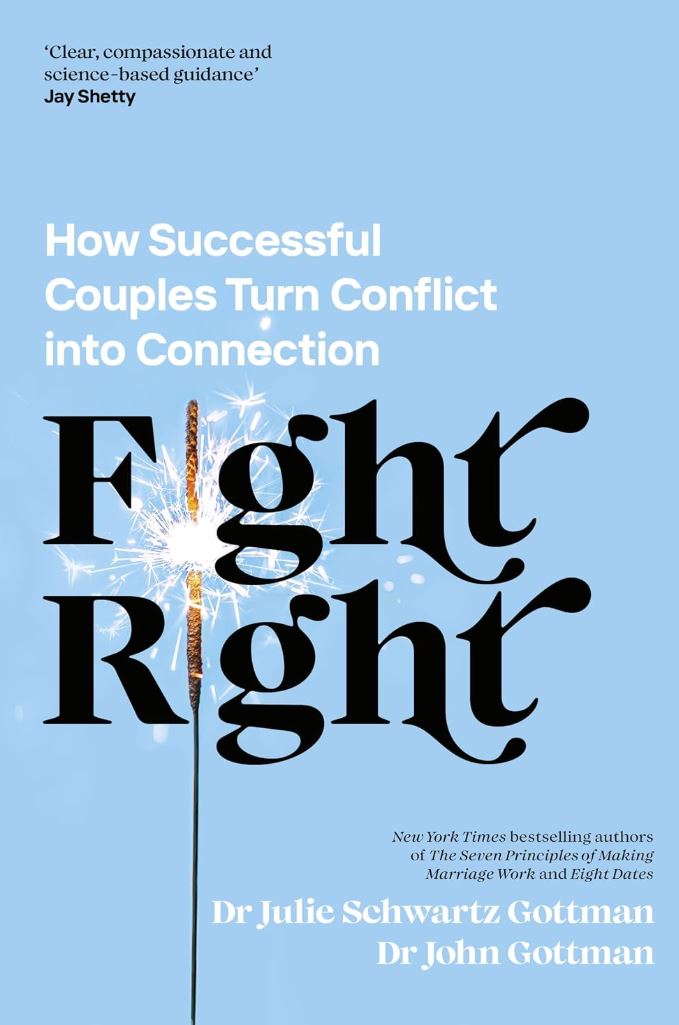
3. Fight Right — Dr John Gottman and Dr Julie Schwartz Gottman
Best for couples whose disconnection appears during conflict
Emotional connection isn’t only built during peaceful moments.
Sometimes it depends on what happens when you disagree.
Fight Right: How Successful Couples Turn Conflict Into Connection takes that challenge head-on.
The Gottmans argue that conflict itself isn’t necessarily the enemy. Their approach focuses instead on how couples navigate disagreement and how conflict can become an opportunity for greater understanding rather than simply a battle to win.
This complements Hold Me Tight nicely.
Johnson encourages readers to recognise the emotional needs beneath relationship distress. The Gottmans provide another lens for examining what happens when those needs collide during disagreements.
The useful question becomes less:
How do we stop arguing?
and more:
How do we disagree without losing each other in the process?
That distinction matters.
A relationship without disagreement isn’t necessarily a connected relationship. Sometimes people stop arguing because one or both partners have simply stopped saying what they need.
Learning to handle differences while preserving respect and connection can be far more valuable than trying to eliminate conflict altogether.
Read this next if: arguments are one of the main moments when you and your partner stop feeling like a team.
4. Attached — Amir Levine and Rachel Heller
Best for an accessible introduction to adult attachment styles
If Hold Me Tight made you curious about attachment theory itself, Attached offers another accessible entry point.
Amir Levine and Rachel Heller explore adult attachment and how attachment patterns can influence romantic relationships. The publisher describes the book as using adult attachment research to help readers understand how people find and sustain love.
For many readers, attachment language can provide a useful vocabulary for behaviours that previously seemed confusing.
Why does one person crave reassurance during uncertainty?
Why might another pull away when emotional intensity increases?
Why can the same situation feel manageable to one partner and deeply unsettling to another?
Labels shouldn’t become excuses or permanent boxes.
The value is in recognising patterns.
Once you can see a pattern, you have a better chance of responding intentionally rather than simply repeating it.
Read this next if: you want a straightforward introduction to adult attachment and how different patterns may show up in relationships.
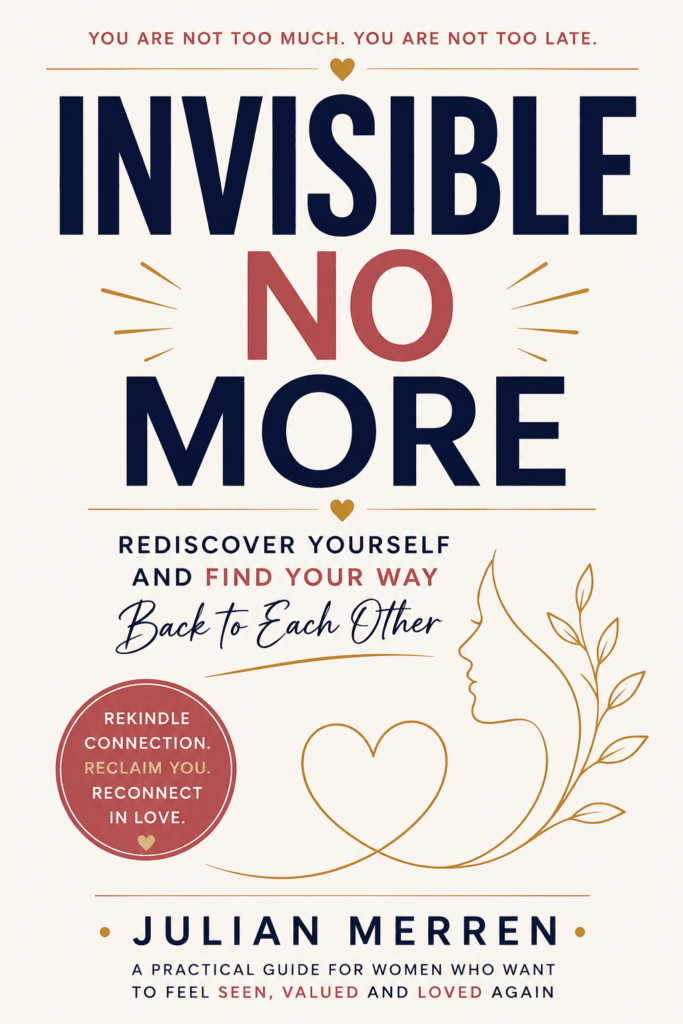
5. Invisible No More — Julian Merren
Best when reconnecting with your partner also means reconnecting with yourself
There’s another kind of relationship disconnection that deserves attention.
Sometimes the distance isn’t only between you and your partner.
It’s between you and yourself.
Over the years, relationships can become dominated by responsibilities.
Work. Children. Bills. Household routines. Family obligations. Problems that need solving.
You become someone’s partner, perhaps someone’s parent, the organiser, the person who remembers everything and the person everyone depends upon.
And somewhere inside all those roles, you become less visible.
That’s where Invisible No More: Rediscover Yourself and Find Your Way Back to Each Other by Julian Merren approaches connection from a different direction.
The book explores rediscovering your identity, recognising your needs, rebuilding confidence, creating healthier boundaries and finding ways to reconnect with your partner without assuming that finding yourself must mean giving up on the relationship.
That’s an important addition to this reading list.
Because rebuilding emotional connection isn’t always about learning to understand your partner better.
Sometimes you need to understand yourself again too.
What do you need?
What have you stopped saying?
What did you once enjoy?
Where have you been making yourself smaller?
And what would it look like to become a full participant in your relationship again rather than simply keeping everything running?
If that sounds familiar, you can explore Invisible No More and the Books That Shape relationship collection.
Read this next if: you want greater connection with your partner but also feel you’ve lost part of yourself along the way.
What the Best Books Like Hold Me Tight Have in Common
The strongest books like Hold Me Tight don’t promise a relationship without difficult moments.
They help you understand those moments differently.
Across these books, several themes keep appearing:
- recurring conflict often has something deeper underneath it
- emotional safety matters as much as communication technique
- vulnerability can reveal what criticism sometimes hides
- patterns become easier to change once you can recognise them
- connection requires curiosity about both your partner and yourself
- healthy closeness doesn’t require losing your individual identity
Perhaps most importantly, these books encourage couples to move away from thinking solely in terms of you versus me.
The more useful question is often:
What keeps happening between us?
That shift can create room for curiosity.
Which Book Should You Read Next?
If you loved the emotional and attachment-based approach of Hold Me Tight, choose according to what you most want to understand.
For more Sue Johnson and attachment theory, start with Love Sense.
For recurring relationship cycles, try Secure Love.
For conflict and disagreements, choose Fight Right.
For an accessible exploration of adult attachment styles, consider Attached.
And if the relationship still matters to you but you’ve gradually stopped feeling like yourself within it, Invisible No More offers a different but complementary place to begin.
There isn’t one relationship book that answers every question.
Sometimes the most useful reading journey is the one that helps you see the same relationship through several different lenses.
And if Hold Me Tight helped you realise that emotional connection deserves attention, these five books can help you continue that conversation — with your partner, and perhaps with yourself.